
About Luigi Calabresi
Lived 1937 – 1972 (aged 34). Luigi Calabresi was an Italian police officer.
Luigi Calabresi (14 November 1937 – 17 May 1972) was an Italian Polizia di Stato officer in Milan. Responsible for investigating far-left political movements, Calabresi was assassinated in 1972 by members of Lotta Continua, who blamed him for the death of anarchist activist Giuseppe Pinelli in police custody in 1969. The deaths of Pinelli and Calabresi were significant events during the Years of Lead, a period of major political violence and unrest in Italy from the 1960s to the 1980s.
Early life and education Calabresi was born on 14 November 1937 into a middle-class Roman family. His father was a wine and cooking oil merchant. He attended the classical secondary school San Leone Magno and then the Sapienza University of Rome to study Law. In 1964, he successfully defended his Ph.D. thesis on the Sicilian Mafia. Having been part of Catholic associations during his years in school, he enrolled, while studying at the Sapienza, in the Oasis movement, founded in 1950 by Jesuits. In 1965, he won the competition to enter L'istituto superiore di polizia and, after completing his studies there, he was assigned to the position of deputy commissioner in Milan. During his time in the police force, he occasionally wrote articles that were published under a pseudonym in the newspaper Momento-sera.
In 1967, after a series of contacts with the organisers of an event in Colico, Calabresi supported their request for a camping license, subsequently provided by the Como Police. During these contacts, Calabresi, according to his son Mario, met railway worker Giuseppe Pinelli, an anarchist activist and organiser. At next year's Christmas, Calabresi gave Pinelli as a gift Enrico Emanuelli's book 1000 Millions of People, a gift reciprocated by Pinelli the following August with Edgar Lee Masters' poetry collection Spoon River Anthology, ostensibly Pinelli's favorite book. Mario Capanna, of the Marxist group Movimento Studentesco joined the funeral procession in a public gesture of denunciation of political violence, but was physically attacked by a number of attendees. Calabresi was present and escorted Capanna away from the attacks. He'd previously met Capanna on 16 November 1967 while in charge of the police force that had evacuated Università Cattolica del Sacro Cuore, occupied for a few hours by students led by Capanna.
Family In 1968, Luigi Calabresi married Gemma Capra, whom he'd met at a celebratory party hosted by a friend in Milan. Genna had found him "witty, like Alberto Sordi."
Piazza Fontana bombing
The late 1960s and early 1970s were a period of intense political agitation in Italy, characterised also by frequent acts of violence, including assassinations. On 12 December 1969, at 16:37 hours local time, a bomb exploded at the headquarters of Banca Nazionale dell'Agricoltura (the National Agricultural Bank) in Piazza Fontana, near the Duomo cathedral, in Milan, Italy, killing seventeen people and wounding eighty-eight. The same day, three more bombs were detonated while a fourth was found unexploded, in Rome and Milan. No organisation declared itself responsible for the attacks. Calabresi, having already undertaken investigations into other bombing attacks, was assigned the inquest for Piazza Fontana. MP Francesco Cossiga of the Christian Democrats believed the terrorist attack had been undertaken by the "extreme right," as he testified in the Parliament decades later. There has not yet been a final judicial verdict as to the culprits of the massacre.
Arrest, interrogation, and death of Giuseppe Pinelli
Despite the July 2000 denial expressed at the Italian Parliament's commission of inquiry on terrorism in Italy and the causes of the failure to identify those responsible for the massacres by Antonio Allegra, Calabresi's superior officer at the time of the massacre, the investigation on the Milan bombing focused initially on militant anarchists.
On 30 December 1969, thousands of mourners and sympathisers followed Pinelli's funeral procession to the Cimitero Maggiore di Milano. but also that the "bruising" that some considered suspect was a frequent consequence in corpses housed in morgues because of the compression of the head on the marble table.
Protests and denunciations Organisations and parties of the Italian left commenced protests against what they perceived as the State's cover-up of the "true" circumstances of Pinelli's death. The Socialist Party's newspaper Avanti!, the PCI's daily l'Unità and its weekly companion Vie Nuove took up a campaign of denunciation against Italian law enforcement and Calabresi specifically. The communist extra-parliamentary organization Lotta Continua was prominent among those disputing the official version of events, denouncing Calabresi as directly implicated in Pinelli's death, an accusation repeated in shouted slogans of "Calabresi assassin!" in street demonstrations, and calling him "commissioner window." "recognised Calabresi in the odious character of the police chief" in the film or, at the very least, "watched a Calabresi-style policeman."
On 5 December 1970, Dario Fo's theatrical play Morte accidentale di un anarchico (Accidental Death of an Anarchist) premiered in Milan. Its main character, the Maniac, is a fraudster who is arrested by the police but manages to impersonate a judge investigating an anarchist's "accidental death." It was produced in 1983 for British television's Channel Four, starring Gavin Richards. The play went on to be performed in almost forty countries.
On 13 June 1971, the weekly magazine L'Espresso published an open letter containing accusations that was written by Camilla Cederna, editor in the magazine and investigative journalist, and signed initially by ten persons and eventually by a total of 757 politicians, activists, intellectuals, artists, journalists, and others.
Lawsuit by Calabresi On 15 April 1970, Calabresi brought charges against Pio Baldelli, editor-in-chief of the Lotta Continua magazine, for "ongoing and aggravated defamation through attribution of a specific act", to wit, the responsibility for Pinelli's death. The trial commenced on 9 October 1970. The previous month, in September 1970, L'Espresso weekly magazine had carried the public appeal made and signed by various Italian intellectuals, university lecturers, and politicians, such as Elvio Fachinelli, Lucio Gambi, Giulio Maccacaro, Cesare Musatti, Enzo Paci, Carlo Salinari and Mario Spinelli. Their open letter issued a challenge: "Railway man Pino Pinelli died on the night of 15–16 December 1969 as a result of a fall from a window at Milan police headquarters. How, we do not know. All we know is that he was innocent." The appeal also criticised, "respectfully but sternly," the "hasty" closure of the investigation by deputy prosecutor Giuseppe Caizzi. In the course of his testimony, Calabresi spoke of Pinelli as having been "a decent fellow" with whom "he had swapped views."
The testimony of other witnesses often contradicted their initial statements during the Caizzi investigation, such as the time the Pinelli interrogation ended or was interrupted. Savino Lo Grano, newly promoted carabinieri captain, after originally testifying he had watched Pinelli throughout the interrogation and saw him throw himself from the window, in court, he claimed he had been looking at the open window while two police officers, "trapped behind the shutters," had been unable to stop the anarchist from jumping. Brigadier Vito Panessa ended his testimony at the trial with the following statement: I've said I'm not in a position to provide details, but, broadly speaking, bear in mind that there was no agreed story and it was, therefore, a matter for investigation. Each of us went before Judge Caizzi and gave out a story." We testify that when the citizens you have accused declare that in this society the army is an instrument of capitalism, a means of repression of the class struggle, we declare it with them. When they say, 'if it is true that the masters are thieves, it is right to go and take back what they have stolen', we say it with them. When they shout 'we arm the masses', we shout it with them. When they pledge to fight one day with arms against the state until liberation from bosses and from exploitation, we pledge with them.
The trial was interrupted after a judge was challenged by Calabresi's lawyer on grounds of "prejudice" and a long recess followed, which lasted well into May 1972.
Assassination of Calabresi On 17 May 1972, at 09:15, after Luigi Calabresi had exited from his home at Via Cherubini No. 6 and started to walk towards his office, a man approached him from behind and fired two gunshots, one hitting Calabresi in the back and the other in the neck. The gunman then entered a "blue Fiat 125" whose driver sped away into the traffic. Calabresi died almost immediately.
Lotta Continua, the day after Calabresi's killing, released a statement: "Political murder is certainly not the decisive weapon for the emancipation of the masses from capitalist domination, just as clandestine armed action is certainly not the decisive form of the class struggle in the phase we are going through. But these considerations cannot in any way induce us to deplore Calabresi's killing." The newspaper's main title read, "Calabresi is dead, the main culprit of the assassination of Pinelli."
Investigation The investigative authorities initially turned to members of the extraparliamentary organisations of the left. Following the arrest of neofascist Gianni Nardi in September 1972, a parallel inquest was launched into possible involvement of persons from the Italian extreme-right, though it made no progress.
In early 1974, neofascist journalist and SID operative Guido Giannettini told a reporter from L'Espresso that the Bundesnachrichtendienst or BND had "arranged" for Calabresi's assassination when they learned that the commissioner discovered that the West German intelligence service was furnishing "concrete" assistance to certain extreme-right groups in Italy, possibly to be used in terrorist acts or even a coup d'état. In mid-1974, right-wing militant Marcello Bergamaschi testified to the Italian police that Carlo Fumagalli, his chief in the armed, far-right group Movimento di Azione Rivoluzionaria, "knew many things" about the assassination. However, this line of inquiry also ended up nowhere. In 1979, a document was discovered at a safe house of the armed, extreme-left group Prima Linea that termed Calabresi's death "an act of proletarian justice," a finding that reactivated the investigation towards the extreme left. Within a year after the discovery of the document, various pentiti, including Roberto Sandalo, confirmed to the authorities that this was the correct trail.
In 1988, a former Lotta Continua militant, Leonardo Marino, turned himself in to the carabinieri and testified that he was the driver of the blue Fiat-125 used in the assassination and Ovidio Bompressi the person who shot and killed Calabresi, both acting "on the orders of [leading Lotta members] Adriano Sofri and Giorgio Pietrostefani." The defendants' appeal was dismissed on 12 July 1991 but the Court of Cassation annulled on 23 October 1992 the dismissal and ordered a re-trial. In the December 1993 retrial of the defendants' appeal, they were all acquitted. The prosecution protested the decision to the Court of Cassation, which annulled the appeal re-trial on account of "inconsistencies" in the decision's "reasoning." On 11 November 1995, the new re-trial of the defendant's appeals, reconfirmed the original prison sentences for Sofri, Bompressi, and Pietrostefani, and considered Marino's crime to be "extinct" on the basis of the new pentiti legislation, so Marino was freed.
On 22 January 1997, the Court of Cassation confirmed the decision of the appeals court and the sentences imposed therein, so Sofri and Bompressi commenced serving their sentences in the Pisa prison while Pietrostefani had absconded to France to avoid prison.
On 20 April 1998, Bompressi was temporarily released from prison for "health reasons", and, on 18 August 1998, his sentence was irrevocably reduced to house arrest.
On 6 October 1998, the Court of Cassation cancelled the decision of the Milan Court of Appeals and reopened the Sofri case. On 24 January 2000, the Court of Appeal of Venice confirmed the original sentence of 22 years.
In November 2005, Sofri, who had refused offers of political supporters to appeal for a pardon, suffered a ruptured oesophagus and, after convalescing in a hospital, the court allowed him to serve the remainder of his sentence under house arrest, at his Impruneta home. On 16 January 2012, Sofri was freed, having served his sentence. He started writing as guest columnist for Il Foglio, La Repubblica, and Panorama, and authored books on Italy's recent political past, such as L'ombra di Moro (The shadow of Moro).
On 17 May 2022, coincidentally, fifty years exactly after Calabresi's assassination, the Paris Court of Appeal heard the public prosecutor's proposal for Pietrostefani to be extradited to Italy to serve his prison sentence and decided to postpone its decision until the 29th of June. On 29 June 2022, the Court rejected Italy's request to extradite the former leftist militants whom the French authorities had arrested, including Giorgio Pietrostefani. The Court released a statement about its decision, citing "the right to respect for private and family life", "the right to a fair trial as laid out by articles 8 and 6 of the European Convention on Human Rights", and the fact that the extradition requests were for "acts committed before 1993".
Aftermath In 1984, Gemma married Milanese poet and designer Tonino Milite and she took the name Gemma Calabresi Milite. They had one child, son Uber. that Milite had raised them and "taken [them] out of the night", citing a line from Milite's poems. He also used that reference in the title of the book that he wrote about his father's history in 2007: "Spingendo la notte più in là" ("Pushing the night further").
Ideological repercussions In 1976, Lotta Continua held its 2nd Congress at Rimini during the period from 31 October up to 4 November. It was held approximately four months after the 1976 general election in Italy, when Democrazia Proletaria ("Proletarian Democracy"), a cartello unitario or "unity cartel", which Lotta had joined, suffered what Lotta considered a "heavy defeat," taking in a total of about 557 thousand or 1.5% of the votes, though it still elected six deputies to the Italian Parliament. During the Congress, speakers pointed out the "fragmentation" of militancy into struggles for feminism, workers' rights, issues of youth, and so on, as well as the "distance" between the leadership and the "new needs " of the movement towards "unity," a path that ran contrary to the concept of "workers' autonomy." At the conclusion of the Congress, Adriano Sofri gave a summing up speech in which he "pointed the finger" at the leadership for being "irresponsible in the face of [internal] contradictions," and asserted the existence of "an ambiguity that has accompanied the entire life of the organisation." After this, the national committee of the organization resigned and Lotta was effectively disbanded.
Repentance In 1998, Adriano Sofri wrote a letter to Calabresi's widow condemning both the execution of her husband and the media campaign instigated against him after the death of Pinelli by Lotta Continua, and, "in particular," the campaign's "completely degenerate part that turned into a real lynching."
After the open letter accusing Calabresi of the death of Pinelli was published in L'Espresso in June 1971, some signatories expressed their regret for having signed it. Carlo Ripa di Meana, formerly a PCI member and European Commissioner for the Environment, proclaimed in 2007 that he asks forgiveness from Signora Calabresi and her sons. In 2017, Eugenio Scalfari, formerly L'Espresso editor and co-founder of La Repubblica, expressed publicly to Calabresi's widow his "deep regret" for having signed. In 2021, journalist Paolo Mieli, appearing on television, said he feels "ashamed" for his signature. Film director Folco Quilici and photographer Oliviero Toscani denied having affixed their signature to the document, in the first place, while Giampaolo Pansa explained in an editorial why he'd refused to sign it when it was presented to him.
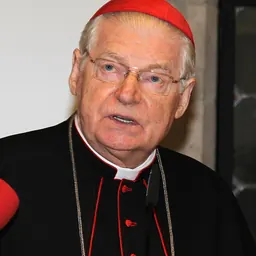
In 2007, priest Ennio Innocenti commenced a public petition for the beatification of Calabresi. Cardinal Camillo Ruini found merit in the petition and it was forwarded to Milan Cardinal Dionigi Tettamanzi who asserted that such an action would be "premature" given that the figure of Calabresi still had a "divisive effect" on the city of Milan. In 2017, Cardinals Angelo Scola and Gaetano Vallini, respectively archbishops emeritus of Rome and Milan, commenced a new campaign to gather support for the beatification of Calabresi, whose death, they asserted, was in odium fidei, "in hatred of the faith." Pope Paul VI and then Pope John Paul II had spoken of Calabresi, after his assassination, as a "servant of God", the latter calling Calabresi "a witness of the Gospel and a heroic defender of the common good."
On 9 May 2009, during the Day of Commemoration of the Victims of Terrorism, Licia Rognini, Giuseppe Pinelli's widow, and Gemma Capra, the widow of Luigi Calabresi, met for the first time at the Quirinal Palace, invited by Giorgio Napolitano, President of the Italian Republic. In Napolitano's presence and before the gathered media, the two women shook hands. Pinelli's daughter was also invited. President Napolitano stated in his eulogy that "the democratic state must always and constantly remain close to [the] wounded families," adding that Giuseppe Pinelli is to be "respected and honoured," having been "victim twice: first of very heavy, unfounded suspicions and then of a sudden, absurd end." Pinelli and Capra were heard saying to each other, "We should've done this sooner." The rapprochement of the two familites was, said Napolitano, "a political and institutional gesture" over "a wound that cannot be separated from that of the seventeen who lost their lives in Piazza Fontana."
Don’t just read it —
keep it.
Full-length biographies made to live with: read them, listen on the way to work, watch them tonight.
- E-book
- Audio
- Video
Instant download · yours to keep · every purchase keeps this site free
Important facts
People in Luigi Calabresi's life
Named in this biography and alive at the same time





Related people
Same field, nearest in time



Contemporaries
People whose lives overlapped Luigi Calabresi's


Frequently asked questions
Who was Luigi Calabresi?
Italian police officer (1937–1972)
When was Luigi Calabresi born?
Luigi Calabresi was born on 14 November 1937 in Rome.
When did Luigi Calabresi die?
Luigi Calabresi died on 17 May 1972 in Milan.
What was Luigi Calabresi's occupation?
Luigi Calabresi was a police officer.
What nationality was Luigi Calabresi?
Luigi Calabresi was Italian.
Sources & further reading
Cite this page
APA: Biography.guide. (2026). Luigi Calabresi. https://biography.guide/luigi-calabresi/
MLA: "Luigi Calabresi." Biography.guide, https://biography.guide/luigi-calabresi/.
Chicago: "Luigi Calabresi." Biography.guide. https://biography.guide/luigi-calabresi/.
Data last updated: 2026-09-25 · Spot an error? Report a correction.
Page generated 2026-09-27 05:12 UTC