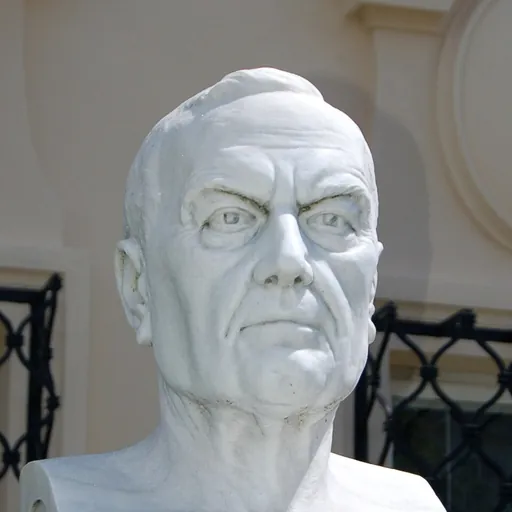
About Ludwig Baumann
Lived 1853 – 1936 (aged 82). Ludwig Baumann was an Austrian architect.
Ludwig Baumann (11 May 1853 – 6 February 1936) was an Austrian architect.
Life
Baumann was born in Seibersdorf Castle in Troppau, Austrian Silesia, and grew up in a middle-class environment, which enabled him eventually to study at the ETH Zurich. He came from a family of constructive expertise, as his father was a civil engineer. After completing his architectural studies (1870–74), he was employed by beginning in 1876, and then by Viktor Rumpelmayer from 1879 to 1882. In 1882 he formed a partnership with Emil Bressler. Beginning in 1888 he served as a highly valued architect to the upper-middle class and aristocracy of the Austro-Hungarian monarchy. In particular, he enjoyed the favor and trust of Archduke Franz Ferdinand. In 1904 with Hermann Helmer he founded the Central Association of Architects.
Initially influenced by the international Renaissance revival due to his studies in Zürich with Gottfried Semper, around 1900 Baumann switched to a conservative Baroque-revival vocabulary as an Austrian "imperial style". In 1907 he was appointed site manager of the New Hofburg, replacing Friedrich Ohmann. Between 1909 and 1913, his Austro-Hungarian War Ministry was erected as the last monumental building on the Ringstrasse. Baumann was also selected to design many buildings in the Lower Austrian city of Berndorf when it was significantly expanded under Arthur Krupp.
In 1929, still active in various planning projects, Baumann was hit by a bus near the Rochuskirche in Vienna. The injuries sustained could not heal properly, and Baumann spent his last three years in a wheelchair before dying in Vienna. His dedicated grave is located on the (Group B 32, no. 51).
Selected works Berndorf in Lower Austria, urban planning (from 1880s) School, Berndorf (1896) Apartment house at Malinovského náměstí 5, Brno, Czech Republic (1896) Villa Pazelt, Bad Vöslau (1897) Austrian Pavilion, Exposition Universelle, Paris (1900) Vienna Ice Skating Club Square (1900) Royal Academy of Oriental Languages, Vienna, today the Embassy of the United States (1902) Ministry of War, Vienna (1908–1910) Hofburg, new building of the ballroom wing, Vienna (from 1910) Wiener Konzerthaus and Akademietheater, Vienna (together with Büro Fellner & Helmer, 1911–1913) Riunione Adriatica di Sicurtà, Vienna, Albertina Platz (1911) Palazzetto Venezia, Rome (reconstruction 1909–1910)
Don’t just read it —
keep it.
Full-length biographies made to live with: read them, listen on the way to work, watch them tonight.
- E-book
- Audio
- Video
Instant download · yours to keep · every purchase keeps this site free
Important facts
People in Ludwig Baumann's life
Named in this biography and alive at the same time

Related people
Same field, nearest in time


Contemporaries
People whose lives overlapped Ludwig Baumann's
Frequently asked questions
Who was Ludwig Baumann?
Austrian architect (1853–1936)
When was Ludwig Baumann born?
Ludwig Baumann was born on 11 May 1853 in Opava, Královec.
When did Ludwig Baumann die?
Ludwig Baumann died on 6 February 1936 in Vienna.
What was Ludwig Baumann's occupation?
Ludwig Baumann was an architect.
What nationality was Ludwig Baumann?
Ludwig Baumann was Austrian.
Sources & further reading
· DBpedia: Ludwig Baumann (architect)
Cite this page
APA: Biography.guide. (2026). Ludwig Baumann. https://biography.guide/ludwig-baumann/
MLA: "Ludwig Baumann." Biography.guide, https://biography.guide/ludwig-baumann/.
Chicago: "Ludwig Baumann." Biography.guide. https://biography.guide/ludwig-baumann/.
Data last updated: 2026-09-22 · Spot an error? Report a correction.
Portrait: Wikimedia Commons · author & licence
Page generated 2026-09-27 05:02 UTC