
About Lucy Brocadelli
Lived 1476 – 1544 (aged 67). Lucy Brocadelli was a nun and mystic.
Lucy Brocadelli, also known as Lucy of Narni or Lucy of Narnia (13 December 1476 – 15 November 1544), was a Dominican tertiary who was a mystic and a stigmatic. She has been venerated by the Roman Catholic Church since 1710. She is known for being the counselor of the Duke of Ferrara, for founding convents in two different and distant city-states and for her remains being returned to her home city of Narni on 26 May 1935, 391 years after her death.
Early life Lucy Brocadelly was born on 13 December 1476 on the feast day of Lucy of Syracuse, the eldest of eleven children of Bartolomeo Brocadelli and Gentilina Cassio, in the town of Narni (then called Narnia) and in the region of Umbria. A pious child, she is said to have received visions from an early age. When she was twelve years old, Lucy made a private vow of chastity, and she determined to become a Dominican nun.
Circumstances, however, changed to make doing so impossible as her father died the following year, leaving her in the care of an uncle. This uncle, following the wish of her father while he was still alive, decided that the best course of action he could take would be to get Lucy married as quickly as possible. He made several attempts to do so. One of these included holding a large family party. He had invited the man he had chosen to become Lucy's husband to the party, with the intention of having the couple publicly betrothed. He however had not informed Lucy of his intentions. The suitor made an attempt to put a ring on Lucy's finger, only to be slapped repeatedly by her for his efforts.
A later attempt involved Count Pietro di Alessio of Milan, an acquaintance of the family. Lucy was actually quite fond of him but felt that her earlier vow of perpetual virginity made the marriage impossible. The strain Lucy felt as a result of the conflicting feelings made her seriously ill. During this time, the Virgin Mary and Saint Dominic reportedly appeared to her, this time accompanied by Saint Catherine of Siena. They reportedly advised Lucy to contract a legal marriage to Pietro, but to explain that her vow of virginity would have to be respected and not violated. Pietro agreed to the terms, and the marriage was formalized.
Stigmata In 1495, Lucy went to Rome and joined a group of Dominican tertiaries who were living in community. The next year she was sent to Viterbo to establish a new convent and there she found she was frequently the object of unwanted attention. It was there, on 25 February 1496, that she is reported to have received the stigmata. Lucy, the Dominican Order, and the pope all agreed quickly to the new proposal. The municipal council of Viterbo, however, objected, not wanting to lose their celebrated mystic. She had already been praying for some time for a way to create a new community of stricter observance, however, and agreed to go to the new convent.
Conflict Lucy's decision precipitated a conflict between Ferrara and Viterbo which would continue for two years. Viterbo wanted to keep the famous mystic for themselves, and the Duke wanted her in Ferrara. After extensive correspondence between the parties, on April 15, 1499, Lucy escaped secretly from Viterbo and was officially received in Ferrara on May 7, 1499. Thirteen young girls immediately applied for admission to the new convent; the construction of the convent began in June and was completed two years later, in August 1501. It contained 140 cells for sisters and the novices, but to fill it with suitable vocations proved to be very difficult.
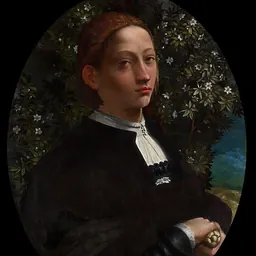
Lucy expressed the wish to have there some of her former friends from Viterbo and Narni. Duke Ercole, in September 1501, sent his messenger to Rome asking for the help of the pope's daughter, Lucrezia Borgia, who was preparing to marry the Duke's son, Alfonso. She collected all eleven candidates whom Lucy had indicated and sent them as a special wedding present to Lucy and the Duke, a few days ahead of her bridal party. She herself solemnly entered Ferrara on 2 February 1502.
The Duke petitioned the local bishop for some help for Lucy in governing her new community, and the bishop sent ten women from a local monastery to join Lucia's convent. For better or worse, these were nuns of the Dominican Second order, who were thus permitted to wear black veils, something Lucy and the other sisters of the Third Order were not. The differences in canonical standing and requirements between the two groups was to cause friction in the convent.
Tensions were heightened when one of these, Maria da Parma, was made the prioress of the convent on September 2, 1503. When Duke Ercole died on 24 January 1505, the new prioress quickly found Lucy to be guilty of some unrecorded transgression (most probably of her open and public support for the Savonarolan church reform), and placed her on a strict penance. Lucy was not allowed to speak to any person but her confessor, who was chosen by the prioress. The local Dominican prior provincial would also not permit any member of the order to see her. There are records that at least one sister, Catherine of Racconigi, did visit her and that Lucy's earlier visitations by departed saints continued. In response to Lucy's insistent prayer, her stigmata eventually disappeared, which caused some of the other members of the community to question whether they had ever been there at all. This punishment was to last her entire life, or at least until 1541, when a niece of Girolamo Savonarola was elected prioress.
Death, veneration and beatification
When Lucy died on November 15, 1544, many people were surprised to find that she had not died years earlier. When her body was laid out for burial, so many people wanted to pay their last respects that her funeral had to be delayed by three days. Her tomb in the convent church was opened four years later and her perfectly preserved body was transferred to a glass reliquary.
When the French Revolutionary Army suppressed the convent in 1797, her body was transferred to the Cathedral of Ferrara, and again, on 26 May 1935, to the Cathedral of Narni, as the diocese had been merged with another. Lucy was beatified by Pope Clement XI on 1 March 1710.
In popular culture Lucy has a very important part in Prince of Foxes by Samuel Shellabarger, a historical novel which dramatizes her escape from Viterbo.
She also was possibly a source of inspiration for Lucy Pevensie, one of the protagonists of The Chronicles of Narnia by C.S. Lewis. Lucy is the first character to discover the world of Narnia in an old wardrobe, and sticks to her story though her siblings at first disbelieve her. Walter Hooper, a biographer of Lewis, has referred to the possible connection.
Don’t just read it —
keep it.
Full-length biographies made to live with: read them, listen on the way to work, watch them tonight.
- E-book
- Audio
- Video
Instant download · yours to keep · every purchase keeps this site free
Important facts
People in Lucy Brocadelli's life
Named in this biography and alive at the same time

Related people
Same field, nearest in time



Contemporaries
People whose lives overlapped Lucy Brocadelli's





Frequently asked questions
Who was Lucy Brocadelli?
Dominican tertiary and stigmatic (1476-1544)
When was Lucy Brocadelli born?
Lucy Brocadelli was born on 13 December 1476 in Narni.
When did Lucy Brocadelli die?
Lucy Brocadelli died on 15 November 1544 in Ferrara.
What was Lucy Brocadelli's occupation?
Lucy Brocadelli was a nun and mystic.
Sources & further reading
Cite this page
APA: Biography.guide. (2026). Lucy Brocadelli. https://biography.guide/lucy-brocadelli/
MLA: "Lucy Brocadelli." Biography.guide, https://biography.guide/lucy-brocadelli/.
Chicago: "Lucy Brocadelli." Biography.guide. https://biography.guide/lucy-brocadelli/.
Data last updated: 2026-09-20 · Spot an error? Report a correction.
Page generated 2026-09-27 05:32 UTC