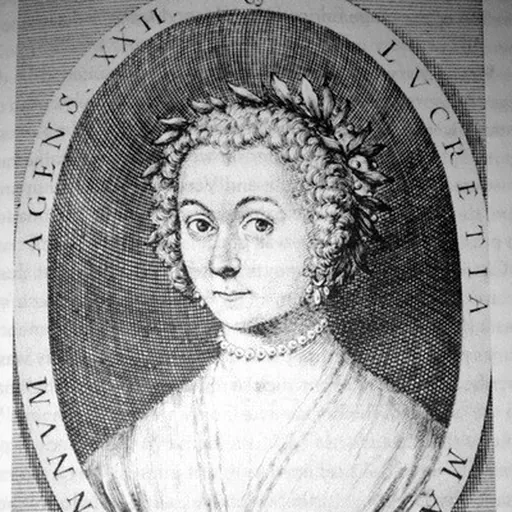
About Lucrezia Marinella
Lived 1571 – 1653 (aged 81–82). Lucrezia Marinella was an Italian writer, poet and philosopher.
Lucrezia Marinella (1571–1653) was a poet, writer, philosopher, polemicist, and women's rights advocate from the Republic of Venice. She is best known for her polemical treatise The Nobility and Excellence of Women and the Defects and Vices of Men. Her works have been noted for bringing women into the philosophical and scientific community during the late Renaissance.
Life
Lucrezia Marinella was the daughter of a physician and natural philosopher, Giovanni Marinelli, who wrote novels, some of which were on women’s well-being, hygiene and beauty. Although her father was not from Venice, Lucrezia and her family were "cittadinaza." Her brother, Curzo Marinella, was also a physician and Lucrezia married the physician Girolamo Vacca. None of her children seem to have been born in Venice. Her father might have been the vital link between her private studies and the writing and the wider world of Venetian literary circles, including the Accademia de’ Desiosi.
Marinella had a close relationship with Giovanni Nicoló Doglioni, one of the founders of the Venetian academy. She was supported by her peers and influential in the formation of the 'new' Venetian academy because of her powerful writing style and insight into women's rights. Marinella helped other female writers publish their works, a rarity at a time when women suffered countless restrictions. Female writers began to dispute claims made by male writers, such as Giuseppe Passi, author of the misogynist tract Dei donneschi difetti (On Women's Faults), showcasing their intelligence and rhetorical writing skills. Unlike other academies, women had institutional support from some male professors and peers, allowing them to negate prejudice about female inferiority.
In this era, many women entered convents or became courtesans (like the famous Veronica Franco). Entering a convent meant that a woman was not obligated to be married and could pursue education and spiritual development. But, at the same time the Roman Catholic Church maintained rigid theories of gender and expectations of women’s place and nature. However, Lucrezia Marinella did not enter the convent and wasn't pressured into marriage. She came from a professional family that very much encouraged her studies, and her father was extremely supportive. Although Marinella received support from her peers to delay marriage and further her education, she still had many barriers preventing her from writing. She lived during the Counter-Reformation, one of the most difficult periods in Italian history. The country was under Spanish domination, which led the Catholic church to dominate political liberty and impose new restrictions. These restrictions limited her writing, but she was encouraged to persevere from emerging ideas from Christian Neoplatonists.
Women in the Late Middle Ages and Early Renaissance
Women’s rights and the equality of women were a major focus of Marinella's writings. In the late Middle Ages and early Renaissance era in Italy, women were largely wives and mothers. Many women who wanted to pursue knowledge either had to be of elite standing, enter convents, or become courtesans. Women were normally not a part of political conversations and had to be extraordinary to be fully recognized in literature. Marinella talks in her writings about the tradition of female inequality that has persisted throughout Western culture and is rooted in Hebrew, Greek, Roman, and Christian ideals.
Although Marinella was one of the best recognized female writers of the time, which included Moderata Fonte, Arcangela Tarabotti and Veronica Franco. Marinella’s works mostly dealt with women’s rights and she even asserted that women were superior to men, which was a popular argument in that time for polemical and philosophical works. In response to anti-feminist writings by Passi, she notes that she is unimpressed with the thinking of men. Her writings often pursue root causes of anti-feminist thoughts.
In La nobiltà et l'eccellenza delle donne co' diffetti et mancamenti de gli uomini, she notes the root of anti-feminist thoughts potentially being attributed to the influence of Aristotle.
The court of Ferrara encouraged writers to experiment with the pastoral form. Her first polemic, The Nobility and Excellence of Women and the Defects and Vices of Men, saw light in 1600, and was composed quickly in response to Giuseppe Passi’s diatribe about women’s defects, “Dei donneschi difetti.” He outlines what he deems to be flaws of women including vanity, greed, and sexual excess. printed in Venice in 1549. The book was largely a long polemic of attacks against women and their defense. It also mounted an attack on men for exactly the same vices Passi had accused women of. Her vibrant responses to misogyny are the reason she is still recognized as one of the great examples of female erudition. It is thought that La nobilita, et l’eccellenza delle donne was published so quickly due to the connections Marinella had with the Venetian Academy. In Enrico, Marinella chose to write in one of the highest literary genres of her time, that was for cultural reasons out of favor in Venice. Marinella’s warrior women in Enrico wear masculine armor with grace and dignity; they were written as respectable in deed and thought, and as chaste virgins (Querelle des femmes). Arcadia Felice also echoes the idea that love is restricting to women and detrimental to their liberty and creativity.
Marinella's work, Vita di Maria Vergine, written in 1602 is well known for recounting the life of the Virgin Mary. It is written in verse and prose. ' She also lamented the state of women in literature and urged women to avoid a literary career. On seclusion, Lucrezia wrote: "I also stated this in my book entitled The Nobility and Excellence of Women, but now considering the issue in a more mature fashion, I am of the view that it is not the result of conscious manipulation nor the action of an angry soul, but the will and providence of nature and God." Despite her efforts and strong beliefs, her later writings seemed more affected by societal pressures and she seemed less convinced that women would ever fully be accepted as equals to men. In Exhortations, she warns women about pursuing professional careers out of their home because of how the system continuously oppresses the success of women. Cristofero Bronzino pronounced her exceptional in writing prose and poetry, most accomplished in sacred compositions, and a supreme expert in moral and natural philosophy." Arcangela Tarabotti was also said to be one of her biggest admirers, but towards the end of her life Lucrezia was said to have "attacked" her. Her father's work as a physician influenced and spurred her curiosity about science. Marinella dedicated her poem Amoro Innamorato et Impazzato to a female reader: Caterina de' Medici, Duchess of Mantua.
Death Marinella died of quartan fever, a form of malaria, in the Campiello dei Squillini in Venice on 9 October 1653. She was buried in the nearby parish church of S. Pantaleone.
Don’t just read it —
keep it.
Full-length biographies made to live with: read them, listen on the way to work, watch them tonight.
- E-book
- Audio
- Video
Instant download · yours to keep · every purchase keeps this site free
Important facts
People in Lucrezia Marinella's life
Named in this biography and alive at the same time


Related people
Same field, nearest in time
Contemporaries
People whose lives overlapped Lucrezia Marinella's




Frequently asked questions
Who was Lucrezia Marinella?
Venetian writer
When was Lucrezia Marinella born?
Lucrezia Marinella was born in 1571 in Venice.
When did Lucrezia Marinella die?
Lucrezia Marinella died on 9 October 1653 in Venice.
What was Lucrezia Marinella's occupation?
Lucrezia Marinella was a writer, poet and philosopher.
What nationality was Lucrezia Marinella?
Lucrezia Marinella was Italian.
Sources & further reading
· Wikipedia: Lucrezia Marinella
Cite this page
APA: Biography.guide. (2026). Lucrezia Marinella. https://biography.guide/lucrezia-marinella/
MLA: "Lucrezia Marinella." Biography.guide, https://biography.guide/lucrezia-marinella/.
Chicago: "Lucrezia Marinella." Biography.guide. https://biography.guide/lucrezia-marinella/.
Data last updated: 2026-09-22 · Spot an error? Report a correction.
Portrait: Wikimedia Commons · author & licence
Page generated 2026-09-27 05:02 UTC