
About Lucius Annaeus Cornutus
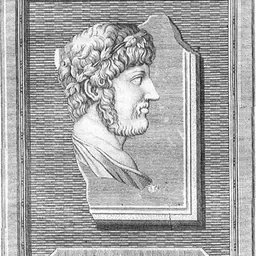
Lived AD 10 – AD 80 (aged 69–70). Lucius Annaeus Cornutus was a Roman philosopher, writer, poet and grammarian.
Lucius Annaeus Cornutus (; ) was a Stoic philosopher who flourished in the reign of Nero, when his house in Rome was a school of philosophy.
Life The amphitheatre of Leptis Magna, built during Cornutus' lifetime. Cornutus was a native of Leptis Magna in Libya, but resided for the most part in Rome. "Through Cornutus Persius was introduced to Annaeus, as well as to Lucan, who was of his own age, and also a disciple of Cornutus". At Persius's death, Cornutus returned to Persius' sisters a bequest made to him, but accepted Persius' library of some 700 scrolls. He revised the deceased poet's satires for publication, but handed them over to Caesius Bassus to edit, at the special request of the latter. after which time nothing more is heard of him. and a commentary on the Categories of Aristotle, whose philosophy he attacked along with his fellow Stoic Athenodorus. He also wrote a work called On Properties .
Compendium of Greek Theology His one major surviving work, the philosophical treatise, ("Compendium of Greek Theology") is a manual of "popular mythology as expounded in the etymological and symbolical interpretations of the Stoics". This early example of a Roman educational treatise, provided an account of Greek mythology on the bases of highly elaborated etymological readings. Cornutus sought to recover the earliest beliefs that primitive people had about the world by examining the various names and titles of the gods. The result, to modern eyes, is often bizarre, with many forced etymologies, as can be seen from the opening paragraph, where Cornutus describes Heaven : The Heaven [], my boy, encompasses round about the earth and the sea and everything both on the earth and the sea. On this account it has acquired its appellation, since it is an "upper limit" [] of all things and "marks of the bounds" [] of nature. Some say, however, that it is called Heaven [] from its "looking after" [] or "tending to" [] things, that is, from its guarding them, from which also "doorkeeper" [] and "watching carefully" [] are named. Still others derive its etymology from its "being seen above" []. Together with everything it encompasses, it is called the "world" [] from its being "so beautifully ordered" [] The book continues in a similar vein, proceeding from such gods as Zeus, Hera, Cronus, and Poseidon, to the Furies, Fates, Muses, and Graces. The work is pervaded throughout with a strong undercurrent of Stoic Physics.
We are told that the world has a soul that preserves it called Zeus who dwells in Heaven whose substance is fiery. Zeus is the power that pervades everything, and who assigns Fate to each person. The gods have sent us Reason , which does not work evil, but which is part of the divine Reason of the universe: "Ocean" is the that "glides swiftly" and changes continuously, whereas Tethys is the stability of the qualities. For from their blending or mixing come about those things that exist; and nothing would exist if either one unmixed gained the upper hand over the other.
Spurious works Scholia to Persius are also attributed to Annaeus Cornutus; the latter, however, are of much later date, and are assigned by Jahn to the Carolingian period. The so-called Disticha Cornuti belong to the Late Middle Ages.
Editions Ramelli, Ilaria (ed.). Anneo Cornuto. Compendio di teologia greca. Milan: Bompiani Il Pensiero Occidentale. 2003. . Torres, José B., Lucius Annaeus Cornutus: Compendium de Graecae Theologiae traditionibus, Bibliotheca Teubneriana, Berlin, De Gruyter, 2018. Online version at De Gruyter.
Don’t just read it —
keep it.
Full-length biographies made to live with: read them, listen on the way to work, watch them tonight.
- E-book
- Audio
- Video
Instant download · yours to keep · every purchase keeps this site free
Important facts
People in Lucius Annaeus Cornutus's life
Named in this biography and alive at the same time



Related people
Same field, nearest in time





Contemporaries
People whose lives overlapped Lucius Annaeus Cornutus's
Frequently asked questions
Who was Lucius Annaeus Cornutus?
1st century AD Roman Stoic philosopher
When was Lucius Annaeus Cornutus born?
Lucius Annaeus Cornutus was born in AD 10 in Leptis Magna.
When did Lucius Annaeus Cornutus die?
Lucius Annaeus Cornutus died in AD 80.
What was Lucius Annaeus Cornutus's occupation?
Lucius Annaeus Cornutus was a philosopher, writer, poet and grammarian.
What nationality was Lucius Annaeus Cornutus?
Lucius Annaeus Cornutus was Roman.
Sources & further reading
· Wikipedia: Lucius Annaeus Cornutus
· DBpedia: Lucius Annaeus Cornutus
Cite this page
APA: Biography.guide. (2026). Lucius Annaeus Cornutus. https://biography.guide/lucius-annaeus-cornutus/
MLA: "Lucius Annaeus Cornutus." Biography.guide, https://biography.guide/lucius-annaeus-cornutus/.
Chicago: "Lucius Annaeus Cornutus." Biography.guide. https://biography.guide/lucius-annaeus-cornutus/.
Data last updated: 2026-09-20 · Spot an error? Report a correction.
Page generated 2026-09-27 05:12 UTC