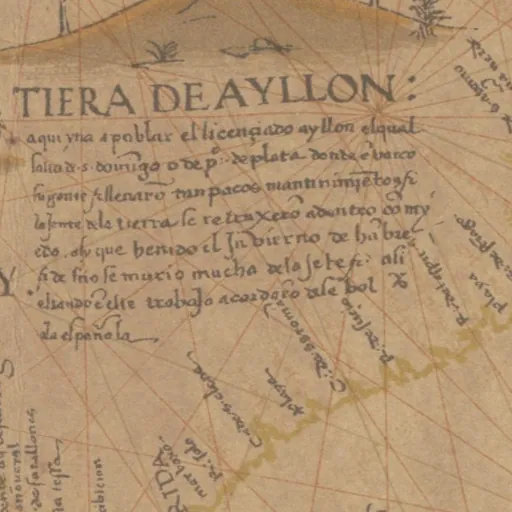
About Lucas Vázquez de Ayllón
Lived 1478 – 1526 (aged 47–48). Lucas Vázquez de Ayllón was a Spanish explorer, conquistador and discoverer.
Lucas Vázquez de Ayllón (
In Hispaniola In 1502, the Spanish Monarchs sent Nicolás de Ovando to serve as governor of Hispaniola in the Indies. Ayllón accompanied Ovando's flotilla and arrived at the capital, Santo Domingo, in April 1502. In 1504, Ayllón was appointed alcalde mayor, the chief magistrate and administrative officer, of Concepción. Ayllón was expected to establish order in the turbulent gold-mining districts in the hinterlands of the island.
In 1509, Ovando and his lieutenants, including Ayllón, were recalled to Spain and subjected to a residencia, a review or audit of their term in office. Ayllón faced charges that he enriched himself unjustly but apparently was able to defend himself successfully with no harm to his career or his wealth. After his return to Spain he undertook additional studies in law and earned the equivalent of a master's degree from the University of Salamanca.
When Ferdinand died in 1516, Cardinal Francisco Jiménez de Cisneros became regent for the young King Charles V. Cisneros was determined to end the abuse of the Indians. He had Ayllón and the other judges of the audencia suspended in 1517 and investigated for alleged abuses. However, when Cisneros was removed from the regency, the residencia was cut short, and the judges were restored to office in 1520.
Ayllón signed a contract with the crown on June 12, 1523, allowing him to establish a settlement on the eastern seaboard and conduct trade with the local natives. He was appointed as governor for life and the title alguacil mayor (high sheriff) would be held by him and his heirs forever. In return for these and numerous other privileges, Ayllón was required to perform a more detailed exploration of the region, establish missions, churches, and a Franciscan monastery to support conversion of the native population. He was restrained from implementing an encomienda or other means of forcing Indian labor. While still in Spain, Ayllón was also named a comendador in the military order of Santiago.
Establishment of San Miguel de Gualdape and death After Quexos' return, Ayllón began preparation for a voyage of settlement that he would lead personally. He spent his considerable fortune and incurred debt to outfit the expedition. He assembled a fleet of six vessels carrying about 600-700 passengers and crew. Some women, children and black enslaved people were included among the settlers. Supplies and livestock, including cows, sheep, pigs and a hundred horses, were loaded and the fleet departed in mid-July 1526. The large colonizing group landed in Winyah Bay on August 9, 1526. Their largest ship struck a sandbar and sank. There was no loss of life but a major portion of their supplies was lost. Ayllón ordered a replacement vessel to be built, probably the earliest example of European-style boat building in what is now the United States.
Ayllón looked for a suitable site to establish a settlement at nearby Pawleys Island, but the soil was poor and a sparse Indian population offered little chance for profitable trade. Several reconnaissance parties were sent out to search for better opportunities. Based on their reports, Ayllón decided to move about 200 miles south to a "powerful river", probably Sapelo Sound in present-day Georgia. Early in September, the healthy men rode to the new site on horseback while the rest traveled by ship. When they reached Sapelo Sound, they began immediately to construct houses and a church.
The short-lived colony of San Miguel de Gualdape was formally established on the festival of Saint Michael, September 29, 1526. While it was established after a 1521 colonization attempt in southern Florida by Ponce de León, it is generally considered the first European settlement in the present-day United States, since the earlier attempt was abandoned almost immediately. Ayllón's rough-hewn town survived less than three months, with settlers enduring exhaustion, cold, hunger, disease, and troubles with the local natives. When Ayllón died on October 18, 1526, from an unnamed illness, the entire enterprise fell apart. The surviving colonists broke into warring factions and by mid-November decided to give up and sail back to Hispaniola. Of the 600-700 people whom Ayllón had brought with him, only 150 survivors reached Hispaniola that winter.
San Miguel de Gualdape was the first European colony in what is now the United States, preceding the unsuccessful colony at Pensacola, Florida, by 33 years, St. Augustine, Florida (the first successful colony) by 39 years, the Roanoke Colony by 61 years, and Jamestown, Virginia, by 81 years. Despite repeated attempts, archaeologists have been unable to locate the site of the town or the shipwreck in Winyah Bay.
Legacy Peter Martyr's Decades of the New World (1530) and especially Francisco Lopez de Gomara's Historia general de las Indias (1552) helped spread the story of Ayllón's new Andalusia into European lore about exploration. His explorations also contributed to Alonso de Chaves's Espejo de Navegantes , Giovanni Vespucci's 1526 map and other future Spanish maps.
Don’t just read it —
keep it.
Full-length biographies made to live with: read them, listen on the way to work, watch them tonight.
- E-book
- Audio
- Video
Instant download · yours to keep · every purchase keeps this site free
Important facts
People in Lucas Vázquez de Ayllón's life
Named in this biography and alive at the same time



Related people
Same field, nearest in time



Contemporaries
People whose lives overlapped Lucas Vázquez de Ayllón's


Frequently asked questions
Who was Lucas Vázquez de Ayllón?
Spanish explorer
When was Lucas Vázquez de Ayllón born?
Lucas Vázquez de Ayllón was born in 1478 in Toledo.
When did Lucas Vázquez de Ayllón die?
Lucas Vázquez de Ayllón died on 18 October 1526 in Virginia.
What was Lucas Vázquez de Ayllón's occupation?
Lucas Vázquez de Ayllón was an explorer, conquistador and discoverer.
What nationality was Lucas Vázquez de Ayllón?
Lucas Vázquez de Ayllón was Spanish.
Sources & further reading
· Wikipedia: Lucas Vázquez de Ayllón
· DBpedia: Lucas Vázquez de Ayllón
Cite this page
APA: Biography.guide. (2026). Lucas Vázquez de Ayllón. https://biography.guide/lucas-vazquez-de-ayllon/
MLA: "Lucas Vázquez de Ayllón." Biography.guide, https://biography.guide/lucas-vazquez-de-ayllon/.
Chicago: "Lucas Vázquez de Ayllón." Biography.guide. https://biography.guide/lucas-vazquez-de-ayllon/.
Data last updated: 2026-09-20 · Spot an error? Report a correction.
Portrait: Wikimedia Commons · author & licence
Page generated 2026-09-27 04:58 UTC