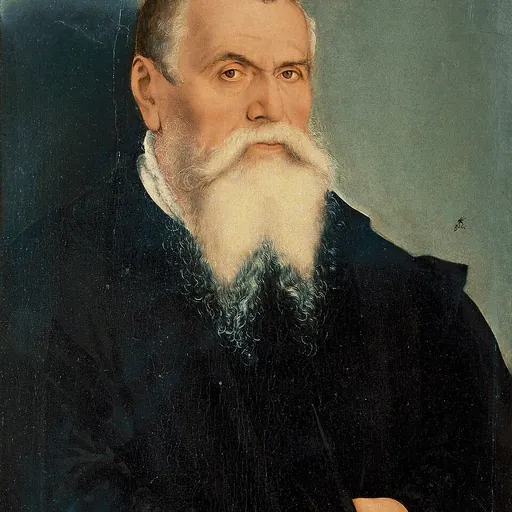
About Lucas Cranach the Elder
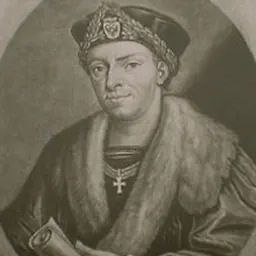
Lived 1472 – 1553 (aged 81). Lucas Cranach the Elder was a German painter, printmaker, graphic artist, architectural drafter, designer and artist.
Lucas Cranach the Elder ( ; – 16 October 1553) was a German Renaissance painter and printmaker in woodcut and engraving. He was court painter to the Electors of Saxony for most of his career, and is known for his portraits, both of German princes and leaders of the Protestant Reformation, whose cause he embraced with enthusiasm. He was a close friend of Martin Luther, and eleven portraits of that reformer by him survive. Cranach also painted religious subjects, first in the Catholic tradition, and later trying to find new ways of conveying Lutheran religious concerns in art. He continued to paint nude subjects from mythology and religion throughout his career.
Cranach had a large workshop and many of his works exist in different versions; his son Lucas Cranach the Younger and others continued to create versions of his father's works for decades after his death. He has been considered the most successful German artist of his time.
Early and personal life
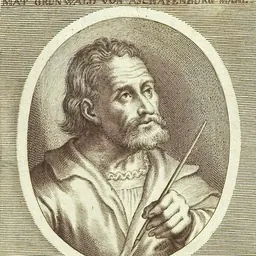
He was born at Kronach in upper Franconia (now central Germany), probably in 1472. His exact date of birth is unknown. He learned the art of drawing from his father Hans Maler (his surname meaning "painter" and denoting his profession, not his ancestry, after the manner of the time and class). His mother, with surname Hübner, died in 1491. Later, a variant of the name of his birthplace was used for his surname, another custom of the times. Where Cranach was trained is not known, but it was probably with local south German masters, as with his contemporary Matthias Grünewald, who worked at Bamberg and Aschaffenburg (Bamberg is the capital of the diocese in which Kronach lies).
According to Gunderam (the tutor of Cranach's children), Cranach demonstrated his talents as a painter before the close of the 15th century. His work then drew the attention of Duke Frederick III, Elector of Saxony, known as Frederick the Wise, who attached Cranach to his court in 1504. The records of Wittenberg confirm Gunderam's statement to this extent: that Cranach's name appears for the first time in the public accounts on the 24 June 1504, when he drew 50 gulden for the salary of half a year, as ("the duke's painter").
Career
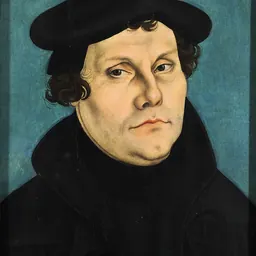
Portrait of Martin Luther, 1529The first evidence of Cranach's skill as an artist comes in a picture dated 1504. Early in his career he was active in several branches of his profession: sometimes a decorative painter, more frequently producing portraits and altarpieces, woodcuts, engravings, and designing the coins for the electorate. to the electors of Saxony in Wittenberg, an area in the heart of the emerging Protestant faith. His patrons were powerful supporters of Martin Luther, and Cranach used his art as a symbol of the new faith. Cranach made numerous portraits of Luther, and provided woodcut illustrations for Luther's German translation of the Bible. Somewhat later the duke conferred on him the monopoly of the sale of medicines at Wittenberg, and a printer's patent with exclusive privileges as to copyright in Bibles. Cranach's presses were used by Martin Luther. His apothecary shop was open for centuries, and was only lost by fire in 1871. and possibly Grünewald or Burgkmair.
Works and art
Study for portrait of Margaret of Pomerania (1518–1569), c. 1545, a drawing with all details of the sitter's costume meticulously described, was intended for the future reference and to facilitate the work on large number of commissions in the artist's atelier. The oldest extant picture by Cranach is the Rest of the Virgin during the Flight into Egypt, of 1504. The painting already shows remarkable skill and grace, and the pine forest in the background shows a painter familiar with the mountain scenery of Thuringia. There is more forest gloom in landscapes of a later time. where scenes from the Passion of Christ were matched by a print mocking practices of the Catholic clergy, so that Christ driving the money-changers from the Temple was matched by the Pope, or Antichrist, signing indulgences over a table spread with cash (see gallery below). Some of the prints were echoed by paintings, such as his Adoration of the Shepherds (c. 1517).
One of his last works is the altarpiece, completed after his death by Lucas Cranach the Younger in 1555, for the Stadtkirche (city church) at Weimar. The iconography is original and unusual: Christ is shown twice, to the left trampling on Death and Satan, to the right crucified, with blood flowing from the lance wound. John the Baptist points to the suffering Christ, whilst the blood-stream falls on the head of a portrait of Cranach, and Luther reads from his book the words, "The blood of Christ cleanseth from all sin."
Mythological scenes Hercules Relieving Atlas of the Globe, c. 1530, National Gallery of Art Cranach was equally successful in a series of paintings of mythological scenes which nearly always feature at least one slim female figure, naked but for a transparent drape or a large hat.
These are mostly in narrow upright formats; examples are several of Venus, alone or with Cupid, who has sometimes stolen a honeycomb, and complains to Venus that he has been stung by a bee (Weimar, 1530; Berlin, 1534). Other such subjects are the Three Graces, Diana with Apollo, shooting a bow, and Hercules sitting at the spinning-wheel mocked by Omphale and her maids.
Humour and pathos are combined at times in pictures such as Jealousy (Augsburg, 1527; Vienna, 1530), where women and children are huddled into groups as they watch the strife of men wildly fighting around them. A lost canvas of 1545 is said to show hares catching and roasting hunters. In 1546, possibly under Italian influence, Cranach composed the Fons Juventutis (The Fountain of Youth), executed by his son, a picture in which older women are seen entering a Renaissance fountain, and exiting it transformed into youthful beauties.
Paintings Portraits
Religion, mythology, allegory
Looted Cranachs The Nazis had a particular affection for Cranach's work and looted many paintings during the Third Reich. This has led to claims for restitution, notably from Jewish collectors who were persecuted or looted by the Nazis. The Nazis looted Cranach's Portrait of John Frederick I, Elector of Saxony (around 1530s) from Jewish art collector Fritz Gutmann before murdering him but the painting was recovered by Gutmann's grandson Simon Goodman eighty years later after decades of searching.
Cranach's "Cupid Complaining to Venus" passed through in Hitler's personal collection, causing the National Gallery to research its history, suspecting that it may have been looted. The diptych Adam and Eve by Lucas Cranach the Elder has been the focus of a legal dispute between the heirs of the former owner, Dutch art collector Jacques Goudstikker, and the Norton Simon museum in California. In 1999, the Commission for Art Recovery of the World Jewish Congress notified the North Carolina Museum of Art that its prized Cranach Madonna and Child had been looted by Nazis from the Jewish Viennese art collector Philipp von Gomperz.
On 20 October 2000 a Budapest court ruled that a Cranach and other paintings claimed by the granddaughter of famous Hungarian Jewish art collector Baron Herzog that were looted by Nazis with the Hungarian financial police should be returned to her. In 2012 the heirs of Rosa and Jakob Oppenheimer submitted a claim to the National Gallery of Ireland for a Cranach painting of Saint Christopher. The museum hired a private provenance researcher, Laurie Stein, to investigate the circumstance of the sale in 1934, and she concluded that the Cranach had not been sold under duress by the Jewish owners.
In April 2021 Cranach's "The Resurrection" was sold at auction following a settlement between the heirs of Holocaust victim Margarete Eisenmann and the art dealer Eugene Thaw. After being looted, the Cranach had been consigned to Sothebys by Hans Lange and passed through Hugo Perls and Knoedler Galleries before being acquired by Eugene Thaw. Most of the lawsuits last many years and go through several appeals in different courts. A painting by a follower of Lucas Cranach the Elder titled Lamentation and completed in the 1530s, which had been looted from Poland in 1946, was returned to the National Museum, Wrocław in 2022.
Don’t just read it —
keep it.
Full-length biographies made to live with: read them, listen on the way to work, watch them tonight.
- E-book
- Audio
- Video
Instant download · yours to keep · every purchase keeps this site free
Important facts
more
Lucas Kronach, Lukas Kranach, Luca Cranach, Lucas Sunder, Lucas Moller, Lucas Müller, Lucas Maler, Sunder Cranach, Lukas Cranach, Lucas Sonder, Lucas Muller, Muller Cranach, Luka Kranakh, Lucas Cranack, Lucas Cranach, the Elder, Lucas I Cranach, Lucas (The Elder) Cranach, Lucas Kranack, Lucas Kranach, L. Cranac, Luc. Cronach, Luca Cranch, L. Cranack, L. Cranach, Cronach, Luc. KraPeople in Lucas Cranach the Elder's life
Named in this biography and alive at the same time
Related people
Same field, nearest in time



Contemporaries
People whose lives overlapped Lucas Cranach the Elder's




Frequently asked questions
Who was Lucas Cranach the Elder?
German painter and printmaker (1472–1553)
When was Lucas Cranach the Elder born?
Lucas Cranach the Elder was born on 4 October 1472 in Kronach.
When did Lucas Cranach the Elder die?
Lucas Cranach the Elder died on 16 October 1553 in Weimar.
What was Lucas Cranach the Elder's occupation?
Lucas Cranach the Elder was a painter, printmaker, graphic artist, architectural drafter, designer and artist.
What nationality was Lucas Cranach the Elder?
Lucas Cranach the Elder was German.
Sources & further reading
· Wikipedia: Lucas Cranach the Elder
· DBpedia: Lucas Cranach the Elder
Cite this page
APA: Biography.guide. (2026). Lucas Cranach the Elder. https://biography.guide/lucas-cranach-the-elder/
MLA: "Lucas Cranach the Elder." Biography.guide, https://biography.guide/lucas-cranach-the-elder/.
Chicago: "Lucas Cranach the Elder." Biography.guide. https://biography.guide/lucas-cranach-the-elder/.
Data last updated: 2026-09-23 · Spot an error? Report a correction.
Portrait: Wikimedia Commons · author & licence
Page generated 2026-09-27 05:05 UTC