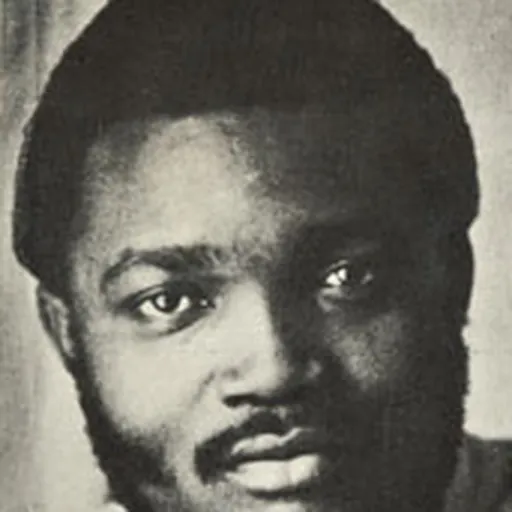
About Luambo Makiadi
Lived 1938 – 1989 (aged 51). Luambo Makiadi was a Congolese singer, composer and guitarist.
François Luambo Luanzo Makiadi (6 July 1938 – 12 October 1989) was a Congolese guitarist, singer-songwriter, bandleader, and cultural revolutionary. He was a central figure in 20th-century Congolese and African music, principally as the bandleader for over 20 years of TPOK Jazz, the most popular and influential African band of its time. He is referred to as Franco Luambo or simply Franco. Known for his mastery of Congolese rumba, he was nicknamed by fans and critics "Sorcerer of the Guitar" and the "Grand Maître of Zairean Music", as well as "Franco de Mi Amor" by female fans. AllMusic described him as the "big man in African music". His extensive musical repertoire included social commentary on love, interpersonal relationships, marriage, decorum, politics, rivalries, mysticism, and commercialism. In 2023, Rolling Stone ranked him at number 71 on its list of the 250 Greatest Guitarists of All Time.
Born in Sona-Bata in Kongo Central and raised in Kinshasa, He initially performed with Luampasi's band, Bandidu, alongside Dewayon, and later worked with Dewayon's band Watam, under the auspices of the Loningisa label, managed by Greek music executive Basile Papadimitriou. As the band's lead guitarist, Luambo developed a distinctive style characterized by polyrhythmic sophistication and intricate multi-string plucking, laying the foundation for what became known as the "OK Jazz School". This style was deeply rooted in rumba odemba, a rhythmic and melodic tradition emanating from the Mongo people of Mbandaka. Franco's early recordings in the 1950s, including the Congolese rumba hits "Bato Ya Mabe Batondi Mboka", "Joséphine Naboyi Ye", and "Da Da De Tu Amor", as well as upbeat cha-cha-chá hits like "Linda Linda", "Maria Valenta", and "Alliance Mode Succès", helped define Congolese rumba's sound across Central, Eastern, and parts of Western Africa, while "On Entre O.K., On Sort K.O." became the band's emblematic motto.
In 1967, Luambo became the co-leader of OK Jazz, alongside vocalist Vicky Longomba, and when the latter departed in 1970, Luambo assumed full leadership. Throughout the 1970s, Luambo became increasingly engaged in politics and aligned himself with President Mobutu Sese Seko's state ideology of Authenticité. He wrote several songs extolling Mobutu and his administration. By the early 1980s, a significant number of TPOK Jazz members had relocated to Europe, seeking refuge from the worsening socio-economic conditions in Kinshasa.
In recognition of his musical impact, Luambo was named an Officer of the National Order of the Leopard in 1976, and he was awarded the Maracas d'Or in 1982 for his influence on Francophone music. Though twice married, Luambo's personal life was often marred by well-known infidelities.
Life and career 1938–1952: Early life and career beginnings
François Luambo Luanzo Makiadi was born on 6 July 1938 in , Bas-Congo (now Kongo Central), in what was then the Belgian Congo (currently the Democratic Republic of the Congo). He came from an interethnic background: his father, Yvon Emongo, was a Tetela railway worker, while his mother, Hélène Mbonga Makiese, was Kongo with Ngombé roots through her paternal lineage. Luambo was one of three children. Following Yvon's death, Hélène had three additional children, with two different partners. Luambo and Dewayon struck up a friendship, which allowed Luambo to further hone his musical skills. Another notable mentor was Albert Luampasi, a guitarist and composer affiliated with Ngoma, under whose tutelage Luambo further polished his guitar skills, before being included in Luampasi's circle alongside Dewayon and beginning to attend performances with Luampasi's band, Bandidu. In 1952, Luambo officially joined Bandidu and toured with the band in Bas-Congo, including an extended stay in Moerbeke, Kwilu Ngongo, where they remained for several months.
1953: Watam Luambo's stint with the Léopoldville-based band Watam is disputed. British musicologist Gary Stewart contends that Luambo co-founded Watam in 1950 with Dewayon, alongside other musicians such as Louis Bikunda, Ganga Mongwalu, and Mutombo. That same year, Watam garnered critical acclaim with two songs composed by Dewayon, "Bokilo Ayébi Kobota" and "Nyekesse", which were released in February 1953 through Loningisa. Watam regularly performed in Ngiri-Ngiri, particularly at Kanza Bar on Rue de Bosenge. Franco's debut solo recordings, "Marie Catho" and "Bayini Ngai Mpo Na Yo" (alternatively titled "Bolingo Na Ngai Na Béatrice"), premiered in October 1955 and swiftly gained widespread attention, which earned him the sobriquet "Franco de Mi Amor" from an expanding female fandom. Ossinondé described these songs as the "greatest success of 1955", and they became Luambo's first records to gain broad popularity in the Belgian Congo and across Africa. Capitalizing on this success during the intense rivalry between the Ngoma and Opika labels, Loningisa worked to maximize the potential of its artists, especially Luambo, who introduced unique harmonic and rhythmic touches in his early recordings. From then on, his guitar appeared on several Loningisa recordings, mostly releases from November 1955 to June 1956. These included De La Lune's "Mia poza", "Komeka te", "Tika bizeti", and "Tango ekoki"; Dewayon's "Vis-à-vis", "Locia wa ngai", "Mabele okanisaka", and "Dit Antoinette"; Luambo's "Flamingo", "Véronica o mboka Bukigam", "Elo mama", "Naboyi yo te", "Ba petits bongo luwo", and "Anna mabele ya ngoya"; Vicky Longomba's "Nalingi ozonga", "Mokili mobongwani", "Viclong Julie", and "Bolingo eleki kisi"; Pholidor Tandjigorah's "Oyo elingi motema" and "Rumbamba"; Rossignol's "Thérèse d'Amour" and "Wa bolingo"; Augustin Moniania "Roitelet"s "Chérie Margo" and "Houlala mopanzi"; Jean Serge Essous' "Alice" and "Chérie atiki ngai"; Pedro "Bemi" Kosi's "Nabosani ndako" and "Palabras amorosas"; and Dessoin's "Wapi yo" and "Osili obébi". The style often featured a dozen vocalists; a seven-piece horn section; a rhythm section comprising bass, drums, and congas; and three guitars (lead, rhythm, and mi-solo), weaving complex interlocking patterns. OK Jazz was supported by two influential groups: a male fan club named AGES (Association des Gentlemen Sélectionnés) and a female counterpart known as La Mode. These fan clubs became central to the band's image and were frequently acknowledged in musical dedications. This widespread acclaim was noted in an article published by the Agence Congolaise de Presse, in which then-Congolese information minister Jean Jacques Kande observed:"In the city's most popular bars, he picks up his guitar, and hordes of young girls crowd around him, as if paying homage to their childlike spirit, giving him looks that could derail a speeding train. For Franco is an undisputed and undeniable master of the guitar..." After his release, Luambo returned to music with renewed determination and was soon hailed as the "Sorcerer of the Guitar". Coming from a wealthy family, Mateta viewed OK Jazz as a launching pad for his broader ambitions, and his partnership with Luambo proved highly productive. That year, they signed a recording and distribution deal with Pathé Marconi in Paris, created a secondary entity called Boma Bango (meaning "kill them" in Lingala, a reference to rivals), and established another company, Lulonga, in Brazzaville (named after Luambo, Longomba, and Ganga).
By 1965, Epanza Makita succeeded Les Éditions Populaires as the band's main label. According to singer Sam Mangwana, Luambo led with an emphasis on inclusivity and mutual respect. While he retained final authority, he sought to ensure that all members felt respected and involved. Unable to tolerate what he perceived as Kwamy's pomposity, Luambo confronted him, after which Kwamy cited a financial disagreement as the reason for his departure.
In 1967, Luambo became co-bandleader alongside Longomba, but significant challenges arose in April during his absence in Europe. A protest movement within the band led to a mass defection of musicians, who established a breakaway group named Orchestre Révolution. The splinter group included prominent former members like Joseph "Mujos" Mulama, Michel Boyibanda, and Kwamy on vocals; Welakingara "John Payne" and Armando "Brazzos" Mwango Fwadi-Maya on guitars; Tshamala "Picolo" on bass; Nicolas "Dessoin" Bosuma on percussion; Duclos on drums; Isaac Musekiwa on saxophone; and Christophe Djali on trumpet. This schism became one of the most significant upheavals in the band's history, although many of the musicians eventually returned to the fold. Luambo, who was unaware of the subterfuge, initially agreed to help with the project. However, Mateta eventually fled with Luambo's contacts and secured a publishing deal independently, receiving a substantial advance, which he used to purchase two automobiles. When commissioned by the regime to compose an anthem for the AZDA (Association Zairoise d'Automobiles), the successor to Difco as the Volkswagen dealership, Luambo acquiesced in exchange for considerable remuneration, a portion of which was allocated to procure vehicles for the musicians. The resulting song, "Azda", featuring the catchy refrain "Vé Wé, Vé Wé, Vé Wé, Vé Wé" (a phonetic nod to "VW" for Volkswagen), became a major hit and reached audiences as far as West Africa. However, rumors began to circulate, alleging that Luambo had engaged in sacrificial rites involving his brother (like other parts of Africa, Kinshasa was rife with witchcraft accusations, especially against public figures such as Luambo).
In 1976, TPOK Jazz marked their 20th anniversary and reached the zenith of their pan-African popularity. They were noted for their vocal harmonies, elaborate stage costumes, choreographed performances, robust brass section, and Luambo's distinctive guitar work. They undertook extensive tours across the continent, performing in countries such as Gabon, Togo, Cameroon, Ivory Coast, Chad, and Sudan. According to Mangwana, the scale of TPOK Jazz's operations was unparalleled: "We had a sound system that weighed seven tons. Only institutions with significant resources could afford to carry it. That's why we mainly performed at major events organized by government ministries". "Radio Trottoir" recounts the story of a woman accusing others of ruining her marriage through defamatory gossip. During his absence, TPOK Jazz was divided into two semi-autonomous factions. The senior group was led by Simaro, Josky Kiambukuta, and Ndombe Opetum, while the younger faction included rising talents such as vocalists Madilu System and Ntesa Dalienst as well as solo guitarist Thierry Mantuika.
In 1982, the headquarters of Luambo's record label, Visa 80, originally launched in Brussels in 1980, was relocated to Paris. However, administrative irregularities led to the band's forced expulsion from Belgium. According to French music journalist Vladimir Cagnolari, this followed complaints from local club owners that TPOK Jazz concerts attracted large audiences away from their establishments. Authorities discovered that the musicians' service passports did not permit them to work, and after a second offense, they were expelled permanently. The song, partly inspired by his 1971 track "Mobali Na Ngai Azali Etudiant Na M'Poto", expressed his loyalty to Kinshasa and frustration with detractors who spread malicious rumors. and featured the songs "Frein A Main", "5 Ans Ya Fabrice", and the hit "Non", which marked Madilu System's breakthrough. Although the track was initially intended for Kiambukuta, Luambo's longtime preferred vocalist, the decision to feature Madilu System was influenced by Luambo's wife. followed by three consecutive nights at Kilimanjaro's Heritage Hall in Washington, DC, beginning on 4 November. In that same period, TPOK Jazz released the Edipop-produced hit "Mamou" (also titled "Tu Vois?"), which was written by Luambo and featured his vocals with Madilu System. The duo continued with the release of the album Franco et le T.P. O.K. Jazz chez Rythmes et Musique à Paris, still in 1984. It featured songs such as "Makambo Ezali Bourreau" and the widely acclaimed "12 600 Lettres". In the latter, Luambo addressed the plight of women tormented by their sisters-in-law, drawing directly from 12,600 letters he had received from distressed wives. The song struck a powerful chord with audiences, especially women. The song turned into one of Luambo's most significant hits, and critic Bensignor called it perhaps "Luambo's greatest masterpiece" and one of the "monuments of 20th-century Congolese music". That same year, TPOK Jazz returned to perform at the Manhattan Center with a full lineup of sixteen musicians, including singers, instrumentalists, and dancers. They followed with another three-hour performance at the Africa Center in London.
In 1986, Malage de Lugendo, a vocalist, was brought into the band, along with Kiesse Diambu ya Ntessa from Afrisa International and the female vocalist Jolie Detta. TPOK Jazz released the four-track LP Le Grand Maitre Franco et son Tout Puissant OK Jazz et Jolie Detta, featuring Luambo's breakout track "Massu", Thierry Mantuika's "Cherie Okamuisi Ngai", Luambo's "Layile", and Djodjo Ikomo's "Likambo Ya Somo Lumbe", featuring guest appearances from Simaro and vocals from Detta and de Lugendo. The LP synthesized Congolese rumba and soukous and garnered substantial acclaim, with "Massu" and "Layile" being hailed as some of the most memorable tracks in TPOK Jazz's discography. The same year, Luambo and TPOK Jazz went on an extensive tour of Kenya, where they performed in various cities, including Eldoret and Kisumu. Their hit single "La Vie Des Hommes", released by the Belgian imprint Choc (a subsidiary of African Sun Music), served as the title track of an album commemorating their 30th anniversary. The project also featured "Ida", with vocals by Luambo and de Lugendo, and "Celio", sung by Djo Mpoyi and de Lugendo. Luambo's vocals and guitar feature on the hopeful opening track, "Toujours O.K.", while his guitar work also surfaces in the closing moments of another song, "Chérie B.B". By September 1989, Luambo's health had begun to decline significantly, yet he continued to perform in Brussels, London, and Amsterdam, playing at Melkweg near Leidseplein on 22 September, before being hospitalized the next day. At the time, Mobutu, then a Chief of Staff of the Congolese National Army, had served as Lumumba's personal aide, before betraying him. Following Lumumba's assassination, Luambo composed the song "Liwa ya Lumumba" ("the death of Lumumba"), alternately titled "Liwa Ya Emery". Luambo then released the album Au Commandement, wherein the eponymous track celebrated Mobutu's ascent to power. It conveyed a hopeful sentiment, praising Lumumba while portraying Mobutu as a reincarnation of Lumumba's legacy. The event was particularly significant as Mobutu, a Catholic, executed Bamba, a prominent Kimbanguist, a member of a traditional Kongolese religious movement. He then propagated a forceful nationalist state ideology known as Authenticité, which sought to reappropriate and exalt indigenous culture while systematically eradicating colonial influence, thus creating a distinctly Zairean identity. At this time, Luambo changed his name to L'Okanga La Ndju Pene Luambo Luanzo Makiadi, and his music became an essential medium for disseminating Mobutu's political ideology, transforming him into a cultural icon and an advocate for the regime's agenda. To commemorate Authenticité, Luambo composed the song "Oya" ("identity"), in which he urged Zaireans to embrace their true heritage. The club, which opened in 1974, became one of the most exclusive venues in Kinshasa. Mobutu's policies of nationalizing foreign-owned companies extended to Luambo as well, as he was granted control of Mazadis, a record-pressing company, to the dismay of smaller producers and musicians who accused Luambo of monopolizing access to the facility.
Despite the outward appearance of national unity and cultural resurgence, Mobutu's regime was marked by endemic corruption, authoritarianism, and social injustices. The 1974 nationalization of small- and medium-sized businesses was disastrous and prompted the government to reverse course and adopt a mixed economy that returned 60% ownership of enterprises to their former proprietors. Nevertheless, embezzlement by high-ranking officials persisted, and abuses of power became widespread. Luambo responded to these conditions through increasingly critical and socially observant music, exemplified by his 1975 single "Matata Ya Mwasi Na Mobali Esilaka Te", which excoriated the misuse of elite influence, particularly those who exploited their positions to interfere in personal relationships. Summoned by Attorney General Léon Kengo wa Dondo, Luambo defended the songs, claiming they contained nothing inappropriate. Although ostensibly directed at lower-level officials, many perceived the song as an implicit critique of Mobutu himself, as he had appointed these very figures. The lyrics implored the public to rally behind Mobutu's leadership, extolling his governance while ominously warning against dissent, metaphorically referring to Mobutu's opponents as "sorcerers".
Illness and death In early 1987, Luambo recorded one of his most impactful songs, "Attention Na Sida" ("Beware of AIDS"), from the eponymous album. At a time when AIDS was a relatively new and poorly understood disease, with limited public information provided by governments, the song served as a powerful and necessary public health message.
In early 1988, Luambo went to Brussels for medical tests to diagnose his worsening health.
Luambo's body was repatriated to Kinshasa on 15 October 1989, where a requiem mass was held at the Cathedral of Notre Dame du Zaïre (now Cathédrale Notre-Dame du Congo) in Lingwala. During the ceremony, Reverend Father Ntoto honored Luambo, describing him not as a disruptive force but as "a voice of conscience". A mausoleum was constructed over Luambo's gravesite,
Recorded output It is difficult to summarize the enormous volume of recordings issued by Luambo (virtually all of them with TPOK Jazz). The range of estimates suggest both the size of, and the uncertainties about, his output. An often-cited number is a list of 84 albums compiled by Graeme Ewens in his 1994 biography of Luambo; this list does not include compilation albums that also have other performers, or OK Jazz tribute albums and compilations issued after Luambo's death (Ewens notes that this number "falls short of the 150 albums which Luambo claimed back in the mid-1980s, but no doubt some of those were collections of singles for the African market"). Ten albums on the list were issued in 1983 alone. Other statements include: "he released roughly 150 albums and three thousand songs, of which Luambo himself wrote about one thousand"; "Franco's prolific output amounted to T.P.O.K releasing two songs a week over his nearly 40-year career, which ultimately comprised a catalogue of some 1000 songs"; "With his band OK Jazz he released at least 400 singles (more than half later compiled onto LP or CD) ... Ewens lists 36 CDs; Asahi-net has 83"; and "from June 1956 to August 1961 the band recorded 320 tracks for the 78 rpm music label Loningisa".
As a rough explanation of its nature, in the 1950s and 1960s, Luambo and TPOK Jazz issued singles, either 78 rpm (1950s) or 45 rpm (1960s), as well as some albums that were compilations of singles, and in the 1970s and 1980s, they issued longer albums. All of this was done by a large number of record labels, in a variety of countries in Africa and Europe as well as in the United States. In the 1990s, many of the albums were reissued in CD form by various record labels but haphazardly reorganized, often combining various parts of multiple albums onto single CDs. Since 2000, several compilations have been issued, collecting aspects of Luambo's work, most notably Francophonic, a pair of two-CD sets of highlights issued by Stern's in 2007 and 2009 and spanning Luambo's entire career. Through 2020, the Planet Ilunga record label has still been able to issue (on vinyl and digitally) compilations that include tracks that had never been reissued since their original release as singles.
Musical style, critical evaluations, and significance
Luambo's guitar playing was unlike that of bluesmen such as Muddy Waters or rock and rollers like Chuck Berry. Instead of raw, single-note lines, Luambo built his band's style around crisp open chords, often of only two notes, which "bounced around the beat". The use of major thirds and sixths, as well as other consonant intervals, became a defining feature of his style, which thus provided a harmony-driven foundation rather than the blues-based tension often found in rock and roll. His sound was connected to what musicologist Bob W. White described as the ondemba tradition, rhythmic, repetitive, and visceral, distinct from the more sophisticated and romantic fiesta style favored by contemporaries like Tabu Ley Rochereau and Papa Wemba. By the late 1970s and early 1980s, Luambo began to experiment with longer song structures, with some pieces, such as the 18-minute "Bina Na Ngai Na Respect", becoming iconic for their musical ingenuity and their social message. and he was its co-leader or sole leader for most of that period.
He is commonly described as the preeminent African musical figure of the 20th century. For example, world music expert Alistair Johnston calls him "the giant of 20th century African music". A reviewer in The Guardian wrote that Luambo "was widely recognized as the continent's greatest musician, back in the years before Ali Farka Touré or Toumani Diabaté". Ronnie Graham, in his encyclopedic 1988 Da Capo Guide to Contemporary African Music, wrote that "Franco is beyond doubt Africa's most popular and influential musician". This is in addition to listing Luambo first in his book's rank-ordered section on Congo and Zaire, and putting on the book's cover, to represent African music, a waist-up photo of Luambo playing guitar. Known in Kinshasa as "Majos", she was a central figure in Luambo's youth. Their relationship, described by contemporaries as intensely affectionate, ended abruptly when Kenge left him, and, according to biographer Raoul Yema (Franco: Le Grand Maître), this breakup influenced Luambo's views on women and interpersonal relationships and marked the beginning of his often critical lyrical portrayals of women and a more cynical worldview. According to French music journalist François Bensignor, Masouba was a member of La Mode, a prominent female fan club that supported OK Jazz during the 1950s. In 1971, Vita Club won its first national championship after defeating Tout Violent Tshipepele of Kananga 2–0, and retained the title in 1972 and 1973.
In 1973, Luambo was succeeded by his deputy, Simon Opango Ibombo, under whom Vita Club won the African Cup of Champions Clubs, the predecessor of the CAF Champions League. Although the continental title came after Luambo left office, Congolese sports journalist François Siki Ntetani credited his administration with helping lay the foundation for Vita Club's national and continental successes.
Selected discography This is a very preliminary, partial list.
YearAlbum1969 Franco & Orchestre O.K. Jazz* – L'Afrique Danse No. 61973 Franco & OK Jazz* – Franco & L'O.K. Jazz1974 Franco Et L'Orchestre T.P.O.K. Jazz* – Untitled1978 "Franco" Luambo Makiadi* & His O.K. Jazz* – Live Recording of the Afro European Tour Volume 11978 "Franco" Luambo Makiadi* & His O.K Jazz* – Live Recording of the Afro European Tour Volume 21979 Luambo Makiadi Franco & l'Orchestre T.P. O.K. Jazz1980 Franco & le T.P. O.K. Jazz a Paris Vol 11980 Franco et Le T.P.O.K. Jazz – A Bruxelles, On Entre O.K. On Sort K.O.1980 Franco et le T.P. O.K. Jazz – En Colere Vol 11980 Franco et le T.P. O.K. Jazz – En Colere Vol 21980 Tonton Franco et le T.P. O.K. Jazz – 6 Juin 1956 – 6 Juin 1980 24 Ans D'Age1981 Le Quart De Siècle de Franco De Mi Amor le T.P.O.K. Jazz – Volume 1 – Volume 4 (Keba Na Matraque)1982 Franco et le T.P. O.K. Jazz – Disque D'Or Et Maracas D'Or On Entre OK On Sort KO1982 L'Alliance de L'Annee 1982 Franco et Sam Mangwana avec le T.P. O.K. Jazz – Spécial Maracas D'Or1982 Franco et le T.P. O.K. Jazz – À 0 Heure Chez 1-2-3 Face A Face1983 Franco et le T.P. O.K. Jazz – Chez Safari Club de Bruxelles (On Entre OK On Sort KO)1983 Franco et le T.P. O.K. Jazz – Chez Fabrice a Bruxelles (Mibali Bokanga Ba Freins a Main)1984 Franco et le T.P. O.K. Jazz – Chantent Tres Impoli (Mpo Na Nini Ozalaka Tres...?)1984 Franco et le T.P. O.K. Jazz – À l'Anciènne Belgique1984 Luambo Makiadi et le T.P. O.K. Jazz – Chantent Candidat Na Biso Mobutu (Ganga Mpe Belela Kombo Ya Mobutu)1985 Franco & le T.P. O.K. Jazz – Le F.C. 105 de Libreville (L'équipe des grandes suprises)1985 Le Grand Maitre Franco et son le T.P. O.K. Jazz – Dans Mario (LP) CHOC CHOC CHOC 0041985 Le Grand Maitre Franco et son le T.P. O.K. Jazz – Dans Mario (LP) CHOC CHOC CHOC 0051985 African Record Center Presente le Tout Puissant O.K. Jazz – Dans Lela Ngai Na Mosika1986 Le Grand Maitre Franco et son Tout Puissant O.K. Jazz et Jolie Detta1986 Le Grand Maitre Franco et Ses Stars du T.P. O.K. Jazz – À Nairobi1986 Franco & Le T.P.O.K. Jazz – Choc Choc Choc La Vie Des Hommes – Ida – Celio (30 Ans De Carrière – 6 Juin 1956 – 6 Juin 1986)1986 Le T.P. O.K. Jazz – Special 30 Ans Par Le Poete Lutumba Simaro & Le Grand Maitre Franco1987 Franco et le T.P. O.K. Jazz – Bois Noir1987 Franco Et Le T.P.O.K. Jazz – L'Animation Non Stop1987 Le Grand Maitre Franco et Son T.P. O.K. Jazz – Ekaba Kaba (Yo Moko Okabeli Ngai Ye Oh)1987 Le Grand Maitre Franco* – Baniel – Nana et le T.P.O.K. Jazz* – Les "On Dit"1987 Le Grand Maitre Franco – Interpelle la Societe dans Attention na SIDA (Franco S'insurge Contre...Le SIDA)1988 Le Grand Maitre Franco – Pepe Ndombe et le T.P. O.K. Jazz attaquent Anjela1988 Le Grand Maitre Franco avec Ntesa Dalienst et le T.P. O.K. Jazz – Dans Mamie Zou, Batandeli Ngai Mitambo, Dodo, Na Lobi Na Ngai Rien1988 Le Grand Maitre Franco et le T.P. O.K. Jazz – Dans La Réponse de Mario (On Entre OK On Sort KO)1988 Le Grand Maitre Franco – Nana – Baniel et le T.P. O.K. Jazz – Dans Cherche Une Maison À Louer Pour Moi Cherie (On Entre On Sort KO)1988 Franco Joue Avec Sam Mangwana1989 Sam Mangwana, Franco et T.P. O.K. Jazz FOREVER
Compilation albums:
Don’t just read it —
keep it.
Full-length biographies made to live with: read them, listen on the way to work, watch them tonight.
- E-book
- Audio
- Video
Instant download · yours to keep · every purchase keeps this site free
Important facts
People in Luambo Makiadi's life
Named in this biography and alive at the same time






Related people
Same field, nearest in time


Contemporaries
People whose lives overlapped Luambo Makiadi's



Frequently asked questions
Who was Luambo Makiadi?
Congolese lingala musician (1938-1989)
When was Luambo Makiadi born?
Luambo Makiadi was born on 6 July 1938 in Kongo Central.
When did Luambo Makiadi die?
Luambo Makiadi died on 12 October 1989 in Mont-Godinne.
What was Luambo Makiadi's occupation?
Luambo Makiadi was a singer, composer and guitarist.
What nationality was Luambo Makiadi?
Luambo Makiadi was Congolese.
Sources & further reading
Cite this page
APA: Biography.guide. (2026). Luambo Makiadi. https://biography.guide/luambo-makiadi/
MLA: "Luambo Makiadi." Biography.guide, https://biography.guide/luambo-makiadi/.
Chicago: "Luambo Makiadi." Biography.guide. https://biography.guide/luambo-makiadi/.
Data last updated: 2026-09-24 · Spot an error? Report a correction.
Portrait: Wikimedia Commons · author & licence
Page generated 2026-09-27 05:08 UTC