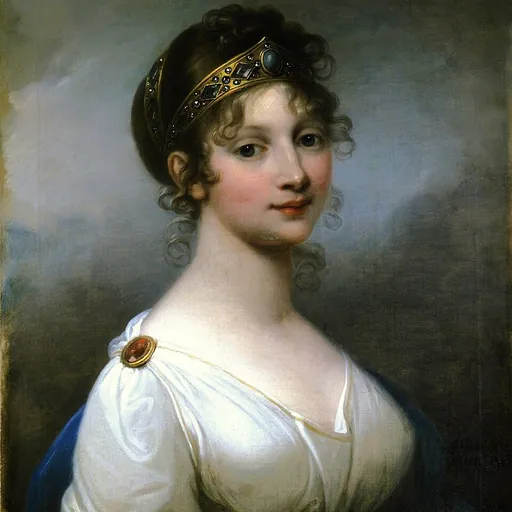
About Louise of Mecklenburg-Strelitz
Lived 1776 – 1810 (aged 34). Louise of Mecklenburg-Strelitz was a German aristocrat.
Louise of Mecklenburg-Strelitz (Luise Auguste Wilhelmine Amalie; 10 March 1776 – 19 July 1810) was Queen of Prussia as the wife of King Frederick William III. The couple's happy, though short-lived, marriage produced nine children, including the future monarchs Frederick William IV of Prussia and William I, German Emperor.
Her father, Prince Charles of Mecklenburg-Strelitz, was field-marshal of the household brigade in Hanover. Her mother was a princess of Hesse-Darmstadt. In 1793 Louise met at Frankfort the crown prince of Prussia, afterwards King Frederick William III., who was so fascinated by her beauty, and by the nobleness of her character, that he asked her to become his wife. They were married on the 24th of December of the same year. After the battle of Jena she went with her husband to Königsberg, and when the battles of Eylau and Friedland had placed Prussia absolutely at the mercy of France, she made a personal appeal to Napoleon at his headquarters in Tilsit, but without success. Early in 1808 she accompanied the king from Memel to Königsberg, whence, towards the end of the year, she visited St Petersburg, returning to Berlin on the 23rd of December 1809. During the war Napoleon attempted to destroy the queen’s reputation, but the only effect of his charges in Prussia was to make her more deeply beloved. On the 19th of July 1810 she died in her husband’s arms, while visiting her father in Strelitz.
At the time of her birth, Louise's father was not yet the ruler of Mecklenburg-Strelitz (he would not succeed his brother as duke until 1794), and consequently she was not born in a court, but rather in a less formal home. The family subsequently moved to Leineschloss, the residence of Hanoverian kings, though during the summer they usually lived at Herrenhausen. When Louise was only six years old, her mother died in childbirth, leaving a permanent mark on the young duchess. She would often give away pocket change to other children who experienced similar losses, stating "she is like me, she has no mother". After Duchess Friederike's death, the family left Leineschloss for Herrenhausen, sometimes called a "miniature Versailles". The twice widowed and grieving duke went to Darmstadt, where he gave the children into the care of his mother-in-law and Louise's grandmother, the widowed Princess Maria Louise. A new governess from Switzerland, Madame Gelieux, was appointed, giving the children lessons in French; as was common for royal and aristocratic children of the time, Louise became fluent and literate in the language, while neglecting her own native German. She received religious instruction from a clergyman of the Lutheran Church. Complementary to her lessons was an emphasis on charitable acts, and Louise would often accompany her governess when visiting the houses of the poor and needy. From the age of ten until her marriage at 17, Louise spent most of her time in the presence of her grandmother and governess, both well-educated and refined. When only nine years old, Louise was present when the poet Friedrich Schiller read from the first act of "Don Carlos" for the entertainment of the assembled court, thus sparking her love for German as a literary language, especially works of Schiller. Louise loved history and poetry, and not only enjoyed reading Schiller, but also came to like the works of Goethe, Paul, Herder and Shakespeare, as well as ancient Greek tragedies.
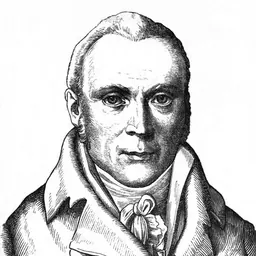
Appearance Contemporary men and women described Louise as beautiful in face and noble in figure. She had eloquent blue eyes that "glowed with feeling" and gave her "a peculiar charm." She had light hair with blonde locks and fair complexion with rosy cheeks. She stood at 174 cm tall and had a shoe size of 41. A lady of her era commented that she always appeared "splendid" and "gentle" despite her large form and that no women matched her beauty even when compared "in single features." Poet Goethe was enchanted by Louise and her sister, remarking "[they] must be counted as heavenly visions." Napoleon called Louise "an exquisite woman," telling Tsar Alexander that "instead of depriving her of a crown, one is tempted to lay one at her feet."
Crown Princess of Prussia (1793–1797)
In 1793, Marie Louise took the two youngest duchesses with her to Frankfurt, where she paid her respects to her nephew King Frederick William II of Prussia. Louise had grown up into a beautiful young woman, possessing "an exquisite complexion" and "large blue eyes," and was naturally graceful. Louise's uncle, the Duke of Mecklenburg-Strelitz, hoped to strengthen ties between his house and Prussia. Consequently, on one evening carefully planned by the duke, seventeen-year-old Louise met the king's son and heir, Crown Prince Frederick William. She made such a charming impression on Frederick William that he immediately made his choice, desiring to marry her. Frederica caught the eye of his younger brother Prince Louis Charles, and the two families began planning a double betrothal, celebrating a month later, on 24 April 1793 in Darmstadt. Frederick and Louise were subsequently married on 24 December that same year, with Louis and Frederica marrying two days later.
In the events leading up to her marriage, Louise's arrival in Berlin, the Prussian capital, caused quite a sensation, and she was greeted with a grand reception by the city's joyful citizens. Another wrote "The more perfectly one becomes acquainted with the Princess the more one is captivated by the inner nobility, and the angelic goodness of her heart."
Louise's father-in-law King Frederick William II gave the couple Charlottenburg Palace, but the crown prince and his new wife preferred to live at Paretz Palace, just outside Potsdam, where Louise kept herself busy with household affairs. Paretz was far from the bustle of court, as the couple were most content in the "rural retirement" of a country life. The marriage was happy, and Louise was well-beloved by the king, who called her "the princess of princesses" and gave her Oranienburg Palace. The crown princess saw it as her duty to support her husband in all his pursuits, and the couple enjoyed singing together and reading from Shakespeare and Goethe.
Queen consort of Prussia (1797–1810) On 16 November 1797, her husband succeeded to the throne of Prussia as King Frederick William III after the death of his father. Louise wrote to her grandmother, "I am now queen, and what rejoices me most is the hope that now I need no longer count my benefactions so carefully." The couple had to abandon their solitude at Paretz and begin living under the restraints of a royal court. Louise was received everywhere with festivities. For the first time in Prussian history, the queen emerged as a celebrated public personality in her own right, as she occupied a much more prominent role than her predecessors. She also became a fashion icon, for instance starting a trend by wearing a neckerchief to keep from getting ill.
After her husband's accession, Louise developed many ties to senior ministers and became a powerful figure within the government as she began to command universal respect and affection. The queen went out of her way to stay informed about political developments at court, and from the very beginning of his reign the new king consulted Louise on matters of state. Frederick William was hesitant and cautious, and hated war, stating in 1798, "I abhor war and... know of nothing greater on earth than the preservation of peace and tranquility as the only system suited to the happiness of human kind". In keeping with the later foreign policy of his father's, Frederick William favored neutrality during the early years of the conflict with the revolutionary French First Republic, which evolved into the Napoleonic Wars (1803–15); he refused the various pressures to pick a side in the War of the Second Coalition. She foresaw that because Prussia was by far the weakest of the great powers, and it would not have been able to ensure it benefited from the results of such an alliance.
Baron vom Stein, a member of the bureaucracy, having abhorred the country's former neutrality, sought to reform the organization of the government from favor-based cronyism into a responsible ministerial government. He prepared a document for the king detailing in strong language what administrative reforms were needed, such as establishing clearer lines of responsibility among ministers; this work however never reached Frederick William, as Stein passed it first to General Ernst von Rüchel, who in turn passed it onto the queen in the spring of 1806. Though Louise agreed with its contents, she thought it "too violent and passionate" for the king, and consequently helped suppress it.
War with France Among the king's advisers, members of his family, such as the queen (an open advocate of war) Knowing the temperament of the king, Hardenberg appealed directly to the queen for desired reform – wisely as it turned out, as Frederick William viewed the demands to remove his trusted advisers in the Kabinett as a "mutiny" similar to the Fronde.
Though Prussia had not fought in a war since 1795, its military leaders confidently expected that they could win against Napoleon's troops. After a small incident concerning an anti-French pamphlet occurred, King Frederick William was finally pressured by his wife and family to break off his uneasy peace and enter the war against the French emperor. The Prussian Army began mobilizing, culminating in the October 1806 Battle of Jena-Auerstedt, which was a disaster for Prussia, as the ability of its armed forces to continue the war were effectively wiped out. The king and queen had accompanied their troops into battle at Jena (with Louise apparently dressed "like an Amazon"), but had to flee from French troops.
Napoleon himself occupied Berlin, causing the king, queen and the rest of the royal family to flee, despite Louise's illness, in the dead of winter to Memel in the easternmost part of the kingdom. On the journey there, there was no food or clean water, and the king and queen were forced to share the same sleeping arrangements in "one of the wretched barns they call houses", according to one witness traveling with them.
After various events took place, Napoleon demanded, from a highly superior position, peace terms in what was to be called the Peace of Tilsit (1807). In the midst of these negotiations, the emperor agreed to keep half of Prussia intact. The men were joined by Queen Louise; Frederick William had sent for his wife, then pregnant with her daughter Princess Louise, to beg for a better settlement for Prussia, with Louise advising her husband, "For God's sake no shameful peace...[Prussia] should at least not go down without honor." As the king felt that her presence might put Napoleon in a "more relaxed mood"; Louise reluctantly agreed to meet the emperor at Tilsit, but only to save Prussia. Napoleon had previously attempted to destroy her reputation by questioning Louise's marital fidelity, but the queen met him anyway, attempting to use her beauty and charm to flatter him into more favorable terms. though he was impressed by her grace and determination, Napoleon refused to make any concessions, writing back to his wife Empress Joséphine that Louise "is really charming and full of coquettishness toward me. But don't be jealous...it would cost me too dearly to play the gallant." Napoleon's attempts to destroy Louise's reputation failed however, and they only made her more beloved in Prussia. The queen recognized that her adopted country depended on her for moral strength, and as a consequence Louise regained her old sense of optimism, often taking time to prepare their eldest son for his future role as king. After the disaster at Tilsit, Louise was instrumental in Stein's reappointment (the king had previously dismissed him), telling Frederick William "[Stein] is my last hope. A great heart, an encompassing mind, perhaps he knows remedies that are hidden to us." Near the birth of her youngest child Princess Louise in 1809, Louise wrote to her father, "Gladly...the calamities which have befallen us have not forced their way into our wedded and home life, rather have strengthened the same, and made it even more precious to us." Louise was sick for much of that year, but returned with the king to Berlin near the end of it after an absence of three years; the queen arrived in a carriage accompanied by her two daughters Charlotte and Alexandrine and younger son Charles, and was greeted by her father at Charlottenburg Palace – the residence was ransacked however, as Napoleon and his commanders had stripped its rooms of paintings, statues, manuscripts, and antiquities. Returning to a much different Prussia than she left, a preacher observed that "our dear queen is far from joyful, but her seriousness has a quiet serenity... her eyes have lost their former sparkle, and one sees that they have wept much, and still weep".
On 19 July 1810, while visiting her father in Strelitz, the queen died in her husband's arms from an unidentified illness. Louise's untimely death left her husband alone during a period of great difficulty, as the Napoleonic Wars and need for reform continued. After his death on 7 June 1840, Frederick William was buried by her side.
Legacy
Queen Louise was revered by her subjects as the "soul of national virtue",
On the anniversary of her birth, in 1814, the widowed King Frederick William instituted the Order of Louise (Luisenorden) as a complementary decoration for the Iron Cross. Its purpose was to be given to those women who had made a significant contribution to the war effort against Napoleon, though it was subsequently awarded to future members of the House of Hohenzollern unrelated to the French emperor, such as her granddaughter-in-law, Empress Victoria of Germany, and her great-granddaughter, Queen Sophia of Greece. In 1880 a statue of Queen Louise was erected in the Tiergarten in Berlin. The Königin-Luise-Bund was active during the time of the Weimar Republic and the first years of Nazi Germany. Despite having actively supported the National Socialist movement since its early stages all through their accession to power in 1933, the Queen Louise League was nonetheless disbanded by the Nazis in 1934, as they viewed it as a hostile organization.
Luisenhospital in Aachen is named after Queen Louise. In East Prussia the Queen Louise Memorial Church, a Protestant church in Königsberg was built in 1901, but after WWII it was converted into a puppet theater once East Prussia became a part of the Soviet Union.
Popular culture
The character of Queen Louise was the popular subject of a number of films released in German cinema. These included Der Film von der Königin Luise (1912), Die elf schillschen Offiziere (1926), and Vivat – Königin Luise im Fichtelgebirge (2005), Luise – Königin der Herzen (2010 documentary). by Henny Porten in Louise, Queen of Prussia (1931),
Louise became the subject of a series of novels by 19th century German historical fiction writer Luise Mühlbach, which included Louisa of Prussia and her Times and Napoleon and the Queen of Prussia.
Issue By Frederick William III of Prussia (3 August 1770 – 7 June 1840); married on 24 December 1793.
Ancestry
Don’t just read it —
keep it.
Full-length biographies made to live with: read them, listen on the way to work, watch them tonight.
- E-book
- Audio
- Video
Instant download · yours to keep · every purchase keeps this site free
Important facts
Family & relationships
People in Louise of Mecklenburg-Strelitz's life
Named in this biography and alive at the same time
Related people
Same field, nearest in time
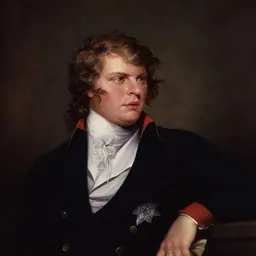
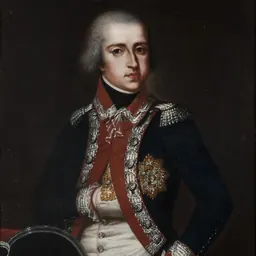

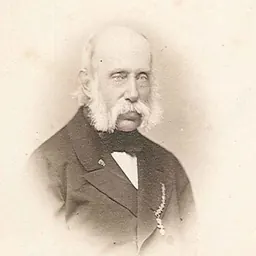
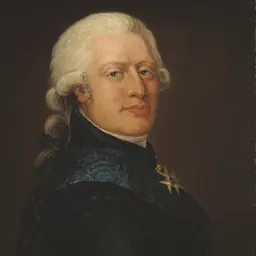
Contemporaries
People whose lives overlapped Louise of Mecklenburg-Strelitz's


Frequently asked questions
Who was Louise of Mecklenburg-Strelitz?
Queen consort of Prussia (1776–1810)
When was Louise of Mecklenburg-Strelitz born?
Louise of Mecklenburg-Strelitz was born on 10 March 1776 in Hanover.
When did Louise of Mecklenburg-Strelitz die?
Louise of Mecklenburg-Strelitz died on 19 July 1810 in Schloss Hohenzieritz.
What was Louise of Mecklenburg-Strelitz's occupation?
Louise of Mecklenburg-Strelitz was an aristocrat.
What nationality was Louise of Mecklenburg-Strelitz?
Louise of Mecklenburg-Strelitz was German.
Sources & further reading
· Wikipedia: Louise of Mecklenburg-Strelitz
· DBpedia: Louise of Mecklenburg-Strelitz
Cite this page
APA: Biography.guide. (2026). Louise of Mecklenburg-Strelitz. https://biography.guide/louise-of-mecklenburg-strelitz/
MLA: "Louise of Mecklenburg-Strelitz." Biography.guide, https://biography.guide/louise-of-mecklenburg-strelitz/.
Chicago: "Louise of Mecklenburg-Strelitz." Biography.guide. https://biography.guide/louise-of-mecklenburg-strelitz/.
Data last updated: 2026-09-27 · Spot an error? Report a correction.
Portrait: Wikimedia Commons · author & licence
Page generated 2026-10-04 11:33 UTC