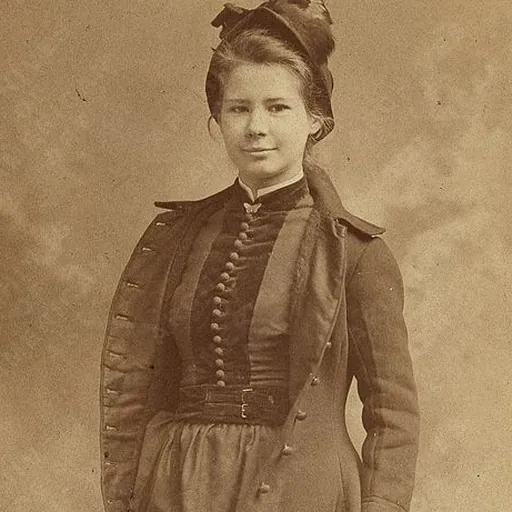
About Louise Cox
Lived 1865 – 1945 (aged 80). Louise Cox was an American painter and artist.
Louise Howland King Cox (June 23, 1865—1945) was an American painter known for her portraits of children. She won a number of prizes throughout her career, notably a bronze medal at the 1900 Paris Exposition and a silver medal at the 1901 Pan-American Exposition in Buffalo. to Anna Stott and James King. Her family moved to New York when she was a child. In 1880, when she was 14, Louise attended small school of Lucy McGuire in Dover, New Jersey. When she first attended art school she lived with her mother and sister Pauline.
On June 30, 1892, she wed her former teacher Kenyon Cox in Belmont, Massachusetts, at the home of her aunt, Mrs. B.M. Jones. Kenyon, who had thought he might be a lifelong bachelor, realized that he was in love with Louise, but he did not express his feelings for some time. They wrote long letters to each other during the period that she was a teacher in Toledo, Ohio.
That same year he declared her to be his best student. Kenyon Cox wrote his mother, "Long before I felt the thrill of love, I knew that she would make the best wife in the world for me if I should love her . . . When love came to add to the friendship and confidence, I felt safe and so we mean to marry as soon as we can."
They both exhibited their works at the National Academy of Design and the Society of American Artists. In April 1893, Louise suffered a miscarriage and the couple sailed for Europe about the SS Maasdam weeks before their first anniversary. The trip, partly for her emotional recuperation, included travel to Paris, Italy, and the Netherlands.
They had three children. Leonard, born in 1894 and named after Leonard Opdycke, was a war hero and had a career in city planning and architecture. Son Allyn, born two years later, became an artist, particularly noted for his mural paintings, and an interior decorator. Daughter Caroline born in 1898 was also a talented artist. Cox enjoyed gardening. She did not support the Women's suffragette movement. She lived in Honolulu, Hawaii by 1930 and as late as 1935. In 1940 she lived on Roaring Brook Road on New Castle, Westchester, New York. At that time she was 74 years of age and still operated and painted in a studio. She died December 11, 1945, in Windham, Connecticut. She was cremated, as was her husband Kenyon, and their ashes were scattered together at Cornish, New Hampshire where they spent their summers. During her time at the National Academy of Design, Louise Cox learned an academic style of painting, grounded in the style of Jean-Léon Gérôme (One of her instructors, Professor Lemuel Wilmarth, was taught by Gérôme). According to Cox, the Gérôme principles "were based on study, thoroughness, and self-discipline" and her "grounding in the Gérôme tradition prevented my taking on the arty methods in vogue". partially supported by a friend of her mother,
It was at the Art Students League that Louise Cox met her art instructor and future husband, Kenyon Cox. Having a solid reputation at the League, Kenyon Cox was selected as the 1885 instructor for the women's life class.
Career Cox's first renowned painting was The Lotus Eaters, which was displayed at the National Academy of Design in 1887, the Paris Exposition in 1889, In 1893 Cox displayed the painting, Psyche at an annual exhibition for the Society of American Artists. She was elected a member in the same year. The National Academy of Design awarded her the 1896 Third Hallgarten Prize for Pomona, and the 1904 Second Hallgarten Prize for The Sisters.
Beginning in 1896 Louise and Keynon Cox spent the summers with their children in the country's first major artist colony, the Cornish Art Colony in New Hampshire. At Cornish she made paintings of her children and local children, some of which were commissioned portraits.
She was elected an Associate of the National Academy of Design in 1902. Her works are in the National Gallery of Art in Washington, D.C.,
Awards 1896 — Third Hallgarten prize of the National Academy of Design for Pamona 1900 — Bronze medal at the Paris Universal Exposition 1903 — Julia Shaw Memorial prize from the Society of American Artists. Portrait of a Young Girl, oil, Lagakos-Turak Gallery, Philadelphia, Pennsylvania Portrait of Mrs. John Larkin, 1903 Portrait of the Artist's Daughter, oil on canvas, private collection Untitled {Young Man with Lute}, , pencil on paper, Smithsonian American Art Museum, Bequest of Allyn Cox
Don’t just read it —
keep it.
Full-length biographies made to live with: read them, listen on the way to work, watch them tonight.
- E-book
- Audio
- Video
Instant download · yours to keep · every purchase keeps this site free
Important facts
Family & relationships
People in Louise Cox's life
Named in this biography and alive at the same time



Related people
Same field, nearest in time

Contemporaries
People whose lives overlapped Louise Cox's


Frequently asked questions
Who was Louise Cox?
American painter (1865-1945)
When was Louise Cox born?
Louise Cox was born on 23 June 1865 in San Francisco.
When did Louise Cox die?
Louise Cox died on 11 December 1945 in Mount Kisco.
What was Louise Cox's occupation?
Louise Cox was a painter and artist.
What nationality was Louise Cox?
Louise Cox was American.
Sources & further reading
· DBpedia: Louise Cox (painter)
Cite this page
APA: Biography.guide. (2026). Louise Cox. https://biography.guide/louise-cox-painter/
MLA: "Louise Cox." Biography.guide, https://biography.guide/louise-cox-painter/.
Chicago: "Louise Cox." Biography.guide. https://biography.guide/louise-cox-painter/.
Data last updated: 2026-09-24 · Spot an error? Report a correction.
Portrait: Wikimedia Commons · author & licence
Page generated 2026-09-27 05:09 UTC