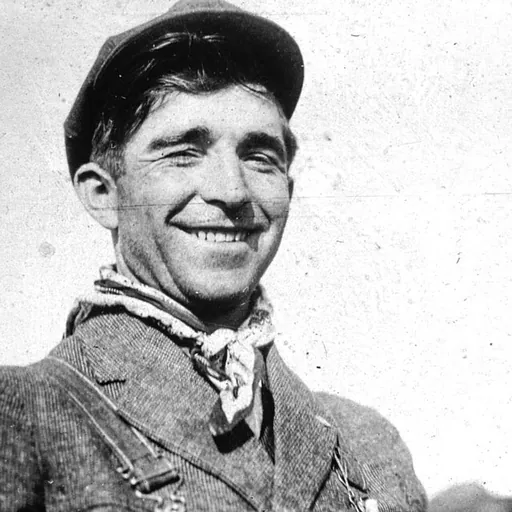
About Louis Tikas
Lived 1886 – 1914 (aged 28). Louis Tikas was a miner, union organizer and trade unionist.
Louis Tikas , born Elias Anastasios Spantidakis (; 13 March 1886 – 20 April 1914), was the main labor union organizer at the Ludlow camp during the 14-month strike known as the Colorado Coalfield War in southern Colorado, between September 1913 and December 1914; described as "the bloodiest civil insurrection in American history since the Civil War". He was shot and killed during the Ludlow Massacre, the bloodiest event of the strike, on 20 April 1914.
Biography
Tikas was born Elias Anastasios Spantidakis in Loutra, Crete, on 13 March 1886. In 1905, he participated in the Theriso revolt with Eleftherios Venizelos. Since his teenage years, Tikas was formed into a Greek nationalist. He later described his fellow Greek strikers in Ludlow as ready to fight "just as their fathers and brothers... have fought the Turks". After the revolt failed, he migrated to the United States in 1906.
In 1910, the year Tikas filed his citizenship papers in the United States, he was part owner of a Greek coffeehouse on Market Street in Denver. At the eve of the First Balkan War, he sought to travel to Greece in order to join the Greek Army. However, he could not do so because of family duties. One historian describes Tikas' attitude as "grinding his teeth" for being unable to go back to Greece.
By the end of 1912, he was an organizer for the United Mine Workers of America. In-between he worked as a miner–strikebreaker in Colorado's Northern (Coal) Field but ended up leading a walkout by sixty-three fellow Greeks at the Frederick, Colorado mine. Tikas was chased from the northern field, shot and wounded by Baldwin-Felts detectives as he escaped through the back door of a boarding house in Lafayette, Colorado in January 1910.
He was shot and killed during the Ludlow Massacre, the bloodiest event of the strike, on April 20, 1914, the day after (Greek Orthodox) Easter. Nineteen people were killed during the massacre, including two women and eleven children and one National Guardsman.
Tikas met with Major Pat Hamrock on the day of the massacre in response to allegations of a man being held against his will in the camp. The militia placed machine guns on the hills and Tikas, anticipating trouble, ran back to camp. But fighting broke out, lasting all day. By 7:00 pm, the camp was aflame. Tikas remained in the camp the entire day and was there when the fire started. Lieutenant Karl Linderfelt, a rival of Tikas' during much of the strike, broke the butt of his gun over Tikas' head. Tikas was later found shot to death, one bullet through his back, another in his hip, a third glancing off his hip and traveling vertically through his body; it was determined that he bled to death. The film Palikari honors his death.
A statue of Louis Tikas was dedicated at the Miner's Memorial on Mani Street in Trinidad, Colorado on June 23, 2018.
Ludlow Massacre
The Ludlow Monument, which was erected by the United Mine Workers of America; a statue of Louis Tikas can be seen on the left. Ceremony dedicating the Tikas Bronze in Trinidad, Colorado on 23 June 2018.
On 20 April 1914, while Tikas was meeting with Major Patrick J. Hamrock, the militia commander in charge of Company B, troopers—as instructed by superiors—located themselves atop Water Tank Hill, just south of Ludlow in response to spotting armed Greek miners milling about. Many armed colonists spotted the militiamen and moved to key points where they could closely watch activities atop the small hill. Other colonists feared something was awry and scurried about for cover. Suddenly the sound of rifle fire echoed through the nearby hills. Neither the militia nor the colonists knew who fired these shots, but an exchange of gunfire began, as both confused colonists and militiamen believed they were coming under attack.
The militia were badly outnumbered by the colonists, but had certain advantages, including a choice location and a machine gun. The spray from the gun drove armed strikers back toward the tents, and provided excellent coverage for guardsmen advancing toward the tents. Meanwhile, Company A reinforcements, along with Lt. Karl Linderfelt, arrived with another machine gun to offer support to Company B. The colonists now faced two automatic weapons and about 150 guardsmen. Machine gun and rifle fire forced women and children colonists to take refuge in storage cellars beneath the tents. This offered some protection but advancing guardsmen eventually forced the cellars' occupants to abandon the underground shelters and to evacuate to the east of the colony site to some hills locally called the "Black Hills" for protection. By late afternoon, it was clear that the militia would overrun the colony site, and everyone would have to abandon the site and join those who had already fled to the Black Hills. Meanwhile, a deserted tent burst into flames and, within a short time, more tents began to burn. At the same time, the militiamen overran and took command of the colony site.
By early morning, 21 April 1914, the colony site––previously covered by hundreds of tents––revealed nothing more than charred rubble remains of the tents. The bodies of two women and eleven children––victims of asphyxiation––were found huddled within a cellar. Five strikers, two other youngsters, and at least four men associated with the militia also died. Though the Ludlow battle ended on the night of 20 April 1914, sporadic violence continued for days after. Battles that took place at various coal camps claimed many more lives. In late April, federal troops moved into southern Colorado, almost immediately restoring peace. The strike, however, continued through early December, finally coming to an end without resolution. Despite the heavy loss of lives and property, the strikers' efforts and losses weren't entirely in vain. The effects of the strike and the violence encouraged state and federal lawmakers to pass legislation that, in the long run, would help hasten improvements in conditions for working miners.
The Ludlow Monument, erected by the United Mine Workers of America a couple years after the massacre, stands near the site to commemorate the dead strikers and their families.
Don’t just read it —
keep it.
Full-length biographies made to live with: read them, listen on the way to work, watch them tonight.
- E-book
- Audio
- Video
Instant download · yours to keep · every purchase keeps this site free
Important facts
People in Louis Tikas's life
Named in this biography and alive at the same time

Related people
Same field, nearest in time


Contemporaries
People whose lives overlapped Louis Tikas's


Frequently asked questions
Who was Louis Tikas?
Greek–American trade unionist
When was Louis Tikas born?
Louis Tikas was born on 13 March 1886 in Loutra.
When did Louis Tikas die?
Louis Tikas died on 20 April 1914 in Colorado.
What was Louis Tikas's occupation?
Louis Tikas was a miner, union organizer and trade unionist.
Sources & further reading
Cite this page
APA: Biography.guide. (2026). Louis Tikas. https://biography.guide/louis-tikas/
MLA: "Louis Tikas." Biography.guide, https://biography.guide/louis-tikas/.
Chicago: "Louis Tikas." Biography.guide. https://biography.guide/louis-tikas/.
Data last updated: 2026-09-23 · Spot an error? Report a correction.
Portrait: Wikimedia Commons · author & licence
Page generated 2026-09-27 05:06 UTC