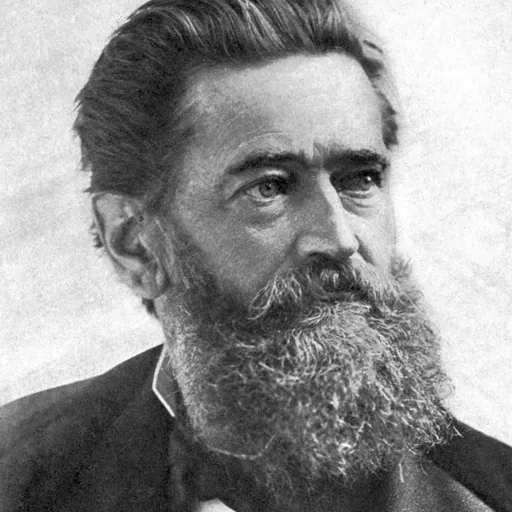
About Louis Prang
Lived 1824 – 1909 (aged 85). Louis Prang was an American lithographer and publisher.
Louis Prang (March 12, 1824 – June 15, 1909) was an American printer, lithographer, publisher, and Georgist. He is sometimes known as the "father of the American Christmas card".
Youth
Prang was born in Breslau in Prussian Silesia. His father Jonas Louis Prang was a textile manufacturer and of French Huguenot origin; his mother, Rosina Silverman, was German. Because of health problems as a boy, Prang was unable to receive much standard schooling and became an apprentice to his father, learning engraving, calico dyeing and printing. In the early 1840s, Prang travelled around Bohemia working in textiles, as well in Hagen, Westphalia studying the chemistry of printing. After some travel in Europe, he became involved in revolutionary activities in 1848. Pursued by the Prussian government, he went to Switzerland and in 1850 emigrated to the United States, settling in Boston, Massachusetts. Prang used numerous stones to produce each of his works, unlike his contemporaries. Between his use of materials, particular methodology and significant time commitment to his work, he was able to deliver an unprecedented level of quality, which resulted in the firm's ultimate success.
Prang's success producing war maps allowed him to amass the necessary funds to return to Europe and learn about new developments in German lithography in 1864. His ability to create such high-quality and accurate copies made him very popular, but also sparked a degree of controversy. Some praised Prang for making art more affordable, while others claimed he was detracting value from the original.
Prang also began creating series of popular album cards, advertised to be collected in scrapbooks, showing natural scenes and patriotic symbols. At Christmas 1873, Prang began creating greeting cards for the popular market in England and began selling the Christmas card in America in 1874; he is sometimes called the "father of the American Christmas card."
In June 1886, Prang published a series of prints under the title Prang's War Pictures: Aquarelle Facsimile Prints, aiming to portray the details of the war in such a way that was both accurate and appealing to the public. Prang was dedicated to using his art to educate and inspire others, so each print was accompanied by text detailing the historical details of the battle portrayed, as well as firsthand accounts of what occurred, many of which came directly from soldiers. This offered readers multiple avenues through which they could learn about and comprehend the magnitude of what transpired, and the series became very popular. They also helped inspire a genre of such prints, particularly the series issued by Kurz and Allison.
In 1897, L. Prang & Company merged with the Taber Art Company of New Bedford, Massachusetts, creating the Taber-Prang Company and moved to Springfield, Massachusetts.
Prang, the art supply brand that he founded, is now owned by Dixon Ticonderoga.
Prang died of pleuropneumonia on June 15, 1909, at the Glendale Sanitarium in Los Angeles. He is buried in Forest Hills Cemetery in Jamaica Plain, Massachusetts.
Louie Awards Since 1988, the Greeting Card Association, the trade association representing the greeting card industry in the US, has held an annual award ceremony for the best greeting cards published that year. The awards are called Louies in recognition of Louis Prang. The most successful winner of Louie Awards is Up With Paper - the original pop-up greeting card company.
As of 2023, Up With Paper has won over 100 coveted Awards.
Personal life On November 1, 1851, Prang married Rosa Gerber of Bern, Switzerland. Gerber assisted Prang in his movement from wood engravings to high quality book illustrations. Their union encouraged him to begin seeking avenues to popularize his art in America. She died on June 2, 1898, and on April 15, 1900, he married Mary Dana Hicks.
The Prangs became close with the family of neighbor Karl Heinzen following the marriage of Prang and Gerber. Heinzen was a journalist with known radical views, many of which he shared with personal friend Karl Marx. Prang did his best to remain unaffiliated with the image Heinzen projected in the interest of succeeding in the world of business. Prang's only child, Rosa Prang, married Heinzen's son Karl. Prang often supported Heinzen both financially and in the face of public criticism the latter faced, particularly from other Germans in the Boston area.
Lithographs
Don’t just read it —
keep it.
Full-length biographies made to live with: read them, listen on the way to work, watch them tonight.
- E-book
- Audio
- Video
Instant download · yours to keep · every purchase keeps this site free
Important facts
Family & relationships
People in Louis Prang's life
Named in this biography and alive at the same time

Related people
Same field, nearest in time



Contemporaries
People whose lives overlapped Louis Prang's




Frequently asked questions
Who was Louis Prang?
American printer (1824–1909)
When was Louis Prang born?
Louis Prang was born on 12 March 1824 in Wrocław.
When did Louis Prang die?
Louis Prang died on 14 September 1909 in Los Angeles.
What was Louis Prang's occupation?
Louis Prang was a lithographer and publisher.
What nationality was Louis Prang?
Louis Prang was American.
Sources & further reading
Cite this page
APA: Biography.guide. (2026). Louis Prang. https://biography.guide/louis-prang/
MLA: "Louis Prang." Biography.guide, https://biography.guide/louis-prang/.
Chicago: "Louis Prang." Biography.guide. https://biography.guide/louis-prang/.
Data last updated: 2026-09-22 · Spot an error? Report a correction.
Portrait: Wikimedia Commons · author & licence
Page generated 2026-09-27 05:04 UTC