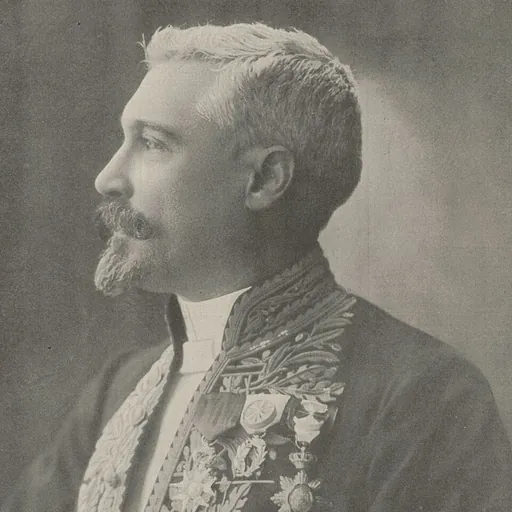
Louis Mouttet
Colonial Governor of Côte d'Ivoire; Colonial Governor of French Guiana; Colonial Governor of Martinique
About Louis Mouttet
Lived 1857 – 1902 (aged 44). Louis Mouttet was a French colonial administrator.
Louis Guillaume Mouttet (10 October 1857 – 8 May 1902) was a French colonial official who served as Governor of Côte d'Ivoire in 1898 and Governor of French Guiana from 1898 till 1901. Appointed Governor of Martinique in 1901, he was killed along with his wife in the eruption of Mount Pelee on 8 May 1902, which completely destroyed the city of St. Pierre.
Origins and early colonial career Born into a French Huguenot farming family of modest origins in Marseille, Mouttet espoused extremely radical socialist views in his early years. His parents were Jean Louis Victor Mouttet (†1884) and Augustine Rosalie (née Chandellier) (†1881).
Classified as an extreme leftist, he contributed articles to the Socialist Review and rubbed shoulders with Benoît Malon. He studied law in Paris, and worked briefly as a sub-editor on the staff of La Patrie before becoming secretary of the Historical Society of Paris.
In 1886, Mouttet joined the French Colonial Service with the support of Félix Faure and was sent to Senegal in May 1887 as a deputy bureau chief, second class. Owing to his initiative and abilities, he quickly gained promotion to Secretary of the Interior for the colony. He was transferred to French Indochina in May 1889 as chief of staff to the Governor-General, Jules Picquet. The following year, he married Marie de Coppet (1867–1902), the niece of the deputy of Le Havre, and was appointed a Chevalier of the Légion d'honneur that September. In 1892, he was appointed minister of internal affairs for Guadeloupe and appointed to the same position in Senegal in 1894. Becoming acting Governor of Senegal in 1895, he oversaw the amalgamation of Senegal, French Sudan, Guinea and the Ivory Coast into the union of French West Africa.
Catastrophe
At 7:15 the following morning, 8 May, Ascension Day, Mouttet boarded a steam launch along with three other members of his commission, excepting Gaston Landes. He set off at 7:40 for Precheur, a small town a mile south of St. Pierre, where he and the other members of the commission would decide if it needed to be evacuated. Around the same time, witnesses observed a strange hiccuping sound from the volcano and a drifting cloud of ash; one observer noted that the summit of the volcano was glowing bright red.
At 8:02, Mount Pelee exploded. Two simultaneous eruptions issued from the volcano; a cloud of ash and steam billowed into the sky. At the same instant, a tremendous pyroclastic surge exploded down the southwestern flanks of the mountain, obliterating two villages in its path, but just missing Precheur. At a speed of and at temperatures of 700 F (370 °C - according to other sources the temperature exceeded 1,075 °C), the surge struck St. Pierre with devastating force. All buildings in its path, as well as the city walls, were instantly demolished. In an instant, some 30,000 people were crushed, burned or asphyxiated to death by the superheated clouds of gases and steam. Gaston Landes, who had remained at his home just outside the surge cloud, was badly burnt and died a few hours later. The cloud spread through the ruins of the city for three minutes, engulfing it in a sea of fire. The cloud then struck the waterfront with terrific force, setting several ships afire.
Legacy Mouttet's legacy suffered after the disaster. Many blamed him for his poor handling of the situation. Some historians have criticised his refusal to evacuate the city in order not to alarm public opinion or give arguments to the local opposition, who were calling for urgent measures.
Don’t just read it —
keep it.
Full-length biographies made to live with: read them, listen on the way to work, watch them tonight.
- E-book
- Audio
- Video
Instant download · yours to keep · every purchase keeps this site free
Important facts
People in Louis Mouttet's life
Named in this biography and alive at the same time

Related people
Same field, nearest in time




Contemporaries
People whose lives overlapped Louis Mouttet's


Frequently asked questions
Who was Louis Mouttet?
Colonial Governor of Côte d'Ivoire; Colonial Governor of French Guiana; Colonial Governor of Martinique (1857–1902)
When was Louis Mouttet born?
Louis Mouttet was born on 6 October 1857 in Marseille.
When did Louis Mouttet die?
Louis Mouttet died on 8 May 1902 in Saint-Pierre.
What was Louis Mouttet's occupation?
Louis Mouttet was a colonial administrator.
What nationality was Louis Mouttet?
Louis Mouttet was French.
Sources & further reading
Cite this page
APA: Biography.guide. (2026). Louis Mouttet. https://biography.guide/louis-mouttet/
MLA: "Louis Mouttet." Biography.guide, https://biography.guide/louis-mouttet/.
Chicago: "Louis Mouttet." Biography.guide. https://biography.guide/louis-mouttet/.
Data last updated: 2026-09-22 · Spot an error? Report a correction.
Portrait: Wikimedia Commons · author & licence
Page generated 2026-09-27 05:03 UTC