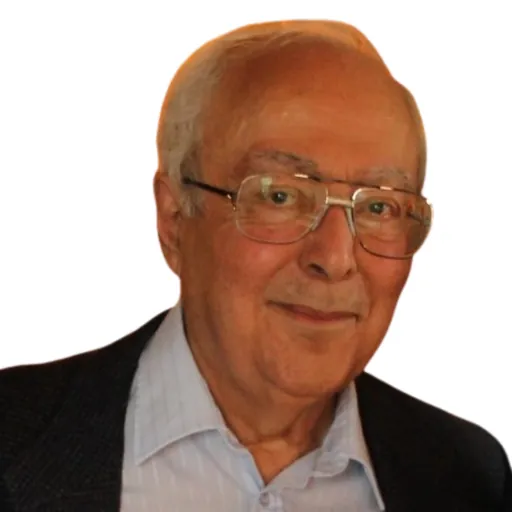
About Lorne Elias
Lorne Elias was a chemist and inventor, known for Explosives detection.
Lorne Elias is a Canadian chemist, inventor, and a pioneer in explosives detection technology. He invented the explosives vapour detector, EVD-1, a portable bomb detection instrument deployed at international airports in Canada in the 1980s. He contributed to the field of explosives detection for over three decades, and is called the father of vapour and trace explosives detection technology.
Education
Lorne Elias obtained a Bachelor of Science in chemistry from Carleton University in 1952. He received a PhD in physical chemistry under the direction of H. Schiff from McGill University in 1956.
Career and research Elias conducted research on trace organic analyses at National Research Council Canada, from pesticides to narcotics and explosives. He invented the portable suitcase-sized explosives vapour detector, EVD-1, and the Trace Narcotics Detector. EVD-1 was based on gas chromatography with electron capture detector, and the Trace Narcotics Detector was based on gas chromatography with nitrogen-phosphorus detector. one of the 100 notable innovations from National Research Council Canada, and one of 50 Greatest Canadian Inventions. EVD-1 was capable of detecting minute amounts of dynamite, other explosives, and 2,3-Dimethyl-2,3-dinitrobutane (DMNB, a taggant or marker in plastic explosives). Similarly, the EVD-1 detected signatures of black powder from the revolver of a security guard during President Reagan's visit to Canada. The EVD-1 technology was transferred from National Research Council Canada to industry, and units of EVD-1 were deployed at international airports in Canada after the 1985 Air India bombing. Elias, a pioneer who shaped the development of explosives detection technology deployed today, is called the father of vapour and trace explosives detection technology.
Elias was part of the International Civil Aviation Organization Ad Hoc Group of Specialists on the Detection of Explosives. He contributed in the development and evaluation of the ICAO detection markers for plastic explosives, which led to the Convention on the Marking of Plastic Explosives for the Purpose of Detection. and their vapour pressures, and conducted research in encapsulating DMNB in order to extend the shelf life.
He retired from National Research Council Canada after 35 years, for a number of government departments, including the U.S. Federal Aviation Administration, Transport Canada, and the Canadian Explosives Research Laboratory of Natural Resources Canada. Trace vapor concentrator (1987) US 4,698,071A Method and Apparatus for the Introduction of a Vaporizable Sample into an Analytical Test Apparatus (1988) US 4,732,046A Sorbent Tube Trace Sample Releasing Apparatus (1990) US 4,890,502A Trace vapour concentrator (1990) CA 1,266,621A Method for Testing the Freshness of Fish (1990) US 4,980,294A Method of determining wood species (1991) CA 2,009,062A1 Thermally-Releasable-Sample Collecting Device (1993) US 5,181,427A Method and apparatus for the detection of a hidden element exuding vapor (2001) WO2001092850A1
Don’t just read it —
keep it.
Full-length biographies made to live with: read them, listen on the way to work, watch them tonight.
- E-book
- Audio
- Video
Instant download · yours to keep · every purchase keeps this site free
Important facts
Related people
Same field, nearest in time



Frequently asked questions
Who was Lorne Elias?
Canadian chemist, inventor
What was Lorne Elias's occupation?
Lorne Elias was a chemist and inventor.
What was Lorne Elias known for?
Lorne Elias was known for Explosives detection.
Sources & further reading
Cite this page
APA: Biography.guide. (2026). Lorne Elias. https://biography.guide/lorne-elias/
MLA: "Lorne Elias." Biography.guide, https://biography.guide/lorne-elias/.
Chicago: "Lorne Elias." Biography.guide. https://biography.guide/lorne-elias/.
Data last updated: 2026-09-21 · Spot an error? Report a correction.
Portrait: Wikimedia Commons · author & licence
Page generated 2026-09-27 04:59 UTC