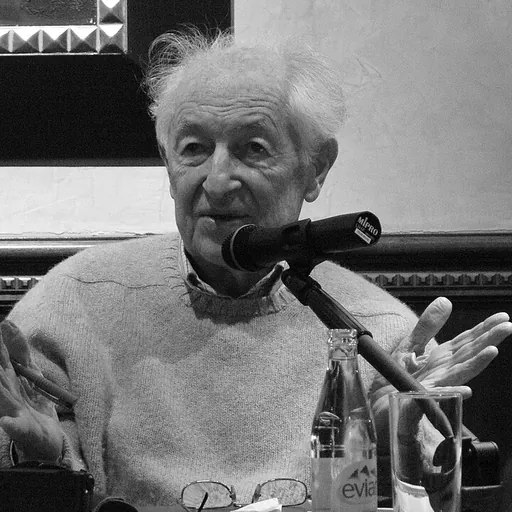
About Lorand Gaspar
Lived 1925 – 2019 (aged 94). Lorand Gaspar was a Hungarian and French poet, surgeon, translator, photographer, historian and writer.
Lorand Gaspar (28 February 1925, in Târgu Mureș – 9 October 2019, in Paris) was a Hungarian–born French poet.
Life Gaspar was born in February 1925 in Târgu Mureș, Romania. In 1943, he enrolled at Palatine Joseph University of Technology and Economics (today: Budapest University of Technology and Economics) in Engineering, was mobilized months later, and then imprisoned in a labor camp. He escaped in March 1945, and surrendered to the French in Pfullendorf.
He moved to France, where he studied medicine, becoming later a surgeon in France, then in Jerusalem, where he lived for sixteen years, and in Bethlehem and Tunis. He lived in Paris, where he was involved in medical research dealing with human psychology.
He published his first verse collection in 1966, Le Quatrième État de la matière (Flammarion) and published a number of prose works and travel books as a photographer.
He mastered several languages: to the languages learned as a child, Hungarian, Romanian and German, and later French, English, Latin, Greek and Arabic. He translated (in collaboration with Sarah Clair), Spinoza, Rilke, Seferis, D. H. Lawrence, Peter Riley, and Pilinsky.
Gaspar died in Paris in October 2019 at the age of 94.
Awards 1998 Prix Goncourt de la Poésie
Works
English Translations "from Nuits: An evening in front of the fireplace at Saint Rémy du Val", Jacket 14, translated by Peter Riley, July 2001
Earth Absolute & Other Texts, translated by Mary Ann Caws and Nancy Kline, New York: Contra Mundum Press, 2015. "Leaving Sidi Bou Said",The Fortnightly Review - New Series, translated by Amine Mouaffak and Sahar Taghdisi Rad, January 2019
French Language Works Le Quatrième État de la matière Paris: Flammarion, 1966. Prix Apollinaire, 1967. Gisements Paris: Flammarion, 1968. Histoire de la Palestine Paris : Maspero, 1968 et 1978. Palestine, année zéro Paris : Maspero, 1970. Sol absolu, Paris : Gallimard, 1972.
Approche de la parole, Paris, Gallimard, 1978. Corps corrosifs, Fata Morgana, 1978. Egée suivi de Judée, Paris, Gallimard, 1980.
Feuilles d'observation. Paris : Gallimard, 1986. Carnets de Patmos. Cognac : Le Temps qu'il fait, 1991. Égée, Judée, suivi d’extraits de Feuilles d’observation et de La maison près de la mer. Paris : Gallimard, 1993. Apprentissage. Paris : Deyrolle, 1994. Carnets de Jérusalem, Cognac, Le temps qu'il fait, 1997. Patmos et autres poèmes. Paris : Gallimard, 2001. Derrière le dos de Dieu. Paris : Gallimard, 2010.
Don’t just read it —
keep it.
Full-length biographies made to live with: read them, listen on the way to work, watch them tonight.
- E-book
- Audio
- Video
Instant download · yours to keep · every purchase keeps this site free
Important facts
People in Lorand Gaspar's life
Named in this biography and alive at the same time


Related people
Same field, nearest in time


Contemporaries
People whose lives overlapped Lorand Gaspar's



Frequently asked questions
Who was Lorand Gaspar?
French poet (1925–2019)
When was Lorand Gaspar born?
Lorand Gaspar was born on 28 February 1925 in Târgu Mureș.
When did Lorand Gaspar die?
Lorand Gaspar died on 9 October 2019 in 6th arrondissement of Paris, Paris.
What was Lorand Gaspar's occupation?
Lorand Gaspar was a poet, surgeon, translator, photographer, historian and writer.
What nationality was Lorand Gaspar?
Lorand Gaspar was Hungarian and French.
Sources & further reading
Cite this page
APA: Biography.guide. (2026). Lorand Gaspar. https://biography.guide/lorand-gaspar/
MLA: "Lorand Gaspar." Biography.guide, https://biography.guide/lorand-gaspar/.
Chicago: "Lorand Gaspar." Biography.guide. https://biography.guide/lorand-gaspar/.
Data last updated: 2026-09-20 · Spot an error? Report a correction.
Portrait: Wikimedia Commons · author & licence
Page generated 2026-09-27 04:57 UTC