
About Loo, Kington
Lived 1930 – 2003 (aged 72). Loo, Kington was a Malaysian architect.
Kington Loo (17 October 1930 – 21 March 2003) was an architect in Malaysia who belongs to the group who brought modernism to Southeast Asia in the wake of World War II. The firm he worked for, Booty and Edwards, became a leader in the region. His mother, Lok Soh June, was an accomplished piano player and was the sixth daughter of millionaire businessman Loke Chow Kit; his father, the engineer Yuson Loo, was the great-grandson of prominent businessman Loke Yew. He was married and had a daughter, Ysa Loo.
Early life
Kington Loo lived in various parts of South East Asia before he settled professionally in Malaya. He was educated in Batu Road School in Kuala Lumpur. Before he reached 13, like many in the area, his life was disrupted by the Japanese invasion. The family relocated to a rubber estate in Ulu Langat, Selangor. Later, they moved to Singapore thinking, erroneously, that it would avoid Japanese occupation. When Singapore was threatened, the family moved again, to India, leaving Yuson Loo behind as all non-disabled men were not allowed to leave. After that, the incomplete family decided to walk across the Himalayas to start a new life in China. However, the Japanese invasion of Burma unsettled the entire region, and the Loos remained in India. Loo continued his studies, and he learned Hindi and Urdu. His father rejoined the family while working as an engineer in the US Army. Kington Loo went to St Columbas High School until Junior Cambridge when the family moved to Delhi, during the great famine of 1945.
At war's the end, the family returned to Kuala Lumpur where Kington Loo started his Form Four at the Victorian Institution. In 1947, Loo finished his studies and joined the Government Commercial Day School where they learned typing, shorthand and book-keeping. His parents could not send him overseas for further studies, so Loo spent a year and a half in a civil engineering course at Technology College; Malaya had no architecture courses at the time. Loo's great-grandmother, Loke Yew, decided to finance his studies and he went to Australia to study architecture at the University of Melbourne. He excelled as a student and won the internal competition to design the Dean of Architecture's holiday house. The university now confers the Kington Loo Prize award to the best design student.
University Malaya's Experimental Theater
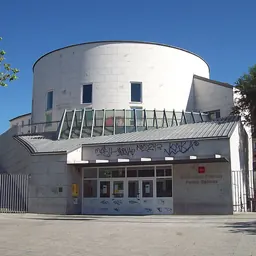
The modern campus of the University Malaya included many significant structures, including the bulky Dewan Tunku Canselor Building. This building in turn included the experimental theatre. It was first open for its convocation ceremony in 1966, and Kington Loo is considered as the hand behind its design. The building's mark has always been its age and its ability to endure while adapting to changing times. The Dewan Tunku Canselor is an example for the brutalist architecture of the 1950s and 1960s, due to its bare concrete structure, use of egg-crate reinforced concrete and béton brut imprints on the poured concrete, which covers the entire building. The use of high grade reinforced concrete for the superstructure also means that the building is structurally very hardy. It caught fire on 29 June 2001 and the experimental theatre was not in use for a decade until the completion of a recent renovation. Although it was badly damaged by the fire, the building still maintained its main structure. The Theater was named a National Heritage site in 2009.
The experimental theatre had consisted of a classical theatrical plan with an arena stage and a proscenium stage. The theatre's trademark was a motorised arena stage, which at that time was the only one in Malaysia. The University of Malaya was the centre of an arts scene in the early seventies. The Experimental Theatre was once known as the premier avant garde venue for modern theatre including stagings of Naga Naga and The Crucible.
Private residences
In 1958, Loo designed his own bungalow house, known as Kington Loo's house. The house was located on Girdle Road, Kenny Hill, and some described it as resembling “a startled tropical bird”. The structure was made of timber and brickwork masonry, and sported a pitched roof which harkened back to Malaya's pre-war colonial traditions. Yet the house's unusual geometry and its V-shaped columns placed it firmly within the modernist tradition. In 1961, Loo together with C.H.R Bailey designed another ‘bungalow’, the Brunei house, the Sultan of Brunei gave the commission to Booty, Edwards and Partners with the stipulation that it be finished within fifty-five days. It cost $600,000 and it was awarded the RIBA Bronze medal. More of a “istana” that a bungalow, the mansion was able to breathe with its system of natural ventilation, that included metal grillwork, glass louvres, along with shading hoods, canopies and overhangs, and both vertical and horizontal fins. The Borneo house has a perfectly square floor plan with spacious verandahs on all sides.
Dayabumi complex
The Dayabumi Complex, also known as Menara Dayabumi, was a 35-storey building located on Jalan Sultan Hishamuddin, Kuala Lumpur, Malaysia. It was completed in February 1984, and houses several commercial facilities. Although it was one of the earliest skyscrapers in Malaysia, it still remains as a famous landmark due to its architecture. It was designed by BEP (Kington Loo) as well as Akitek MAA, He was an active man and he became president of the Selangor Club. He was a chairman of Bukit Bintang MCA.
In 1962, Loo was elected as the first local (non-British) president of the Federation of Malaya Society of Architects (FMSA) and he served as president until 1973. Furthermore, he assisted BAM in the revision of the Code of Professional Conduct and the Architect's Rules.
Loo donated his time and services to other causes as well. He displayed a strong commitment to the natural environment as he complained about the development of Kuala Lumpur that caused pollution in drains and river when he became the president of the Malaysian Institute of Architects (PAM). He was the chairman of the Malaysian Zoological Society, as well as the founding trustee of the World Wide Fund for Nature Malaysia (WWFM). Additionally, he was passionate about the arts and served as chairman of the Malaysian Arts Council and he was on the working committee for the National Art Gallery.
Don’t just read it —
keep it.
Full-length biographies made to live with: read them, listen on the way to work, watch them tonight.
- E-book
- Audio
- Video
Instant download · yours to keep · every purchase keeps this site free
Important facts
People in Loo, Kington's life
Named in this biography and alive at the same time

Related people
Same field, nearest in time



Contemporaries
People whose lives overlapped Loo, Kington's


Frequently asked questions
Who was Loo, Kington?
Malaysian architect
When was Loo, Kington born?
Loo, Kington was born on 17 October 1930.
When did Loo, Kington die?
Loo, Kington died on 21 March 2003.
What was Loo, Kington's occupation?
Loo, Kington was an architect.
What nationality was Loo, Kington?
Loo, Kington was Malaysian.
Sources & further reading
Cite this page
APA: Biography.guide. (2026). Loo, Kington. https://biography.guide/loo-kington/
MLA: "Loo, Kington." Biography.guide, https://biography.guide/loo-kington/.
Chicago: "Loo, Kington." Biography.guide. https://biography.guide/loo-kington/.
Data last updated: 2026-09-20 · Spot an error? Report a correction.
Page generated 2026-09-27 05:15 UTC