
About Lokua Kanza
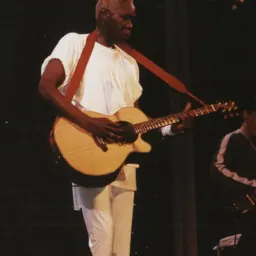
Born 1958. Lokua Kanza is a Congolese singer, composer, songwriter, guitarist, jazz guitarist and musician.
Pascal Lokua Kanza (born 21 April 1958) is a Congolese singer, songwriter, arranger, producer, philanthropist, television personality, and multi-instrumentalist. He is known for his soulful, folksy sound, which is atypical of the dancefloor-friendly African rumba music. He sings in French, Swahili, Lingala, Portuguese, English, and Wolof. He was a member of the coaching panel of the Voice Afrique Francophone from 2016 to 2017.
Kanza began his career as a guitarist in Abeti Masikini's band Les Redoutables in 1977 and later moved to Ivory Coast, where he worked with Best Orchestra. In 1984, Kanza relocated to Paris, where he emerged as a significant figure within the French world music scene. His eponymous debut solo album, Lokua Kanza, released in 1992, catapulted him to stardom and won the Best African Album at the African Music Awards.
Throughout his life in Kinshasa, Kanza received his education under his father's guidance at the National Institute of Arts (l'Institut National des Arts), which served as a hub for nurturing and training performance artists in Kinshasa, where he honed his skills. In 1977, Australian musicologist Gerhard Kubik and Malawian musician Donald Kachamba visited him and his classmate, Magongo Sanga, at the institute. They found that Kanza's father had collected 78 rpm records since 1948, which deeply influenced Kanza's skill on the guitar and his vocal harmonies in local church choirs.
After completing his secondary studies, Kanza joined Abeti Masikini's band Les Redoutables as a guitarist. Sources differ regarding the exact date of his entry into the band, with some citing 1980,
From 1984 through the latter part of the 1980s, he performed and sang with Ray Lema, contributing to two of Lema's albums — Bwana Zoulou Gang (1987) and Nangadeef (1989), and in 1988, worked with several French musicians, including Charlélie Couture, Jacques Higelin, and Alain Bashung. In 1991, he teamed up with Cameroonian singer Manu Dibango and his Soul Makossa Gang, which helped kickstart his solo career. During this time, he met his backing singer Julia Sarr from Senegal and percussionist Didi Ekukuan, with whom he remained closely affiliated. The album saw its release in October of that year through RCA Records with distribution by BMG France. L'Événement du jeudi, a French weekly magazine, lauded Wapi Yo as "one of the most beautiful things to happen to African music."
In October 1995, Kanza performed at the Théâtre de la Ville in Paris for a sold-out week, becoming the first Congolese solo artist to do so since Papa Wemba in February 1990. In November, he collaborated with Ugandan artist Geoffrey Oryema on his third studio album, Night To Night, serving as the bassist on four tracks. Kanza's work as an arranger on Papa Wemba's album Emotion was awarded in December during the new edition of the African Music Awards, held in Libreville, Gabon. On 1 April 1996, he performed at Olympia Hall and continued to participate in significant spring festivals, from Bourges to Angoulême. On 13 July, the Francofolies festival in La Rochelle held "La Fête à Lokua", a soirée where Kanza appeared alongside Youssou N'Dour and Papa Wemba.
In 1997, Kanza toured the United States, holding multiple concerts early in the year. He was invited by Brazilian singer Djavan Caetano Viana to take part in the Festival de Todos os Sons (Festival of All Sounds) in Curitiba that April. Lokua Kanza 3 came out in the fall under RCA Records, with added orchestral components, including strings that enriched the overall sound. Lyrics were performed in Lingala, Swahili, French, and English, and the record explored diverse themes linked to everyday life. He also appeared on Portuguese singer Sara Tavares' second studio album Mi Ma Bô on tracks such as "I've Got a Song in My Heart" and "Tu És O Sol". Toyebi Té was officially released in June 2002 with 16 tracks and was a compendium of folk ballads sung in English, French, and Lingala. and later made a guest appearance in the debt relief compilation project, Drop the debt, alongside a collective of African and Latin American artists, such as Meiway, Tiken Jah Fakoly, Aladji Ndiaye, and Zêdess. Produced by Seydoni Productions, Drop the debt focused on alleviating debt for underprivileged nations and encouraging artists to push for global equality. followed by two sold-out consecutive concerts in Yaoundé and Douala in October of that year. In November 2003, he performed in Luanda alongside the Brazilian singer Milton Nascimento. Released in April under the No Format! label in Paris, Le Monde praised the album as a "perfect dream of freshness, lightness and sweetness, with its silky voices and fluid guitars....".
2005–2016: from Plus vivant to "Lampedusa" On 14 February 2005, Kanza released his 15-track sixth studio French album titled Plus Vivant. Co-arranged with Sylvain Luc, the album was co-produced by Universal Music and EmArcy Records. Kanza teamed up with Canadian singer Corneille on lead vocals and provided backing vocals with Valérie Belinga, Aretha Lokua, René Lokua, Anne Papiri, and Stephy Lokua. The bass was played by Guy Nsangué and Richard Bona, drums by Manu Katché, guitar by Sylvain Luc, keyboards by Vincent Bruley, percussion by Komba Bellow and Sola Akingbola, piano by Bertrand Richard, and violin by Jean-Luc Deschamps. In November 2005, Kanza composed three songs for Brazilian singer Gal Costa's thirtieth studio album, Hoje.
In May 2006, Kanza contributed as a guest artist to the No Child Soldiers project—an album dedicated to combating the use of child soldiers in Africa, alongside Alpha Blondy, Angélique Kidjo, Salif Keita, Ben Okafor, Tété, Corneille Nyungura, Aïcha Koné, Rokia Traoré, Youssou N'Dour, Madéka, Bibie, Mama Keïta, Extra Bokaya, and Geoffrey Oryema. In 2007, he relocated to Brazil, where he devoted several years to further advancing his career. While in Brazil, he composed songs for various artists, most notably Ney Matogrosso and Vanessa de Mata. That same year, he worked on Koffi Olomidé's album Bord Ezanga Kombo. Nkolo includes two duets, one with the Brazilian artist Vander Lee and the other with Fally Ipupa. and later performed at the N'Sangu Ndji-Ndji music festival in Brazzaville. In October 2012, he received a nomination at the Ndule Awards in Abidjan. In February 2014, he participated at the Amani Festival in Goma, alongside Lexxus Legal and Innoss'B. On 31 May and 1 June 2014, Kanza celebrated his 20-year solo career by giving two concerts: one at the Théâtre de la Verdure and the other on the stage of the eighth edition of the International Jazz Festival also in Kinshasa. He was accompanied on stage by Richard Bona, Jean Goubald Kalala, Sara Tavares, Fally, Olivier Tshimanga, and Malaika Lokua.
In October 2016, Kanza became a member of the coaching panel for The Voice Afrique Francophone, alongside A'Salfo from Magic System, Charlotte Dipanda, and Singuila. In an interview with Deo Salvator of Guitar magazine, Kanza mentioned that Moko signifies peace, unity, and harmony. The album was recorded across 12 countries and features vocals in 14 languages. It includes guest appearances by Manu Dibango, Richard Bona, Wasis Diop, Paco Séry, Sidiki Diabaté, Charlotte Dipanda, Pamela Baketana, Grady Malonda, and Ray Lema. Moko was officially launched on 21 April 2021 through a joint production by Nzela Productions and Universal Music Africa. The album's standout single "Tout va bien", a tribute to life and love, received widespread acclaim. On 17 March 2022, Kanza appeared on the song "Leopards Fimbu International" in support of Les Léopards during the 2022 FIFA World Cup African qualifiers' playoff round. Other artists involved in "Leopards Fimbu International" included Félix Wazekwa, Flaety W. Manuke, Kadiyoyo, JB Mpiana, Barbara Kanam, Koffi Olomide, Cindy Le Cœur, Héritier Watanabe, Laetitia Lokua, Adolphe Dominguez, Werrason, Lemiran LEM, Kristy Diamond, Ferré Gola, and Innoss'B. In July 2022, Kanza became a member of the Recording Academy, the body that oversees the Grammy Awards.
Discography Over the years, Lokua Kanza has continued to release a series of successful albums, including: Lokua Kanza (1993, YE WO Music) Wapi Yo (1995, RCA and BMG) Lokua Kanza 3 (1998, Universal) Toyebi Te (2002, Universal Music) Toto Bona Lokua (2004, No Format!) with Richard Bona & Gerald Toto Plus Vivant (2005, Universal Music and EmArcy Records) Nkolo (2010) Moko (2021)
Awards and nominations
Don’t just read it —
keep it.
Full-length biographies made to live with: read them, listen on the way to work, watch them tonight.
- E-book
- Audio
- Video
Instant download · yours to keep · every purchase keeps this site free
Important facts
People in Lokua Kanza's life
Named in this biography and alive at the same time



Related people
Same field, nearest in time



Contemporaries
People whose lives overlapped Lokua Kanza's


Frequently asked questions
Who is Lokua Kanza?
singer-songwriter
When was Lokua Kanza born?
Lokua Kanza was born on 22 April 1958 in Bukavu.
What is Lokua Kanza's occupation?
Lokua Kanza is a singer, composer, songwriter, guitarist, jazz guitarist and musician.
What nationality is Lokua Kanza?
Lokua Kanza is Congolese.
Sources & further reading
Cite this page
APA: Biography.guide. (2026). Lokua Kanza. https://biography.guide/lokua-kanza/
MLA: "Lokua Kanza." Biography.guide, https://biography.guide/lokua-kanza/.
Chicago: "Lokua Kanza." Biography.guide. https://biography.guide/lokua-kanza/.
Data last updated: 2026-09-20 · Spot an error? Report a correction.
Page generated 2026-09-27 05:20 UTC