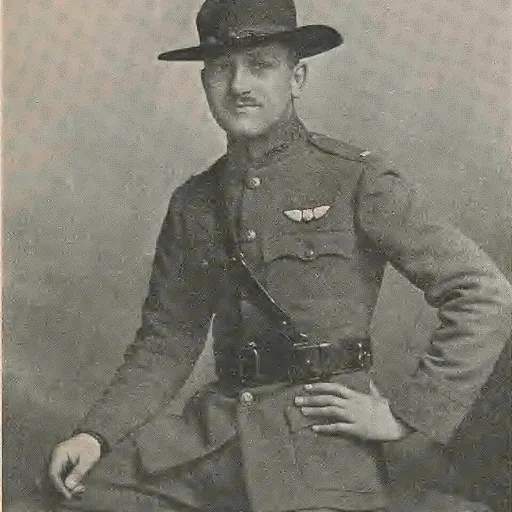
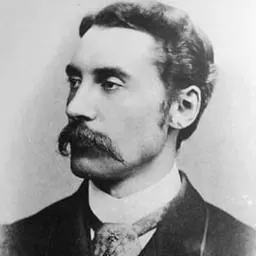
Lloyd Hamilton
American flying ace
About Lloyd Hamilton
Lived 1894 – 1918 (aged 24). Lloyd Hamilton was an American airman.
First Lieutenant Lloyd Andrews Hamilton (13 June 1894 – 24 August 1918) was an American World War I flying ace credited with ten aerial victories. During five months of 1918 he became an ace with the Royal Air Force (RAF) and then again with the United States Air Service (USAS). Hamilton Air Force Base is named after him.
Early life Lloyd Andrews Hamilton was born in Troy, New York, the only child of Methodist minister Reverend John A. Hamilton and his wife Jennie Andrews Hamilton. on 28 April and in May he reported to Plattsburgh, New York, for officer training. He first scored as a combat pilot on 11 April 1918, flying the Sopwith Camel against his first German opponent, an LVG C.VI observation aircraft. The next day he made his second aerial kill; his third a week later. On 20 April he was flying at the tail end of 'C' flight when his commander Richard Raymond-Barker was attacked and killed by Manfred von Richthofen, known as the Red Baron. From far away Hamilton saw Richthofen shoot down a second aviator (who crashed but lived), then Hamilton was near enough to engage a blue Fokker Dr.I triplane, expending more than 300 rounds at it after which it went into a dive and spin, but Hamilton's own maneuvers prevented him from seeing what happened to it. Hamilton returned to base and claimed a kill but it was never confirmed—all of Richthofen's flight had returned safe from the engagement. On 3 June 1918, Hamilton became an ace, scoring his fifth confirmed victory.
Hamilton was assigned to the USAS 17th Aero Squadron to help them complete their training. When they moved into combat, he was one of their Flight Commanders. In his service he downed three enemy aircraft and two observation balloons, becoming a double ace—once flying under RFC command and once again for USAS. His first USAS victory on 7 August was during an offensive patrol; the squadron was flying high at when they noticed eight Fokker D.VIIs well below them over Armentières. The 17th squadron dove to attack and Hamilton downed an enemy aircraft after firing 200 rounds.
On Hamilton's final mission he was paired with Lt. Jesse F. Campbell to bomb and strafe transports along the Bapaume–Cambrai road, to strafe enemy troops in retreat and to attack an observation balloon that had been spotted to the north. After dropping their bombs on a small building and transports, Campbell and Hamilton turned to bust the balloon. Hamilton sprayed the balloon with machine gun rounds, and its German observer officer was seen to jump from the basket as the balloon exploded in flame. Hamilton was then killed by defensive fire from ground forces.
Legacy
Hamilton scored five victories each in 3 Squadron RAF and in the 17th Aero Squadron. He shared some of his victories teamed with such other aces as Douglas John Bell, William Tipton, Adrian Franklyn, Will Hubbard, and Robert Miles Todd.
Hamilton's body was laid to rest at Pittsfield Cemetery in Pittsfield, Massachusetts. His father mentioned Hamilton in Sunday sermons for many years after the war.
In July 1932, the new military airfield at Novato, California was named Hamilton Field in tribute. In April 1934, a plaque was emplaced to commemorate him.
Honors and awards Distinguished Service Cross (DSC)
The Distinguished Service Cross is presented to Lloyd A. Hamilton, First Lieutenant (Air Service), U.S. Army, for extraordinary heroism in action at Varssenaere, Belgium, August 13, 1918. Leading a low bombing attack on a German aerodrome, 30 miles behind the line, Lieutenant Hamilton destroyed the hangars on the north side of the aerodrome and then attacked a row of enemy machines, flying as low as 20 feet from the ground despite intense machine-gun fire, and setting fire to three of the German planes. He then turned and fired bursts through the windows of the chateau in which the German pilots were quartered, 26 of whom were afterwards reported killed. General Orders No. 20, W.D., 1919.
Distinguished Flying Cross (DFC)
On 13 August 1918, Lt. Hamilton led a flight on a mission against Varssenaere aerodrome. He dropped four bombs from 200 feet on aeroplane hangars, recording two hits. He then used machine guns on the German officers' billets and made four circuits of the aerodrome. On the first circuit, he shot one enemy aircraft on the ground, which caught fire. On the third circuit, he shot a Fokker biplane, which also caught fire. On 7 August 1918, he destroyed a Fokker biplane over Armentières. On 12 July, he brought down two enemy aircraft and on two other occasions drove down enemy machines.
Don’t just read it —
keep it.
Full-length biographies made to live with: read them, listen on the way to work, watch them tonight.
- E-book
- Audio
- Video
Instant download · yours to keep · every purchase keeps this site free
Important facts
People in Lloyd Hamilton's life
Named in this biography and alive at the same time





Related people
Same field, nearest in time

Contemporaries
People whose lives overlapped Lloyd Hamilton's


Frequently asked questions
Who was Lloyd Hamilton?
American flying ace
When was Lloyd Hamilton born?
Lloyd Hamilton was born on 13 June 1894 in Troy.
When did Lloyd Hamilton die?
Lloyd Hamilton died on 24 August 1918 in Lagnicourt-Marcel.
What was Lloyd Hamilton's occupation?
Lloyd Hamilton was an airman.
What nationality was Lloyd Hamilton?
Lloyd Hamilton was American.
Sources & further reading
· DBpedia: Lloyd Andrews Hamilton
Cite this page
APA: Biography.guide. (2026). Lloyd Hamilton. https://biography.guide/lloyd-hamilton/
MLA: "Lloyd Hamilton." Biography.guide, https://biography.guide/lloyd-hamilton/.
Chicago: "Lloyd Hamilton." Biography.guide. https://biography.guide/lloyd-hamilton/.
Data last updated: 2026-09-23 · Spot an error? Report a correction.
Portrait: Wikimedia Commons · author & licence
Page generated 2026-09-27 05:07 UTC