Lizzie van Zyl
South African child prisoner
About Lizzie van Zyl
Lived 1894 – 1901 (aged 7). Lizzie van Zyl was a South African child.
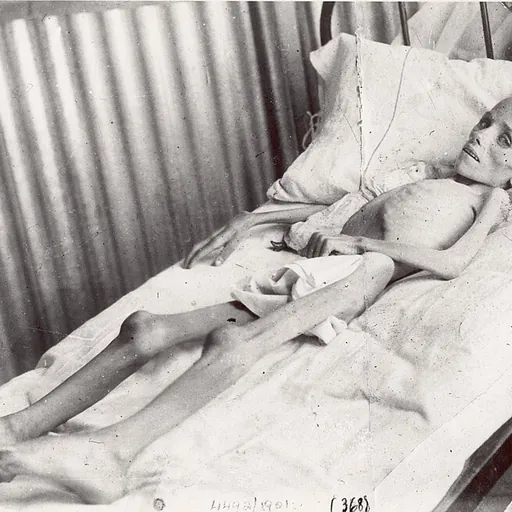
Elizabeth "Lizzie" Cecilia van Zyl (; 22 April 1894 – 9 May 1901) was a South African Dutch Boer child inmate of the British-operated who died from severe typhoid fever and starvation, in addition to severe abuse, mistreatment, and neglect during the Second Anglo-Boer War. After her death, van Zyl's photograph (showing her in a extremely malnourished state) was used as a well-known and renowned example to show the severe and cruel mistreatment and suffering that Dutch Boers had to face and endure in the concentration camps during the Second Boer War, by the British.
Background Elizabeth Cecilia van Zyl was born on in the small rural village of Langverwacht, Orange Free State, a Dutch Boer Republic (located in modern-day South Africa), as the fifth of ten children of a rural Dutch Boer bywoner peasant tenant farmer of lower class named Hermanus Egebert Pieter van Zyl (1859–1921) and his wife, Elizabeth Cecilia van Zyl (; 1869–1940). Van Zyl was subsequently baptized and christened in the local Dutch Reformed Church parish.
Like with many other people who lived in the Boer Republics, van Zyl and her family were Afrikaans-speaking Dutch Boer rural peasants of lower class who lived in the Orange Free State Republic and had belonged to the Dutch Reformed Protestant Christian faith. During the Second Boer War, the British Empire had invaded the independent and self-governing Boer Republics in southern Africa in October 1899 and attempted to gain control over the republics van Zyl's father Hermanus Egebert Pieter went to fight in the Boer Army against the British Army in order to protect his republic, like many Dutch Boer civilians did as well during the war; however, the Dutch Boers were rapidly losing the war and their land, and the British were rapidly gaining control over the Boer republics.
Following the control over the specific region that van Zyl and her family lived in by the British Army by 1900, along with many other Dutch Boers, six-year-old van Zyl, her mother Elizabeth Cecilia, and seven of her brothers and sisters were taken and arrested by the British during a massive roundup of Dutch Boers and they were deported on a transport to the Bloemfontein Concentration Camp on or around 28 November 1900. During their stay in the camp, van Zyl, her mother, and her seven brothers and sisters were labelled as 'undesirables' and placed on the lowest food rations and were forced to starve and were subjected to severe and cruel abuse and mistreatment by the British because van Zyl's father was one of the few Dutch Boer soldiers who had still refused to stop fighting and surrender to the British Army, despite the fact that the Boers were losing and British Army were rapidly gaining control over the republics.
Following van Zyl's death on 9 May 1901, her mother Elizabeth Cecilia and seven of her brothers and sisters were still imprisoned in the Bloemfontein concentration camp and subjected to regular severe abuse and mistreatment and were kept in severely bad conditions because they were Dutch Boers and the patriarch of the family, Hermanus Egebert Pieter van Zyl, still refused to surrender to the British and continued to fight for his republic; as a result, van Zyl's 14-year-old elder sister Hester Wilhelmina van Zyl is believed to have most likely died nine months later on or around 17 February 1902, and her six-year-old younger brother Pieter had died the following month on or around 20 March from a severe gangrene of his jaw.
Photo
Initially, the publishers of Hobhouse's reports refused to publish the photograph.
The image was released with the detail that it was taken when van Zyl and her mother entered the camp. Chamberlain was quoted in The Times on 5 March 1902, saying that van Zyl's mother was prosecuted for mistreatment.
Emily Hobhouse investigated the case and was unable to find any evidence of a case or the prosecution of van Zyl's mother for neglect. She located the photographer, a man named de Klerk, who was also a camp inmate at the time, and de Klerk stated that the photograph was taken two months after van Zyl had arrived at the camp, not when they had just arrived.
Don’t just read it —
keep it.
Full-length biographies made to live with: read them, listen on the way to work, watch them tonight.
- E-book
- Audio
- Video
Instant download · yours to keep · every purchase keeps this site free
Important facts
People in Lizzie van Zyl's life
Named in this biography and alive at the same time
Frequently asked questions
Who was Lizzie van Zyl?
South African child prisoner
When was Lizzie van Zyl born?
Lizzie van Zyl was born on 22 April 1894 in Orange Free State.
When did Lizzie van Zyl die?
Lizzie van Zyl died on 9 May 1901 in Bloemfontein.
What was Lizzie van Zyl's occupation?
Lizzie van Zyl was a child.
What nationality was Lizzie van Zyl?
Lizzie van Zyl was South African.
Sources & further reading
Cite this page
APA: Biography.guide. (2026). Lizzie van Zyl. https://biography.guide/lizzie-van-zyl/
MLA: "Lizzie van Zyl." Biography.guide, https://biography.guide/lizzie-van-zyl/.
Chicago: "Lizzie van Zyl." Biography.guide. https://biography.guide/lizzie-van-zyl/.
Data last updated: 2026-09-21 · Spot an error? Report a correction.
Portrait: Wikimedia Commons · author & licence
Page generated 2026-09-27 04:59 UTC