
About Livia della Rovere
Lived 1585 – 1641 (aged 55). Livia della Rovere was an aristocrat.
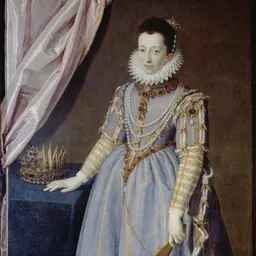
Livia della Rovere (16 December 1585 – 6 July 1641) was an Italian noblewoman of the House of della Rovere and the last Duchess of Urbino (1599–1631).
Life Born in Pesaro on 16 December 1585, she was the eldest child of Ippolito della Rovere, Lord of Castelleone and Montalfoglio and Marquess of San Lorenzo in Campo –an illegitimate but later legitimised son of Cardinal Giulio Feltrio della Rovere– and his wife Isabella Vitelli, Marchioness dell'Amatrice. She had one brother, Giulio (later Marquess of San Lorenzo in Campo and dell'Amatrice) and at least four sisters: Lucrezia (wife of Marcantonio Lante, later Marquess of San Lorenzo in Campo in succession of his brother-in-law; their second son was Ippolito Lante Montefeltro della Rovere, later 1st Duke of Bomarzo ), Elisabetta (who died in infancy), Eleonora and Livia (both nuns at the Corpus Domini monastery at Pesaro). It was in this climate of fear for the fate of the Duchy that the councilors and the population urged the Duke to remarry, and he reluctantly agreed.
Marriage After the death of her mother during the birth of her brother Giulio in 1598, Livia and her sisters were placed in the Santa Maddalena convent in Pesaro, from where she was removed after being chosen by her father to be the new bride of the Duke of Urbino, her second cousin (son of her grandfather's brother, Guidobaldo II della Rovere). After obtaining dispensation from Pope Clement VIII, the marriage between Livia and Francesco Maria II took place on 26 April 1599 in Casteldurante (now Urbania) in a rather modest ceremony.
The disgrace of both her father Ippolito and uncle Cardinal Giuliano isolated the Duchess, and with the death of her mother-in-law Vittoria Farnese (who had convinced her son to marry Livia) on 13 December 1602 she lost her only support. Now at the mercy of her husband, she feared the worst; however, his attitude towards her changed when in November 1604 Livia found herself finally pregnant, with the notice officially announced to the court in January 1605. The birth of a long-awaited male-heir repaired the relations between Livia and Francesco Maria II for a while, but the aging Duke showed little interest in his son, leaving him under the affectionate care of his mother for some time; however, he eventually removed the child from Livia's care and sent him to Florence to continue with his education, while she was virtually imprisoned in the Casteldurante Palace. Separated from her son, Livia wrote several letters to him: for example, in one of them dated 19 June 1616 she called herself as his "Most Loving Mother, who loves you as her own soul" (Amorevolissima madre, che vi ama quanto l'anima). The distance from both parents meant that Federico Ubaldo became in a troubled child and later in an arrogant and reckless teenager.
Towards the extinction of the Duchy of Urbino Federico Ubaldo died suddenly on 29 June 1623, after an epileptic attack; with his death, the destiny of Livia and the Duchy of Urbino changed again, because the dynasty was again without a direct male-heir. The young Duke was buried at Urbino Cathedral. In October, Claudia and her daughter Vittoria moved to the Medici court, leaving Livia devastated by the loss of her beloved granddaughter and alone with her elderly and almost paralyzed husband, ) with Ferdinando II de' Medici, Grand Duke of Tuscany in 1637.
Last years The view over San Lorenzo in Campo from Castelleone di Suasa, where Livia was raised and spent the latter part of her life in reclusion. Livia retired to the paternal estate of Castelleone di Suasa in the palace built there by her father. Here she spent the last years of her life, dying on 6 July 1641 aged 55. She was buried in the Corpus Domini convent of Pesaro (where her sister and namesake Livia was Abbess), according to her will preserved in the parish archives documenteds of Castelleone:
A dì 6 Julio 1641. La ser(enissi)ma Livia Duchessa d'Urbino morì di età di anni 60 incirca et hebbe tutti li SS.mi sacramenti dal sig. D. Carlo Rivi pievano et il corpo fu portato a Pesaro nella chiesa delle moniche del Corpus Domini.
Owner of a huge amount of artistic works and the wealth accumulated over the years by the Ducal family, she appointed her granddaughter Vittoria della Rovere as her sole heiress. Following this, most of the artistic heritage of the Della Rovere family was then removed from Urbino (for example, the double portrait of the Dukes of Urbino, Federico da Montefeltro and Battista Sforza, of Piero della Francesca) and transferred to Florence to the collections of the Medici or to Rome in the Papal Palaces.
Don’t just read it —
keep it.
Full-length biographies made to live with: read them, listen on the way to work, watch them tonight.
- E-book
- Audio
- Video
Instant download · yours to keep · every purchase keeps this site free
Important facts
Family & relationships
People in Livia della Rovere's life
Named in this biography and alive at the same time


Related people
Same field, nearest in time


Contemporaries
People whose lives overlapped Livia della Rovere's



Frequently asked questions
Who was Livia della Rovere?
Italian noble (1585-1641)
When was Livia della Rovere born?
Livia della Rovere was born on 16 December 1585 in Pesaro.
When did Livia della Rovere die?
Livia della Rovere died on 6 July 1641 in Castelleone di Suasa.
What was Livia della Rovere's occupation?
Livia della Rovere was an aristocrat.
Sources & further reading
· Wikipedia: Livia della Rovere
Cite this page
APA: Biography.guide. (2026). Livia della Rovere. https://biography.guide/livia-della-rovere/
MLA: "Livia della Rovere." Biography.guide, https://biography.guide/livia-della-rovere/.
Chicago: "Livia della Rovere." Biography.guide. https://biography.guide/livia-della-rovere/.
Data last updated: 2026-09-20 · Spot an error? Report a correction.
Page generated 2026-09-27 05:33 UTC