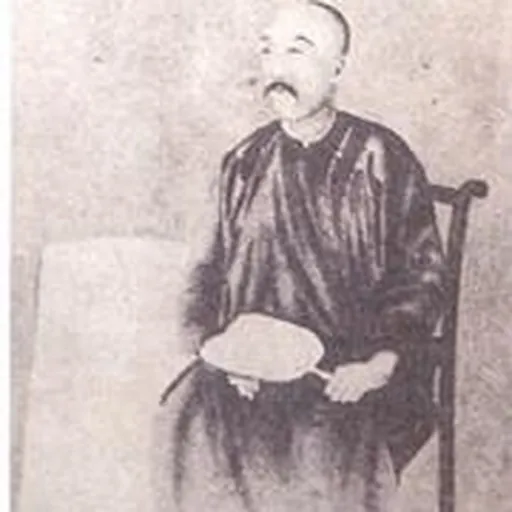
About Liu Mingchuan
Lived 1836 – 1896 (aged 59). Liu Mingchuan was a Chinese politician.
Governor of Taiwan Bust of Liu Mingchuan location at 228 Peace Memorial Park, Taipei. By a decision of the Qing court, Taiwan Province was declared an independent province in 1887. Having never gotten full support from the mainland's Imperial court and the navy presence he wanted, Liu is instead remembered for his efforts to lay the foundation of modern infrastructure in Taiwan as its first provincial governor. He continued and enlarged Shen Baozhen's ideals for managing Taiwan, and started a massive modernization programme that included setting up defenses, developing transportation, taxation, farming, public security, commercial enterprises, financial affairs, and education. Construction works including telegram, railway, army machinery, telegram schools, Western schools, and modern forts, in addition to purchasing modern artillery and rifles.
Liu promoted a series of Western-style architectural developments, including the headquarters of Taiwan's Telegraphy (辦理臺灣水路電報總局, 1892), Taipei Machinery Car Repair Factory , an iron bridge, Western Supervising Dormitory , and Western School (西學堂, 1890). In 1886, under the support of German military engineer Max E. Hecht, he built nine modern Western-style forts, including Keelung Sheliao Fort , Uhrshawan Battery, Hobe Fort, Daping Mountain Fort (旗後大平山炮台, destroyed), Penghu West Castle Fort , Penghu West-Islet Fort , Penghu Mazu Fort (金龜頭砲臺), and Anping Fort.
Under Liu's auspices, a 28.6 km railroad connecting the cities of Keelung and Taipei (see Taiwan Railways Administration) became the earliest railroad system of China when it came into operation with nine Europe-made steam locomotives in 1891. An undersea telegraph line between Tamsui and Fuzhou was laid during his tenure. He sponsored the exploitation of coal using new technologies in northern Taiwan and the creation of a modern postal service. Liu's governance saw China's earliest nighttime electrical illumination when the walled prefecture city of Taipei was lightened up with street lamps in 1887. However, those lights would be turned off after the initial trial period due to a lack of operating funds.
Despite that these projects were limited in scope and scale, they were carried out against strong opposition and plagued with financial difficulties. Unassisted by the Qing court, the governor resorted to a series of radical means of funding his projects. These included forcefully seizing control of some areas traditional inhabited by aboriginal tribes in the northern part of the island province and imposing a land census on the island's landowning class to expand camphor and tea production and increase tax revenues. Some of the repercussions of these measures would work to suffocate Liu's plans for Taiwan and his political career. On 6 October 1888 a mob of land-owning farmers and militia revolted (施九緞事件) in Changhua County, attacking Qing officials led by Li Jiatang , a county magistrate who had threatened to use capital punishment when carrying out the land census.
A longtime animosity between the Xiang and the Huai Armies is believed to be another factor in Liu's eventual political frustration. Liu Ao , a Xiang Army veteran officer and Superintendent of Military Affairs in Taiwan , was Liu Mingchuan's arch opponent when he took office. Although Liu Mingchuan succeeded in purging Liu Ao from his jurisdiction by accusing the latter of various misdeeds, which led to the latter's exile as a guarded prisoner to Heilongjiang in 1885, the governor himself was never free from targeted attacks as a representative figure of the Huai faction in the government and as an important associate of Li Hongzhang.
Resignation and death In June 1891, Liu Mingchuan resigned his post as governor of Taiwan for health reasons at the age of 56, and returned to his hometown in Anhui. Most of the modernization projects initiated by Liu came to a halt shortly after his resignation and were never restarted throughout the rest of the Qing reign over the island. This has led to speculation that Liu's resignation was actually due to political opposition in the Qing court to his work. Whether or not this is true, the policy reversal adopted by Liu's successors—affiliated with the Huai faction or not—illustrates the financial difficulties China's early modernizers faced while the empire's fiscal resources were spent on the creation of the Beiyang Fleet and the renovation of the Summer Palace.
After leaving Taiwan, Liu Mingchuan received no further official commissions and in 1895, Taiwan was ceded to Japan by the Treaty of Shimonoseki. Liu died in his hometown of Hefei in 1896, and was given the title of Grand Protector of the Crowned Prince and the posthumous name Zhuang Su . Permission was granted to build a temple and have his biography written.
Before his death, he had mentioned Taiwan, looking to the East, where Taiwan lay. He cried: "Blue sky! Give me back Taiwan!", in sorrow for the victory of Japan over China and the colonisation of Taiwan by Japan.
Namesakes Liu Mingchuan is greatly remembered in both mainland China and Taiwan. In Mainland China, the name of the township where Liu was born in Feixi County was changed to his name in 2006. Hefei No. 8 High School has a campus named after him in this township. In Taiwan, Ming Chuan University and several elementary and middle schools were named after him. There is also a road named after him in Keelung. The first Oliver Hazard Perry-class frigate purchased from the United States, which was later classified as Cheng Kung-class frigate No. 9, was also named after him.
Don’t just read it —
keep it.
Full-length biographies made to live with: read them, listen on the way to work, watch them tonight.
- E-book
- Audio
- Video
Instant download · yours to keep · every purchase keeps this site free
Important facts
more
ChuangsuPeople in Liu Mingchuan's life
Named in this biography and alive at the same time

Related people
Same field, nearest in time




Contemporaries
People whose lives overlapped Liu Mingchuan's





Frequently asked questions
Who was Liu Mingchuan?
Chinese general, first governor of Chinese province of Taiwan (1836-1896)
When was Liu Mingchuan born?
Liu Mingchuan was born on 7 September 1836 in Hefei.
When did Liu Mingchuan die?
Liu Mingchuan died on 21 January 1896 in Hefei.
What was Liu Mingchuan's occupation?
Liu Mingchuan was a politician.
What nationality was Liu Mingchuan?
Liu Mingchuan was Chinese.
Sources & further reading
Cite this page
APA: Biography.guide. (2026). Liu Mingchuan. https://biography.guide/liu-mingchuan/
MLA: "Liu Mingchuan." Biography.guide, https://biography.guide/liu-mingchuan/.
Chicago: "Liu Mingchuan." Biography.guide. https://biography.guide/liu-mingchuan/.
Data last updated: 2026-09-21 · Spot an error? Report a correction.
Portrait: Wikimedia Commons · author & licence
Page generated 2026-09-27 05:00 UTC