
About Liu Ji
Lived 1311 – 1375 (aged 63). Liu Ji was a Chinese politician, civil servant, poet, writer, philosopher and astronomer.
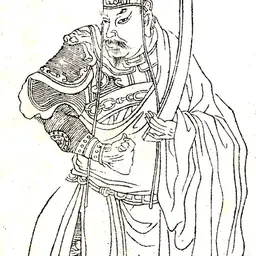
Liu Ji (1 July 1311 – 16 May 1375), courtesy name Bowen, better known as Liu Bowen, was a Chinese military strategist, philosopher, and politician who lived in the late Yuan and early Ming dynasties. He was born in Qingtian County (present-day Wencheng County, Lishui, Zhejiang). He served as a key advisor to Zhu Yuanzhang, the Hongwu Emperor, the founder of the Ming dynasty, in the latter's struggle to overthrow the Yuan dynasty and unify China proper under his rule. Liu is also known for his prophecies and has been described as the "Divine Chinese Nostradamus".
Early service under the Yuan dynasty Liu sat for the imperial examination and obtained the position of a jinshi ("presented scholar", the highest grade of successful candidate) in the final years of the Yuan dynasty. He spent much of his early career attempting to save the Yuan dynasty from collapse. He served the Yuan dynasty as an official for 25 years, gaining a reputation for integrity and honesty, and became known as a distinguished scholar and strategist. In 1348, he was appointed to a military position and assigned to put down a southern rebellion against the dynasty. The leader of the rebellion attempted to save himself by offering Liu a bribe. When Liu refused, the rebel went to Beijing and succeeded in bribing his way into favour there.
Once the secessionist had bribed his way into the regime's favour, he was given a public office and a salary. Liu's relationship with the Yuan government deteriorated after this event. He attempted to resign twice, in 1349 and 1352. He was demoted in 1358, and finally left service to retire in his ancestral homeland. In 1360, Liu was introduced to Zhu Yuanzhang, a former leader of a radical White Lotus rebellion who was then the leader of a broad anti-Yuan rebellion.
Service to Zhu Yuanzhang Liu served not only in the administration of Zhu Yuanzhang, but also in many battles as a commanding officer on land and water, leading the early Ming naval forces. Zhu Yuanzhang placed Liu in charge of the campaign to conquer all of Zhejiang from Yuan forces. Liu was also responsible for military ventures against opposing Chinese rebel groups, as well as the wokou. Later in the rebellion, Zhu Yuanzhang only rarely relied on Liu to personally command his armies in the field, as he acquired other capable generals, including Xu Da, Deng Yu and Chang Yuchun. Liu was most often consulted for his strategic advice during this period.
Death The shock and shame of being groundlessly dismissed from office had destroyed Liu's health, and he died soon after. The precise cause of Liu's death is considered uncertain by modern scholars. In late January of Hongwu's eighth year (1375), Liu caught a cold. After Zhu Yuanzhang found out, he sent Hu Weiyong to find an imperial doctor for Liu. However, after Liu had taken the doctor's medicines, he felt as if some uneven stones were being squeezed together in his stomach, which gave him even more pain. Liu gently told Zhu Yuanzhang that he felt more pain after taking Hu Weiyong's doctor's medicines. After Zhu Yuanzhang listened to this, he only gave some comforting words to Liu, which made Liu feel upset. In late March, Liu had already been unable to move freely. Therefore, he decided to return home. Once he got home, he refused all the medicines and just tried to maintain a normal diet as much as possible. Eventually, in April, Liu died. Some scholars believe that Liu was poisoned by the Hongwu Emperor himself, not because Liu had failed his duty, but because the emperor was envious and even fearful of his knowledge and influence.
Within five years of Liu's death, the man who had slandered Liu in order to hold office, Hu Weiyong, was himself suspected of plotting against the Hongwu Emperor. In the subsequent orgy of the emperor's paranoid efforts to root out conspiracy, 30,000–40,000 people were executed.
Prophecy Liu's most famous prophecy to Zhu Yuanzhang, written down in a lyrical style, is called the Shaobing Song (燒餅歌). The poem is written in cryptic verse and is difficult to understand. Some people believe that the Shaobing Song predicted future events in China, including the Tumu Crisis of 1449, and the Xinhai Revolution of 1911 that led to the Republic of China.
Don’t just read it —
keep it.
Full-length biographies made to live with: read them, listen on the way to work, watch them tonight.
- E-book
- Audio
- Video
Instant download · yours to keep · every purchase keeps this site free
Important facts
People in Liu Ji's life
Named in this biography and alive at the same time


Related people
Same field, nearest in time


Contemporaries
People whose lives overlapped Liu Ji's




Frequently asked questions
Who was Liu Ji?
Chinese philosopher and politician (1311–1375)
When was Liu Ji born?
Liu Ji was born on 1 July 1311 in Wenzhou.
When did Liu Ji die?
Liu Ji died on 16 May 1375 in Zhejiang.
What was Liu Ji's occupation?
Liu Ji was a politician, civil servant, poet, writer, philosopher and astronomer.
What nationality was Liu Ji?
Liu Ji was Chinese.
Sources & further reading
Cite this page
APA: Biography.guide. (2026). Liu Ji. https://biography.guide/liu-ji-politician/
MLA: "Liu Ji." Biography.guide, https://biography.guide/liu-ji-politician/.
Chicago: "Liu Ji." Biography.guide. https://biography.guide/liu-ji-politician/.
Data last updated: 2026-09-20 · Spot an error? Report a correction.
Page generated 2026-09-27 05:29 UTC