
About Linda MacDonald
Born 1946. Linda MacDonald is an artist.
Linda MacDonald was born in 1946, in Berkeley, California. She is a multimedia artist who was at the forefront of the studio quilt art movements.
Early life
MacDonald grew up in a small town called Willits, located in Mendicino County, California. She grew up in a household with quilts but "took their presence for granted" along with other family skills such as "knitting, crochet, and dressmaking." As a child, MacDonald's "early successes were art-related." She competitively won the rank as "class artist" and teachers called on her when they "needed drawings for their classroom." She "learned to sew from her mother (as) clothing was expensive" and could more economically be made at home. Textile and fibers were MacDonald’s first art medium.
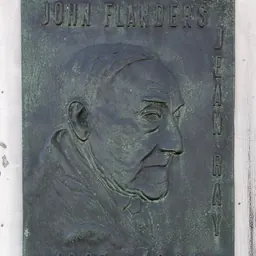
Studio art quilt movement MacDonald was "aware of the national and California art scenes" as well as the 1965 beginnings of the studio art quilt movement, "an art form that uses traditional quilting techniques to create art objects." She chose to "forget all about it (the movement) and just work from (her) daily life (and) experiences." In retrospect, she, along with others such as Jean Ray Laury, Yvonne Porcella, and Therese May, drove the California art quilt revolution while others were doing the same thing in New England and Ohio. She realized her art training could be used on textiles.
MacDonald eventually expanded her repertoire to add art quilter to her career as an artist. In 1974 she joined "a feminist consciousness-raising group" where she was introduced to quilt making. She tried the craft at home using a book by Michael James, The Quiltmaker's Handbook. She recalled, "His first book was invaluable because (it) showed us how to stack all the pinned pieces . . . and (to) sew them in long flags" and "his work was important . . . because it was contemporary." She initially made a crazy quilt then "made a few more quilts but began designing her own repeat blocks rather than copying old ones." She soon realized "she was gratified by the warm reception viewers gave to quilts." She noticed, "the difference in feeling between a person looking at a drawing and a person looking at a quilt was really remarkable. There is no distance between a person and fabric, especially when it has all these romantic and nostalgic feelings." It became apparent that it was fairly "easy to sew while she was home with her young children." Initially, "she worked in relative isolation, not realizing other artists were making quilts." She used her skills as an artist to create "geometric designs in fiber."
Education MacDonald's formal education in art began at San Francisco State University but was interrupted by the "riots of the 1960s". She moved with her husband, Robert Comings, also a multi-media artist, to a "rural country existence" The show, curated by Paula Gray, subtitled, "20 years of art from ecological concerns to homespun whimsy" contained 46 pieces of MacDonald's art.
Environmentalism Linda MacDonald "is best known for her environmental work" born of her experience living in northern California. Quilts highlighting environmental themes such as oil drilling followed her "series of quilts with a logging theme" called, "What is Happening to the Trees?" She has a gift of approaching these sensitive subjects with "a playful sense of humor." An example of this is Even the Old Growth Must Work for Its Keep. Most of her art portrays California’s native environment, such as Redwood trees.
Gallery Route One in Point Reyes, California, highlighted MacDonald's work in a one-person show in 2010 called, "Linda MacDonald: Stories from the North Woods.” This mixed-media exhibition included drawings, paintings, fiber, and eco-graphics. Her fiber section used “tongue-in-cheek humor to state the obvious.” MacDonald's unique vantage born of literally living and "(working) on the edge" of the forests of Mendocino County informs her environmental art including a series on the Spotted Owl called, Spotted Owl vs. The Chain Saw.
Another important fiber series, Trees, Lumber, Houses, and People "tells a story in a dozen chapters" chronicling the life of a forest being decimated by logging until it is eventually "the inevitable forest of stumps."
Linda MacDonald, an "artist, who began as a painter, switched to textiles in the 1980s, and soon combined the two," primarily painting on traditional canvas as of 2013.
Don’t just read it —
keep it.
Full-length biographies made to live with: read them, listen on the way to work, watch them tonight.
- E-book
- Audio
- Video
Instant download · yours to keep · every purchase keeps this site free
Important facts
People in Linda MacDonald's life
Named in this biography and alive at the same time




Related people
Same field, nearest in time



Contemporaries
People whose lives overlapped Linda MacDonald's




Frequently asked questions
Who is Linda MacDonald?
American artist
When was Linda MacDonald born?
Linda MacDonald was born in 1946.
What is Linda MacDonald's occupation?
Linda MacDonald is an artist.
Sources & further reading
Cite this page
APA: Biography.guide. (2026). Linda MacDonald. https://biography.guide/linda-macdonald/
MLA: "Linda MacDonald." Biography.guide, https://biography.guide/linda-macdonald/.
Chicago: "Linda MacDonald." Biography.guide. https://biography.guide/linda-macdonald/.
Data last updated: 2026-09-20 · Spot an error? Report a correction.
Page generated 2026-09-27 05:14 UTC