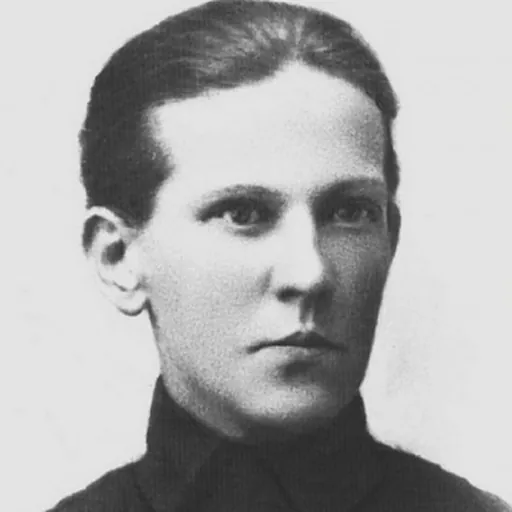
About Lidiâ Mihajlovna Knipovič
Lived 1856 – 1920 (aged 63). Lidiâ Mihajlovna Knipovič was a revolutionary.
Lydia Mikhailovna Knipovich (; ; 1857–1920) was a Finnish-Russian revolutionary socialist. A member of Narodnaya Volya, she later joined the League of Struggle for the Emancipation of the Working Class and was arrested for illegally printing the group's publications. While in internal exile, she helped establish the socialist newspaper Iskra and joined the Bolshevik faction of the Russian Social Democratic Labour Party (RSDLP).
Biography Lydia Mikhailovna Knipovich was born in Finland, in 1857. In the late 1870s, she became a revolutionary socialist and joined the Narodnaya Volya organisation. From 1881 to 1882, she was a member of a socialist group in Helsinki, and in 1889, she moved to Saint Petersburg, where she began teaching and engaging in revolutionary activism.
Together with Nadezhda Krupskaya and Apollinariya Yakubova, she became a leader of the Saint Petersburg workers' movement during its early stages. She also became a close confindant of Vladimir Lenin. With them, she joined the League of Struggle for the Emancipation of the Working Class and clandestinely printed the group's publications.
In the summer of 1896, Knipovich was arrested and imprisoned for her revolutionary activities. According to Krupskaya, Knipovich had been given up by a typesetter she had worked with to print the group's publications. Knipovich requested that she be exiled to Ufa. She spent her years in internal exile in Astrakhan, Tver and Samara, where she remained active in the socialist movement, helping to establish the socialist newspaper Iskra. Knipovich was one of five women, out of twelve total contributors, who worked on the paper.
In 1905, Knipovich attended the Second Congress of the Russian Social Democratic Labour Party (RSDLP), where the party split into two factions. Knipovich herself joined Lenin's Bolshevik faction. She then moved to Odesa, where she was secretary of the local RSDLP committee and contributed to the publication Proletariat. In 1911, she was internally exiled to the Poltava Governorate and withdrew from political activity in 1914. After the Russian Revolution of 1917, she moved to Crimea, where she died in 1920.
Don’t just read it —
keep it.
Full-length biographies made to live with: read them, listen on the way to work, watch them tonight.
- E-book
- Audio
- Video
Instant download · yours to keep · every purchase keeps this site free
Important facts
People in Lidiâ Mihajlovna Knipovič's life
Named in this biography and alive at the same time

Related people
Same field, nearest in time


Contemporaries
People whose lives overlapped Lidiâ Mihajlovna Knipovič's





Frequently asked questions
Who was Lidiâ Mihajlovna Knipovič?
Finnish-Russian revolutionary (1856–1920)
When was Lidiâ Mihajlovna Knipovič born?
Lidiâ Mihajlovna Knipovič was born on 15 December 1856 in Tuusula.
When did Lidiâ Mihajlovna Knipovič die?
Lidiâ Mihajlovna Knipovič died on 9 February 1920 in Simferopol.
What was Lidiâ Mihajlovna Knipovič's occupation?
Lidiâ Mihajlovna Knipovič was a revolutionary.
Sources & further reading
· Wikipedia: Lidiâ Mihajlovna Knipovič
Cite this page
APA: Biography.guide. (2026). Lidiâ Mihajlovna Knipovič. https://biography.guide/lidia-mihajlovna-knipovic/
MLA: "Lidiâ Mihajlovna Knipovič." Biography.guide, https://biography.guide/lidia-mihajlovna-knipovic/.
Chicago: "Lidiâ Mihajlovna Knipovič." Biography.guide. https://biography.guide/lidia-mihajlovna-knipovic/.
Data last updated: 2026-09-21 · Spot an error? Report a correction.
Portrait: Wikimedia Commons · author & licence
Page generated 2026-09-27 05:00 UTC