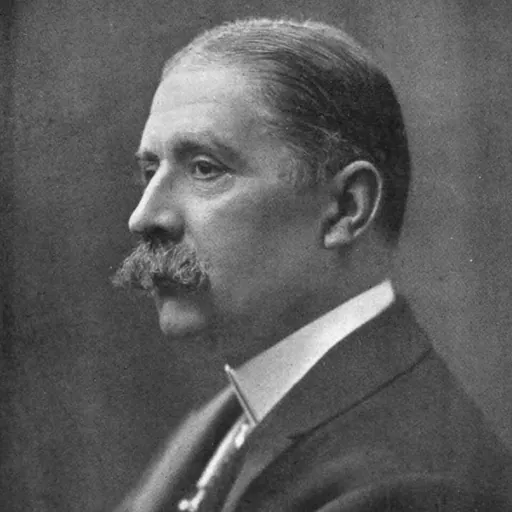
About Leslie Ward
Lived 1851 – 1922 (aged 70). Leslie Ward was a British caricaturist, painter and artist.
Sir Leslie Matthew Ward (21 November 1851 – 15 May 1922) was a British portrait artist and caricaturist who over four decades painted 1,325 portraits which were regularly published by Vanity Fair, under the pseudonyms "Spy" and "Drawl". The portraits were produced as watercolours and turned into chromolithographs for publication in the magazine. These were then usually reproduced on better paper and sold as prints. Such was his influence in the genre that all Vanity Fair caricatures are sometimes referred to as "Spy cartoons" regardless of who the artist actually was.
Early portraits, almost always full-length (judges at the bench being the main exception), had a stronger element of caricature and usually distorted the proportions of the body, with a very large head and upper body supported on much smaller lower parts. Later, as he became more accepted by his social peers, and in order not to offend potential sitters, his style developed into what he called "characteristic portraits". This was less of a caricature and more of an actual portrait of the subject, using realistic body proportions.
Ward started caricaturing while still at school at Eton College, using his classmates and school masters as subjects. In 1867 his bust of his brother was exhibited at the Royal Academy in London. At school, Ward had been an unexceptional student, and after he left Eton in 1869 his father encouraged him to train as an architect. Ward was too afraid to tell his father that he wanted to be an artist and he spent an unhappy year in the office of the architect Sydney Smirke, who was a family friend. The artist W. P. Frith spoke to Ward's father on his behalf, and after a great deal of arguing he finally agreed to support his son's training as an artist, and Ward entered the Royal Academy Schools in 1871. In 1873 he sent some of his work to Thomas Gibson Bowles, four years after Vanity Fair was founded. This led to him being hired to replace "Ape" (Carlo Pellegrini), who had temporarily left the magazine after falling out with Bowles. As his nom de crayon, Ward suggested to Bowles that he use the name "Spy", meaning "to observe secretly, or to discover at a distance or in concealment".
Ward worked methodically, often from memory, after observing his 'victims' at the racecourse, in the law courts, in church, in the academy lecture theatre, or in the lobby of the Houses of Parliament. Sometimes they came to his studio to pose in their robes or uniforms. A caricaturist, Ward believed, was born, not made. He observed, "A good memory, an eye for detail, and a mind to appreciate and grasp the whole atmosphere and peculiarity of the 'subject' are of course essentials."
In an 1897 interview given by Oliver Armstrong Fry (editor of Vanity Fair) to Frank Banfield of Cassell's Magazine, it was reported that Ward received between £300 and £400 per portrait. Ward was the most famous Vanity Fair artist; indeed, the whole genre of caricatures is often referred to as "Spy cartoons". He worked for Vanity Fair for over forty years, producing more than half of the 2,387 caricatures published.
Later years Ward's clubs included the Arts, the Orleans, the Fielding, the Lotus, the Punch Bowl, and the Beefsteak, where he was one of the original members. There he sketched many of his victims. In 1899, years after her father had refused him permission to marry her, Ward married the society hostess Judith Mary Topham-Watney, the only daughter of Major Richard Topham of the 4th Queen's Own Hussars. They had one daughter, Sidney. Ward prophesied that "when the history of the Victorian era comes to be written in true perspective, the most faithful mirror and record of representative men and spirit of their times will be sought and found in Vanity Fair". After a nervous breakdown Ward died suddenly of heart failure at 4 Dorset Square, Marylebone, London on 15 May 1922 and was buried on 18 May at Kensal Green Cemetery in London.
About 300 of his original watercolours for Vanity Fair are in the National Portrait Gallery, London.
Gallery
Don’t just read it —
keep it.
Full-length biographies made to live with: read them, listen on the way to work, watch them tonight.
- E-book
- Audio
- Video
Instant download · yours to keep · every purchase keeps this site free
Important facts
more
Sir Leslie Matthew WardPeople in Leslie Ward's life
Named in this biography and alive at the same time



Related people
Same field, nearest in time




Contemporaries
People whose lives overlapped Leslie Ward's





Frequently asked questions
Who was Leslie Ward?
British cartoonist (1851-1922)
When was Leslie Ward born?
Leslie Ward was born on 21 November 1851 in London.
When did Leslie Ward die?
Leslie Ward died on 15 May 1922 in London.
What was Leslie Ward's occupation?
Leslie Ward was a caricaturist, painter and artist.
What nationality was Leslie Ward?
Leslie Ward was British.
Sources & further reading
Cite this page
APA: Biography.guide. (2026). Leslie Ward. https://biography.guide/leslie-ward/
MLA: "Leslie Ward." Biography.guide, https://biography.guide/leslie-ward/.
Chicago: "Leslie Ward." Biography.guide. https://biography.guide/leslie-ward/.
Data last updated: 2026-09-22 · Spot an error? Report a correction.
Portrait: Wikimedia Commons · author & licence
Page generated 2026-09-27 05:04 UTC