
About Leroy Foster
Lived 1923 – 1958 (aged 35). Leroy Foster was an American musician.
"Baby Face" Leroy Foster (February 1, 1923 – May 26, 1958) was an American blues singer, drummer and guitarist, active in Chicago from the mid-1940s until the late 1950s. He was a significant figure in the development of the postwar electric Chicago blues sound, particularly as a member of the Muddy Waters band during its early years.
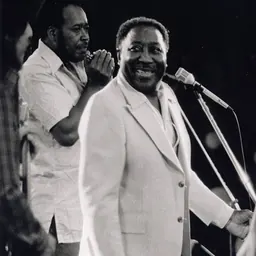
Early life Foster was born in Algoma southwest of Tupelo, Mississippi. He was introduced to the singer and guitarist Muddy Waters by an acquaintance Waters met at a recording session in 1946. Foster was soon playing guitar and drums in Waters's band, along with Jimmy Rogers, a guitarist and harmonica player. Calling themselves the Headhunters, the trio was known for going from club to club and “cutting” (i.e. engaging in musical duels with) other bands.
First recordings Foster's first recordings were made, as a sideman, with the pianist Lee Brown in 1945 for J. Mayo Williams' Chicago label. In 1946, he took part in another session with Brown; the same year he also recorded for Columbia Records backing James "Beale Street" Clark and Waters, although only the sides by Clark were issued at the time. He accompanied Sunnyland Slim on a 1947 or 1948 session for the Opera label. Four singles were released from the session, two by Foster and two by Little Walter. One of the singles, the two-part "Rollin' and Tumblin'",
Later career and death After signing with Parkway, Foster left Waters's band, possibly in the hope of a solo career resulting from the Parkway releases, but the label soon folded. Foster recorded two further sessions for J.O.B. in 1951 and 1952; only the first of these resulted in the release of a single.
Foster died of a heart attack in Chicago in 1958, at the age of 35; alcoholism may have been a factor leading to his early death. He was buried at Fern Oak Cemetery in Griffith adjacent to Gary, Indiana. In 2012 the Killer Blues Headstone Project, a nonprofit organization, placed a headstone on Foster's unmarked grave. As of 1973, there was only one known photograph of Foster.
Influences and performing style Foster sang in a style which was influenced by Sonny Boy Williamson and Doctor Clayton. While he played guitar and drums competently, the talents for which he was popular have been described as "drinking, singing and clowning".
Discography As leader "Locked Out Boogie" / "Shady Grove Blues" (1948), Aristocrat 1234 "My Head Can't Rest Anymore" / "Take a Little Walk with Me" (1949), J.O.B. 100 "Boll Weevil" / "Red Headed Woman" (1950), Parkway 104 "Rollin' and Tumblin' part 1" / "Rollin' and Tumblin' part 2" (1950), Parkway 501 "Pet Rabbit" / "Louella" (1951) J.O.B. 1002
Don’t just read it —
keep it.
Full-length biographies made to live with: read them, listen on the way to work, watch them tonight.
- E-book
- Audio
- Video
Instant download · yours to keep · every purchase keeps this site free
Important facts
People in Leroy Foster's life
Named in this biography and alive at the same time



Related people
Same field, nearest in time



Contemporaries
People whose lives overlapped Leroy Foster's



Frequently asked questions
Who was Leroy Foster?
American blues singer, drummer and guitarist (1923-1958)
When was Leroy Foster born?
Leroy Foster was born on 1 February 1923 in Algoma.
When did Leroy Foster die?
Leroy Foster died on 26 May 1958 in Chicago.
What was Leroy Foster's occupation?
Leroy Foster was a musician.
What nationality was Leroy Foster?
Leroy Foster was American.
Sources & further reading
· DBpedia: Leroy Foster (musician)
Cite this page
APA: Biography.guide. (2026). Leroy Foster. https://biography.guide/leroy-foster-musician/
MLA: "Leroy Foster." Biography.guide, https://biography.guide/leroy-foster-musician/.
Chicago: "Leroy Foster." Biography.guide. https://biography.guide/leroy-foster-musician/.
Data last updated: 2026-09-20 · Spot an error? Report a correction.
Page generated 2026-09-27 05:29 UTC