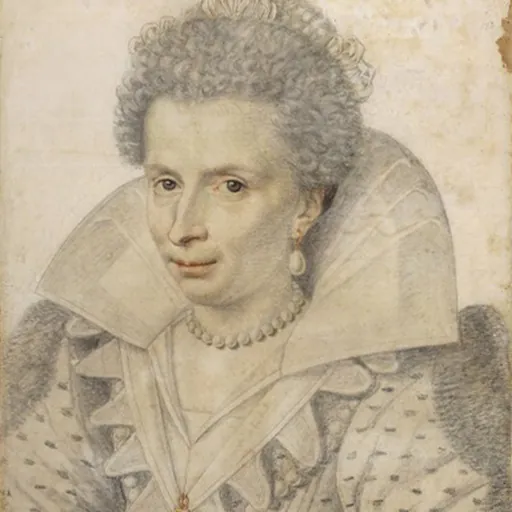
About Leonora Dori
Lived 1568 – 1617 (aged 49). Leonora Dori was a lady-in-waiting.
Leonora Dori Galigaï (19 May 1568 – 8 July 1617) was a French courtier of Italian origin, an influential favourite of the French regent Marie de' Medici, mother of King Louis XIII. Galigaï was married to Concino Concini, the later marquis and then marshal d'Ancre, during Marie's reign as queen mother and regent of France.
Early life and France Galigaï, the daughter of a carpenter named Dori, grew up in Florence in the Palazzo Pitti as a young attendant of Marie de' Medici, who managed to buy her adoption from the Galigai, a poor but noble Florentine family.
In 1600, she followed her mistress to France who married King Henry IV of France, who named Galigaï Dame d'atour (lady-in-waiting) to the Queen Marie, immediately after her marriage to the Florentine nobleman Concini.
Galigaï suffered from debilitating depressions and paralyzing spasms, which may have been symptoms of epilepsy, which the queen and her courtiers believed to be due to demonic possession, but which were resistant to exorcism. She was treated by the Portuguese-born, Italian-Jewish court physician of Marie and Louis XIII: Filotheo Eliau Montalto (died 1616).
In an age when people believed in witchcraft and sorcery, Galigaï was hired by the queen to perform exorcisms and white magic to counter black magic and curses. She earned huge sums of money by these tasks, as well as from bribes for giving people access to the queen. Galigaï amassed an enormous fortune, which she invested in banks and in real estate in France and Italy.
In 1610 King Henri IV, the husband of Marie de' Medici, was assassinated, and his widow became the Queen Mother of Louis XIII and the Regent of France. After Concini was murdered by his political enemies in 1617, his wife Galigaï was arrested, imprisoned in Blois and charged with lèse majesté through practicing black magic, witchcraft and "Judaizing". Galigaï was judged guilty of having bewitched the regent. She was beheaded and her body subsequently burned at the stake at the Place de Grève in Paris. Concurrent with these times, in 1616 and 1617, various songs and tracts were published in Paris, Rouen, and London (English translations), concerning the couple, their activities and fate.
Legacy Galigaï's life is the subject of Alfred de Vigny's 1831 tragedy La Maréchale d'Ancre and the 1839 Italian opera La Marescialla d'Ancre, with a libretto by Giovanni Prati, based on the de Vigny work, and music by Alessandro Nini.
Don’t just read it —
keep it.
Full-length biographies made to live with: read them, listen on the way to work, watch them tonight.
- E-book
- Audio
- Video
Instant download · yours to keep · every purchase keeps this site free
Important facts
People in Leonora Dori's life
Named in this biography and alive at the same time

Related people
Same field, nearest in time



Contemporaries
People whose lives overlapped Leonora Dori's




Frequently asked questions
Who was Leonora Dori?
Italian noble
When was Leonora Dori born?
Leonora Dori was born on 19 May 1568 in Florence.
When did Leonora Dori die?
Leonora Dori died on 8 July 1617 in Paris.
What was Leonora Dori's occupation?
Leonora Dori was a lady-in-waiting.
Sources & further reading
Cite this page
APA: Biography.guide. (2026). Leonora Dori. https://biography.guide/leonora-dori/
MLA: "Leonora Dori." Biography.guide, https://biography.guide/leonora-dori/.
Chicago: "Leonora Dori." Biography.guide. https://biography.guide/leonora-dori/.
Data last updated: 2026-09-21 · Spot an error? Report a correction.
Portrait: Wikimedia Commons · author & licence
Page generated 2026-09-27 04:59 UTC