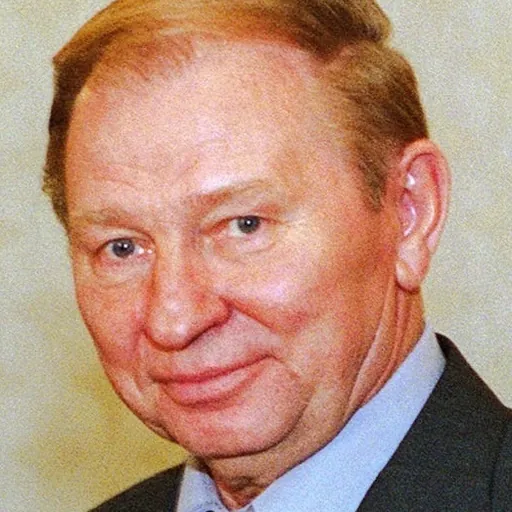
Leonid Kuchma
Ukrainian businessman and politician, second President of Ukraine from 1994 to 2005
About Leonid Kuchma
Born 1938. Leonid Kuchma is a Russian and Ukrainian politician, engineer and entrepreneur.
Leonid Danylovych Kuchma (, ; born 9 August 1938) is a Ukrainian politician who served as the second president of Ukraine from 19 July 1994 to 23 January 2005. The only president of Ukraine to serve two terms, his presidency was marked by economic stabilization and an improvement in Russia–Ukraine relations, but at the same time was accompanied by democratic backsliding and growth of the influence of Ukrainian oligarchs, as well as several scandals.
After a successful career as a rocket engineer and businessman in the Soviet Union, Kuchma began his political career in 1990, when he was elected to the Verkhovna Rada (Ukrainian parliament); he was re-elected in 1994. He served as Prime Minister of Ukraine between October 1992 and September 1993. Kuchma took office after winning the 1994 presidential election against his rival, incumbent President Leonid Kravchuk. Kuchma won re-election for an additional five-year term in 1999. Corruption accelerated after Kuchma's election in 1994, but in 2000–2001, his power began to weaken in the face of exposures in the media.
Kuchma's administration began a campaign of media censorship in 1999, leading to arrests of journalists, the death of Georgiy Gongadze, and the subsequent Cassette Scandal and mass protests. The Ukrainian economy continued to decline until 1999, whereas growth was recorded since 2000, bringing relative prosperity to some segments of urban residents. During his presidency, Ukrainian-Russian ties began to improve. Kuchma declined to seek a third term in office, instead supporting Party of Regions candidate Viktor Yanukovych for the 2004 election. Following public protests over the alleged electoral fraud which escalated into the Orange Revolution, Kuchma took a neutral stance and was a mediator between Viktor Yushchenko and Viktor Yanukovych. Between 2014 and 2020, Kuchma was a special presidential representative of Ukraine at the quasi peace talks regarding the war in Donbas.
Kuchma's legacy has proven controversial, and he has been described as authoritarian by various sources. Widespread corruption and media censorship under Kuchma's administration continue to have an impact on Ukraine today, and he has been accused of promoting oligarchism.
Early life and family Leonid Danylovych Kuchma was born in the village of Chaikyne in rural Chernihiv Oblast on 9 August 1938 to Danylo Prokopovych and Paraskoviia Trokhymivna Kuchma. The origins of Kuchma's family are unclear, though his surname is most common in the western Lviv Oblast, and after his election as president various parts of Ukraine claimed to have been the original location of his family. One myth from Drohobych claimed that an individual named Danylo Kuchma left the town for Dnieper Ukraine in 1927, while western Ukraine was ruled by Poland and Ukrainisation policies were in effect in the Ukrainian SSR. Biographer Kost Bondarenko has cast doubt on these stories, saying that they are likely common in various regions of Ukraine as a result of Kuchma's unclear lineage. Kuchma was born into a family of peasants and is the youngest of three children. Both of his older siblings worked as coal miners. Kuchma's early life was shaped by the confluence of Ukrainian, Belarusian and Russian culture in northern Chernihiv Oblast; the mixed Russian–Ukrainian Surzhyk dialect was the most frequently used language in the region.
Danylo Kuchma was an ideological communist who joined the Communist Party of the Soviet Union in the 1930s. He was mobilised into the Red Army shortly after Operation Barbarossa, and fought in the 229th Rifle Division. He died at a field hospital in the village of Novoselitsy, Novgorod Oblast in 1944, and his remains were identified in 1997. Leonid lived with his mother during the Nazi German occupation, and after Chaikyne was destroyed by the Germans in a retaliatory attack against Soviet partisans in nearby Bryansk, they fled to neighbouring , where Paraskoviia's sister was working as a teacher. Karasi was later subjected to aerial bombardment and artillery attacks amidst the German retreat, again displacing the Kuchma family, this time into the forests. After the war's end, the Kuchma family moved onto a kolkhoz, where they lived in a hut with an area of . The remainder of Kuchma's childhood was dominated by destitute poverty, particularly during the Soviet famine of 1946–1947, which significantly affected eastern Ukraine.
Kuchma joined the CPSU in 1960, graduating from Dnipropetrovsk State University (now the Oles Honchar Dnipro National University) with a degree in engineering physics the same year. As one of the first students at the university studying physics (a position of increased importance as a result of the nuclear arms race during the Cold War), Kuchma came under the patronage of Leonid Brezhnev, then First Secretary of the Dnipropetrovsk Regional Committee of the Communist Party of Ukraine, and the defence industry Kuchma sought employment in was a crucial part of Brezhnev's Dnipropetrovsk Mafia patronage network. Kuchma holds a Candidate of Engineering Sciences degree, and was a professor at Dnipropetrovsk State University after his graduation. The topic of his thesis remains classified as of 2007, though Bondarenko has posited that it may have been about missile launch facilities for the R-36 missile under development at the time Kuchma would have written his thesis. An apocryphal claim states that early in his career Kuchma was nicknamed for his short stature and alcoholism; biographer Gennady Korzh has disputed this, noting that documents from the KGB, which continually monitored Kuchma due to his career in the rocket industry, never alluded to such a thing.
Engineering and business career After graduation, Kuchma worked in the field of aerospace engineering for the Dnipropetrovsk-based Pivdenne Design Bureau, which designed missiles and space rockets for the Soviet Union. At the age of 28 he served as testing director at the Baikonur cosmodrome in Kazakhstan, and he was later secretary of the Communist Party committee at Pivdenne. As one of the designers of the R-36 missile, Kuchma was awarded the Lenin Prize. Kuchma also worked in the Soviet space programme under Sergei Korolev for some months in 1961, amidst the Space Race, before returning to Pivdenne to work as a rocket designer.
Kuchma became the director of rocket manufacturer Pivdenmash in 1986, succeeding Oleksandr Makarov. He had previously served as head of the party committee at the company from 1976 to 1982. Pivdenmash was the Soviet Union's main manufacturer for intercontinental ballistic missiles, as well as the main supplier for the country's space programme. By the time he resigned as the company's director in 1992, Kuchma had become a red director and a member of the nomenklatura "par excellence", according to human rights activist Adrian Karatnycky.
Early political career Kuchma was serving as head of a committee of Komsomol members at Pivdenne in 1961 when he was appointed head of the Komsomol in Dnipropetrovsk's Industrialnyi District. That summer, he was sent to a kolkhoz to organise weed control efforts (as was a popular summer activity in the Komsomol). Most of those working under Kuchma were young women.
While working on the kolkhoz, Kuchma fell in love with the Russian-born Lyudmila Talalayeva, and presented her with a bouquet on 19 June 1961. The two married the next year. Talalayeva was the adopted daughter of Gennady Tumanov, chief of technology at Pivdenmash and later a low-level minister. The Ukrainian Independent Information Agency posited in 2007 that Kuchma's marriage into Tumanov's family benefited his career. Bondarenko argues against such allegations, citing individuals close to Kuchma as saying that Tumanov was a Stalinist who disliked nepotism.
Kuchma was elected to the Central Committee of the Communist Party of Ukraine in 1976, the same year that he became head of the Communist Party committee at Pivdenmash. He was a delegate to the 27th and 28th Congresses of the CPSU.
By 1989, Ukraine was in the midst of a popular revolution against the Soviets. Though it was centred around Lviv in the west, the revolution's supporters were increasingly travelling throughout Ukraine spreading rhetoric against Soviet rule, which the Ukrainian Soviet government failed to provide a popular alternative to. With the survival of communism in question, Kuchma was faced with a choice between further integrating himself into Ukrainian political structures or leaving Ukraine for Russia to continue his business career. He ultimately decided to fully enter politics, and in December 1989 declared his intention to run for the Supreme Soviet of the Ukrainian SSR at the 1990 election.
Kuchma was elected to the Supreme Soviet in 1990, representing Dnipropetrovsk's Krasnohvardiiskyi District (now Chechelivskyi District). At the time, he described himself as an ethnic Russian. During the 1991 Soviet coup attempt Kuchma was in Dnipropetrovsk; according to Bondarenko, while he did not actively back the putschist State Committee on the State of Emergency, he was prepared to support the committee as the new Soviet government. After the failure of the coup attempt, Kuchma voted in favour of the Declaration of Independence of Ukraine, saying of the coup, "We snuck by this time, but why should the fate of Ukraine further depend on events occuring beyond her borders?" He endorsed Ihor Yukhnovskyi in the 1991 Ukrainian presidential election; the election was won by Leonid Kravchuk, the chairman of the Supreme Soviet.
Premiership
Ukraine's independence and the dissolution of the Soviet Union, unlike in the cases of the formerly Soviet-aligned states of Central Europe, presented the challenge of building previously nonexistent state and economic institutions. Kravchuk, as well as Vitold Fokin, the prime minister of Ukraine appointed after the 1990 election, were faced with hyperinflation, economic collapse and the growth of organised crime. Kravchuk's efforts to build a centralised state were rejected by a coalition of industrialists and pre-independence regional elites. As a result of the power struggle, Fokin was forced to resign, and the group of business and local bosses pushed Kravchuk to appoint Kuchma in his place. Two other individuals (Valentyn Symonenko of Odesa and Azovstal Iron and Steel Works director Oleksandr Bulianda) were publicly floated for the position, but after Zaporizhstal director Vitaliy Satskyi publicly expressed his desire for Kuchma to become prime minister, he was confirmed by the Verkhovna Rada (the parliament and successor to the Supreme Soviet) on 13 October 1992.
Kuchma's government included five anti-communist national democrats: Yukhnovskyi, Oleksandr Yemets, Viktor Pynzenyk, Taras Stetskiv and Mykola Zhulynskyi. Besides the inclusion of individuals from the anti-government Democratic Bloc, the government included several members of the Dnipropetrovsk Mafia patronage network, as well as other business figures from the Donbas. Seventeen members of the new government maintained their positions from the Fokin government.
Kuchma alleged that Ukraine's economic dependence on Russia, the absence of sovereign credit resources provided by the Ukrainian government and a lack of developmental aid were among the sources of the economic crisis, statements that were publicly perceived as attacks on Kravchuk's presidency. While Kuchma initially proposed to reassert state control over the economy and maintain the Fokin government's system of bailouts for state-owned enterprises, his position changed at first to restructuring of state enterprises into joint-stock companies with the government as the controlling shareholder before he embraced privatisation in January 1993. Kuchma proposed to reduce deficit spending from 35% of Ukraine's gross domestic product to 5–6%, reduce monthly inflation to 2–3%, implement privatisation and progressive taxes, abolish state monopolies and reduce export restrictions.
Kuchma's premiership oversaw Ukraine's abandonment of the Soviet ruble as currency and the introduction of the karbovanets as the temporary legal tender, preceding a drop in hyperinflation that would allow for the adoption of the hryvnia. On 18 November 1992, Kuchma's government was provided by the Rada with the right to rule by decree to undertake economic reforms and combat corruption. In addition to , which were permitted within a six-month period until 18 May 1993, Kuchma was granted the right to change any established laws and propose new legislation to the Rada. The only limit placed upon the decrees was that they could be revoked by the Rada within ten days of their enactment. Among the decrees passed by Kuchma's government, welfare spending was reduced, the state monopoly on trade was abolished and debt monetisation was banned.
Kuchma's reforms were staunchly opposed by the Rada, which was largely made up of ex-communists and blocked his economic policies, as well as the Donetsk Clan patronage network. Other problems faced by Kuchma in pushing through reforms included the opposition of some members of the cabinet (chiefly deputy prime minister and minister of the agro-industrial complex ) to the measures and the continued autonomy of both the National Bank of Ukraine and the State Property Fund, therefore leaving monetary and credit policy outside of the government's control. Karatnycky has cast doubt on the seriousness of the programme, noting that, "In reality, privatization lagged far behind the shiny reformist rhetoric," and that the Ukrainian state failed to prevent (and at times even assisted in) widespread corruption in the privatisation process, resulting in the further enrichment of elites.
As a result of declining economic situation, in June 1993 a wave of miners' strikes started in the Donbas, with their participants demanding higher wages and pensions. The Rada, prescient of the previous wave of strikes in 1989 that had been a key part of the revolution, soon voted to accept their demands. In response to the strikes and increased political unrest, snap parliamentary and presidential elections were scheduled for March and June 1994, respectively. Kuchma resigned from office on 22 September 1993 and announced his intention to run for the presidency, blaming Kravchuk for the inability to achieve economic reforms. Subsequently, Kravchuk placed the responsibilities of the cabinet and the prime minister under the presidency, while appointing Yukhym Zvyahilsky of the Donetsk Clan as acting prime minister. Yurchenko argues that the 1993–1994 political crisis was a struggle between factions of the elites, claiming that Donetsk Clan sought to utilise the strikes to criticise Kuchma's economic policies, strengthen their political and economic power and obtain autonomy for the Donbas from the Ukrainian government.
1994 elections
Kuchma with Leonid Kravchuk in 2014. Kravchuk was Kuchma's predecessor as president and rival in the 1994 Ukrainian presidential election. Following Kuchma's resignation, he was re-elected at the 1994 Ukrainian parliamentary election, this time representing the 448th district in Chernihiv Oblast. Kuchma, who won his constituency with 91% of the vote, was one of a number of individuals elected to the Rada described as "possible rivals" to Kravchuk by Steven Erlanger of The New York Times, alongside reformist economists Pynzenyk and Volodymyr Lanovyi, leader of the national-democratic Rukh party Viacheslav Chornovil, and chairman of the Rada Ivan Plyushch. In contrast to expectations of low turnout, 75% of Ukrainians voted in the parliamentary election Kuchma also became leader of the Ukrainian Union of Industrialists and Entrepreneurs, a lobbying group for business interests linked to the red directors. The Union of Industrialists and Entrepreneurs would later provide financial backing for Kuchma's 1994 presidential campaign.
Kuchma's main ally, both in the Rada and his presidential campaign, was leader of the liberal New Ukraine party Volodymyr Hrynyov. Alongside Hrynyov, Kuchma founded the (, abbreviated MRBR) in December 1993, and the two served as co-chairmen of the party. The MRBR was cautious of the national democrats such as Rukh, with Kuchma describing the national democrats pejoratively as "national chauvinists". Likewise, the national democrats were suspicious of both Hrynyov and Kuchma's sympathies for the Commonwealth of Independent States, the Russian language in Ukraine and economic reintegration with Russia; Kuchma's statement that "Ukraine cannot live without Russia" caused further controversy on the right. Despite these differences, the MRBR and Rukh were forced into negotiations for a political alliance after the parliamentary election as a result of the victory of the reconstituted Communist Party of Ukraine (, abbreviated KPU) and their mutual antipathy towards Kravchuk. Results of the second round of the 1994 Ukrainian presidential election. Kuchma's best results were in southern and eastern Ukraine, while Kravchuk was dominant in western Ukraine. The presidential election was primarily based around language and ethnicity, with Kravchuk taking a more nationalist position than he had in 1991. All but one candidate (Oleksandr Moroz of the Socialist Party of Ukraine) out of seven contesting the 1994 election was an independent. Kravchuk sought to cast Kuchma as a Russophile, baselessly claiming that he was anti-Ukrainian, sought to surrender the Black Sea Fleet and Crimea to Russia, and endeavoured to restore the Soviet Union. In Western media, Kuchma was frequently compared to Alexander Lukashenko, the pro-Russian president of Belarus who had been elected earlier that year. Kuchma rejected accusations of Russophilia, arguing that he favoured balanced relations with both Russia and the West; in the spring of 1994, he travelled to Washington, D.C. along with campaign officials Oleksandr Volkov, Dmytro Tabachnyk and Oleksandr Tkachenko to demonstrate a pro-Western position, meeting with American diplomats Zbigniew Brzezinski and Jeane Kirkpatrick and members of the non-governmental organisation Freedom House. Kuchma's supporters emphasised his business and managerial credentials as former director of Pivdenmash, as well as his support for strong presidential power.
Kuchma placed second in the first round of the election, with 31.3% to Kravchuk's 37.7%. In the second round, however, he defeated Kravchuk in an upset, with 52.1% to Kravchuk's 45.1%. While he was not formally endorsed by the KPU (which, like Rukh, declined to endorse a candidate), Kuchma's support largely came from its members, as well as residents of southern and eastern Ukraine. Conversely, Kravchuk found himself supported largely by Ukrainian speakers and those from western Ukraine, a reversal of the 1991 election.
First term as president (1994-1999) Domestic policy Economic reforms Kuchma's first presidential campaign had been run on promises of economic reform. After his electoral victory Roman Shpek, the Minister of Economy, was appointed responsible for reforming Ukraine's economy in cooperation with international advisors provided, among others, by the foundation of George Soros, USAID, the European Union's TACIS program, International Monetary Fund, as well as members of the Ukrainian diaspora. In October 1994, in his speech to parliament, Kuchma declared his aim of radical market reforms including reduced subsidies, lifting of price controls, lower taxes, privatization of industry and agriculture, and reforms in currency regulation and banking. The parliament approved the plan's main points. The IMF promised a $360 million loan to initiate reforms.
In order to stop hyperinflation, which had peaked at 91% in December 1993, Viktor Yushchenko, then head of the National Bank of Ukraine, temporarily stopped the issuing of credit, which allowed to stabilize the economy. Price liberalization during Kuchma's first months as president helped to reduce shortages and reinvigorated the agriculture. The abolition of subsidies on gas imports from Russia further reduced the budget deficit. Through a presidential decree, Kuchma also reduced the maximum personal income tax from 90 to 50 percent. In 1994-1995 the parliament adopted a new Law on Taxation and reduced the value-added-tax rate. By March 1995 the financial stabilization allowed the Ministry of Finance to issue treasury bills.
On 1 March 1995 Kuchma dismissed Communist-aligned Prime Minister Vitaliy Masol, who had opposed his reforms, and promoted his own ally, Yevhen Marchuk, in his place. In his new address to the parliament in April he praised the success of previous reforms and proclaimed his aim to be "state-regulated transition to a social-market economy". In October this declaration was followed by the adoption of a new government program of evolutionary market reform.
Despite the macroeconomic stabilization, Ukrainian economy continued to perform poorly during the latter part of the 1990s due to excessive bureaucracy, corruption, overregulation and lack of foreign investment. Additional problems were caused by the influence of the 1998 Russian financial crisis. A tax reform introduced in 1999 allowed to reduce the size of shadow economy and eventually contributed to the renewal of economic growth in the following years.
Currency reform
In July 1995 Kuchma announced the introduction of a new national currency to replace the karbovanets by October of the same year. However, this declaration caused panic and mass selling of currency, which forced authorities to delay the plan. In September 1996 hryvnia was launched as Ukraine's national currency, contributing to the stabilization of the economy.
Privatization
In 1995 privatization vouchers were distributed through Ukraine's state savings bank to 28,5 million citizens (55% of the population). These certificates could either be used by citizens themselves in privatization auctions, or transferred to a state-licensed investment fund. Sale of vouchers was not allowed. The privatization policy was managed by Yuri Yekhanurov, head of the State Property Fund of Ukraine. Throughout Kuchma's early presidency, Ukraine's Communist-dominated parliament attempted to block privatization efforts and issued a list of up to 6000 enterprises excluded from being privatized. The privatization of smaller enterprises had been mostly completed by 1996, but many large-scale and medium enterprises were either appropriated by their managers through insider privatization at minimum cost, or remained state property. Voucher privatization was officially ended in mid-1997 and replaced by cash privatization through outside investors. By that time the share of Ukraine's GDP originating from private sector had risen to 55%, further increasing to 65% after 2002, although some estimates offered the number of 80%.
Constitutional reform In March 1995 the Ukrainian parliament invalidated the previously adopted separatist Constitution of Crimea, restoring direct Ukrainian control over the peninsula In May the parliament supported Kuchma's Law on State Power and Local Self-Government with amendments, which removed norms on impeachment and dissolution of parliament by the president. Enjoying higher popularity that the legislature, Kuchma repeatedly threatened to issue a decree on a popular referendum, extracting concessions from the deputies. On 8 June 1995 Kuchma and Verkhovna Rada speaker Oleksandr Moroz signed a constitutional agreement, which provided additional powers to the president.
Finally, on 28 June 1996 the new Constitution of Ukraine was adopted through parliamentary vote. The new basic law was a victory for Kuchma, as it subordinated the cabinet of ministers to the president, who nominated the prime minister to be approved by the parliament, and appointed all ministers and regional governors. The president preserved the right to issue economic decrees and veto laws. The constitution guaranteed the right to private property. It declared Ukraine a unitary state and recognized Ukrainian as the sole official language, with Russian being provided a minority status. Executive control over law enforcement was reinforced, and judicial reform received little attention. Although leaving an important role to the legislature, the new constitution awarded the president with excessive powers.
Foreign policy
Kuchma was elected for his first term in 1994 on promises of improving relations with Russia. In his inaugural address, he said:
Kuchma signed a Treaty of Friendship, Cooperation, and Partnership with Russia, and endorsed a round of talks with the CIS. Additionally, he referred to Russian as "an official language". Despite this, Kuchma's foreign policy wasn't characterized with any kind of reorientation toward Moscow, and under his presidency Ukraine's involvement into the CIS continued in the same limited manner, as under his predecessor. In 1994, Ukraine joined the Partnership for Peace program. The next year Ukraine also became a member of the Council of Europe. His opponent in the runoff was Communist leader Petro Symonenko, whose party had significantly improved its result during the previous year's parliamentary election.
Domestic policy During its later years, Kuchma's presidential regime was described as a "blackmail state" due to his government's systematic use of blackmail in order to persecute political opponents. Kuchma's administration closed opposition papers and several journalists and political opponents, such as Viacheslav Chornovil, died in mysterious circumstances. Opponents accused him of involvement in the killing in 2000 of journalist Georgiy Gongadze, but Kuchma has consistently denied such claims. Critics have also blamed Kuchma for restrictions on press freedom. Kuchma is believed to have played a key role in sacking the Cabinet of Viktor Yushchenko by Verkhovna Rada on 26 April 2001. After his dismissal Yushchenko became the main leader of anti-Kuchma opposition. He also hoped for a free trade treaty with the EU.
After Kuchma's popularity at home and abroad sank as he became mired in corruption scandals, he turned to Russia as his new ally. From the late 1990s he adopted a foreign policy which he described as "multi-vector", reaching out to Russia, Europe, and the United States. Critics assessed this policy as manipulating both the West and Russia to the personal benefit of Kuchma and Ukrainian oligarchs.
On 4 October 2001, Siberia Airlines Flight 1812 was shot down over the Black Sea by the Ukrainian Air Force while en route to Novosibirsk, Russia, from Tel Aviv, Israel. All 78 occupants of the plane, most of whom were Israelis visiting relatives in Russia, were killed. Following the shootdown, Kuchma initially refused to accept the resignation of Oleksandr Kuzmuk, Minister of Defence of Ukraine, and said, "Look what is happening around the world, in Europe. We are not the first, and we will not be the last. There is no need to make a tragedy out of this. Mistakes happen everywhere, and not only on this scale, but on a much larger, planetary scale." A week later, however, Kuchma announced his willingness to cooperate with Russian investigators, apologised to the governments of Russia and Israel, and accepted Kuzmuk's resignation.
Murder of Georgiy Gongadze and Cassette Scandal
From 1998 to 2000, Kuchma's bodyguard Mykola Melnychenko was allegedly eavesdropping Kuchma's office, later publishing the recordings. The release of the tapes – dubbed the Cassette Scandal – supposedly revealed Kuchma's numerous crimes, in particular approving the sale of radar systems to Saddam Hussein among other illegal arms sales and ordering the death of journalist Georgiy Gongadze.
In September 2000, Gongadze disappeared and his headless corpse was found mutilated on 3 November 2000. On 28 November, opposition politician Oleksandr Moroz publicised the tape recordings implicating Kuchma in Gongadze's murder. In 2005, the Ukrainian Prosecutor General's office instigated criminal proceedings against Kuchma and members of his former administration in connection with the murder of Gongadze. In 2005, the press reported that Kuchma had been unofficially granted immunity from prosecution in return for his graceful departure from office.
Critics of the tapes point to the difficulty of Melnychenko recording 500 hours of dictaphone tape unaided and undetected, the lack of material evidence of said recording equipment, and other doubts which question the authenticity and motive of the release of the tape. Kuchma acknowledged in 2003 that his voice was one of those on the tapes, but claimed the tapes had been selectively edited to distort their meaning.
However, according to the United States ambassador to Ukraine, Carlos Pascual, that the tapes are genuine, undistorted, unaltered, and not manipulated. His statement was based on the conclusion made by FBI Electronic Research Facility's analysis of the original recording device and the original recording, which found no unusual sounds which would indicate tampering of the recording, detected no breaks in its continuity and no traces of manipulation in the digital files.
The Prosecutor General of Ukraine's Office cancelled its resolution to deny opening of criminal cases against Kuchma and other politicians within the Gongadze-case on 9 October 2010. On 22 March 2011, Ukraine opened an official investigation into the murder of Gongadze and, two days later, Ukrainian prosecutors charged Kuchma with involvement in the murder. A Ukrainian district court ordered prosecutors to drop criminal charges against Kuchma on 14 December 2011 on grounds that evidence linking him to the murder of Gongadze was insufficient. The court rejected Melnychenko's recordings as evidence. Gongadze's widow, Myroslava Gongadze, lodged an appeal against the ruling one week later.
During the trial of Oleksiy Pukach for the murder of Gongadze, he claimed that Kuchma and Kuchma's head of his Presidential Administration, Volodymyr Lytvyn, were the ones who ordered the murder. Pukach was convicted and sentenced to life imprisonment for his part in the murder of Gongadze. Kuchma's reply the next day was, "This is another banal example of a provocation, which I've heard more than enough in the past 12 years". Kuchma, who had been cleared by the Constitutional Court to run for a third term, eventually refused to take part in the elections and endorsed the candidacy of Viktor Yanukovych, who was also supported by Russian president Vladimir Putin.
Kuchma was urged by Yanukovych and Viktor Medvedchuk (the head of the presidential office) to declare a state of emergency and hold the inauguration of Yanukovych. He denied the request. Later, Yanukovych publicly accused Kuchma of a betrayal. Kuchma refused to officially dismiss Prime Minister Yanukovych after the parliament passed a motion of no confidence against the Cabinet on 1 December 2004. Soon after, Kuchma left the country. He returned to Ukraine in March 2005.
In September 2011, Kuchma stated that he believed that Yanukovych was the real winner of the 2004 election.
Post-presidency Kuchma has been active in politics since his presidency ended. He aligned himself with President Viktor Yushchenko in 2005, but later raised concerns about the president in correspondence with John F. Tefft, then United States Ambassador to Ukraine. Kuchma said in October 2009 that he would vote for Victor Yanukovych in the 2010 Ukrainian presidential election and endorsed him during the presidential campaign. In a document dated 2 February 2010 and uncovered during the United States diplomatic cables leak, Kuchma, in a conversation with Tefft, called the voters' choice between Yanukovych and Yulia Tymoshenko during the second round of the 2010 presidential election as a choice between "bad and very bad" and praised (the candidate eliminated in the first round of the election) Arseniy Yatsenyuk instead.
Involvement in the 2014 pro-Russian conflict in Ukraine
Kuchma represented Ukraine at negotiations with the armed separatists in the Donetsk and Luhansk provinces on 21 June 2014 to discuss President Petro Poroshenko's peace plan. His role as a diplomat was received positively by the west and Russia as well as by the public in Ukraine.
On 11 February 2015, Kuchma was one of the signatories of a draft plan to end the conflict in Donbas. The summit was known as Minsk II. The plan ensured that a ceasefire was implemented; reaction from leaders in Europe was generally positive.
In March 2015, Kuchma delivered an address calling on the west for greater involvement in the region. He criticized the action of Russian-backed forces in the attempt to seize the town of Debaltseve.
In September 2015, Kuchma was again appointed as the representative for Ukraine at the Trilateral Contact Group. The group met in Belarus to discuss ending the conflict in Donbas. In early 2017, Kuchma spoke out against the transport blockade of Donbas. In March 2017 at the Trilateral Contact Group (TCG) in Minsk, he demanded that the Russian Federation repeal their decree on the recognition of passports issued in separatist-held areas.
On 2 October 2018, Kuchma stepped down as Ukraine's representative in the Trilateral Contact Group due to his age. He returned to the talks in June 2019, at the request of newly elected Ukrainian president Volodymyr Zelenskyy and after mediation by Victor Pinchuk. According to American sources, he left the post again in July 2020, citing fatigue. He was replaced by Leonid Kravchuk.
Russian invasion of Ukraine
When Russia began its invasion of Ukraine in 2022, Kuchma said that he would remain to help defend the country: "I stay at home, in Ukraine, because we are all in our Homeland, there is no other. And we will defend it together until the very victory – without division into party columns, without personal interests and old arguments. United we stand around the Flag, the Army, and the President. Ukraine is not Russia. And it will never become Russia. No matter how hard they want this. We are already winning. And this can’t be stopped. And I will only say to the Russian Federation that I agree with the words of my compatriots who say in one voice: damn you all!".
In November 2023, Kuchma presented his new book Ukraine is Not Russia: Twenty Years Later.
Family and personal life
Kuchma has been married to Lyudmyla Talalayeva since 1967. is the Honorary President of the National Fund of Social Protection of Mothers and Children, "Ukraine to Children" and is also known as a paralympic movement in Ukraine supporter.
Kuchma was an amateur guitar player in his younger years. He was also known for his skill at the complicated card game preferans.
In 2003, he published his book.
After retirement, Kuchma was allowed to keep the state-owned dacha in Koncha-Zaspa for his personal use upon completion of his state duties. Government order #15-r, which allowed Kuchma to keep his estate, was signed by acting Prime Minister Mykola Azarov on 19 January 2005. Kuchma was also allowed to keep his full presidential salary and all service personnel, along with two state-owned vehicles. That order also stated that these costs would be paid out of the state budget.
Legacy Kuchma's legacy as President of Ukraine has proven divisive and controversial. He has been commonly referred to as authoritarian, and his attacks on independent media, as well as his economic reforms, have continued to impact Ukraine in the years since he left office.
Ideology Political advisor Dmytro Vydrin and first head of Kuchma's presidential administration Dmytro Tabachnyk claimed Kuchma to be a representative of centrist forces supported by Ukraine's industrial establishment, and denied his allegiance to any particular ideology. According to them, during his presidency Kuchma combined his functions as a political leader with those of a manager, seeing Ukraine as a stabilizing force on the post-Soviet space and as an equal participant in the global market. Kuchma himself didn't deny Ukraine's need for a national idea, but refused to see it in exclusively ethnonationalist terms.
Kuchma's political legacy has also been impactful. Each of his successors except Volodymyr Zelenskyy began their political career under and with the support of Kuchma. Several other politicians, such as Medvedchuk, Volodymyr Lytvyn, Leonid Derkach, Volodymyr Horbulin, and Oleksandr Omelchenko also were promoted by Kuchma during his tenure in office. Istiglal Order (6 August 1999 ) Order of Merit for the Fatherland, 1st class (Russia, 20 April 2004) – for his contribution to strengthening friendship and cooperation between Russia and Ukraine Grand Cross of the Order of Vytautas the Great (Lithuania, 20 September 1996) Grand Cross of the Order of the Lithuanian Grand Duke Gediminas (Lithuania, 4 November 1998, Ludmila too) Order Laila Utama Dardzha Kerabat, 1st class (Brunei, 2004) Chain of the Order of Prince Henry (Portugal, 16 April 1998) 3 February 1999 Order of the "Star of Bethlehem" (State of Palestine, 2000)
Don’t just read it —
keep it.
Full-length biographies made to live with: read them, listen on the way to work, watch them tonight.
- E-book
- Audio
- Video
Instant download · yours to keep · every purchase keeps this site free
Important facts
Family & relationships
People in Leonid Kuchma's life
Named in this biography and alive at the same time


Related people
Same field, nearest in time






Contemporaries
People whose lives overlapped Leonid Kuchma's




Frequently asked questions
Who is Leonid Kuchma?
Ukrainian businessman and politician, second President of Ukraine from 1994 to 2005
When was Leonid Kuchma born?
Leonid Kuchma was born on 9 August 1938 in Chaikyne.
What is Leonid Kuchma's occupation?
Leonid Kuchma is a politician, engineer and entrepreneur.
What nationality is Leonid Kuchma?
Leonid Kuchma is Russian and Ukrainian.
Sources & further reading
Cite this page
APA: Biography.guide. (2026). Leonid Kuchma. https://biography.guide/leonid-kuchma/
MLA: "Leonid Kuchma." Biography.guide, https://biography.guide/leonid-kuchma/.
Chicago: "Leonid Kuchma." Biography.guide. https://biography.guide/leonid-kuchma/.
Data last updated: 2026-09-21 · Spot an error? Report a correction.
Portrait: Wikimedia Commons · author & licence
Page generated 2026-09-27 04:58 UTC