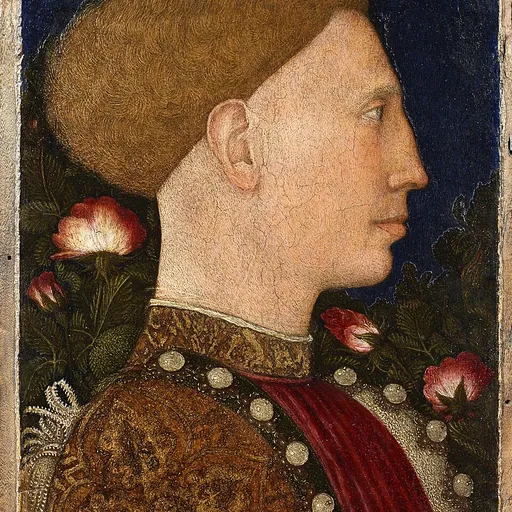
About Leonello d'Este, Marquis of Ferrara
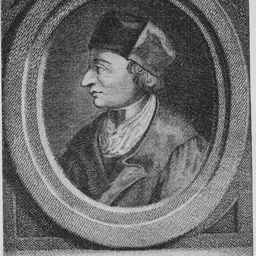
Lived 1407 – 1450 (aged 43). Leonello d'Este, Marquis of Ferrara was a ruler, patron of the arts and philosopher.
Leonello d'Este (also spelled Lionello; 21 September 1407 – 1 October 1450) was Marquess of Ferrara, Modena, and Reggio Emilia from 1441 to 1450. Despite the presence of legitimate children, Leonello was favoured by his father as his successor. In addition, his virtuous qualities, high level of education, and popularity among the common people as well as his formal papal recognition ultimately made him the most suitable heir.
Leonello had little influence over the Italian political landscape and aristocracy in Ferrara. Contrary to other prior d’Este family leaders, such as Azzo VII, Niccolò III, and Isabella d’Este, who had a drive for power and control, Leonello is recognized principally for his sponsorship of the arts, literature, and culture. In 1441–1450, his learned courts and developing knowledge assisted him in transforming the city of Ferrara. Under the guidance of Guarino Veronese, his humanist teacher, and with the approval of the commune, Leonello began the reformation, particularly, the University of Ferrara.
Leonello not only elevated the humanistic cultural movements during his rule, but it also influenced the political and artistic advancements of his successors. Leonello d’Este served as the precursor of the achievements in the history of the House of Este.
Biography Leonello was one of three illegitimate sons of Niccolò d'Este III and Stella de' Tolomei. He received a military education under the condottiero Braccio da Montone, and was tutored by Guarino Veronese, later appointed professor at the University of Ferrara, who also instructed him on the traits of a desirable ruler and how to govern. In 1425, after the execution of his elder brother Ugo Aldobrandino, he was the sole heir of Niccolò. In 1435, he married Margherita Gonzaga on 6 February and was recognized as legitimate son by Pope Martin V. Margherita, who died in 1439, gave birth to a child, Niccolò, in 1438, who is also known as Niccolò di Leonello to avoid confusion with his grandfather Niccolò d'Este III. Niccolò the son died in 1476. In late December 1441, Leonello succeeded to his father's possessions after his death in northern Italy.
Coming from a strong academic background, Leonello brought significant unprecedented economic, political, and cultural changes to Ferrara right after he took over from Niccolò III. In May 1444, Leonello married Mary of Aragon who was at the age of 19, an illegitimate daughter of King Alfonso V of Naples. The marriage was a political one. To ensure the political stability within Ferrara, Leonello remained neutral in the political affairs between Milan and Venice. However, Leonello's circumstances for securing his rights to succession differed from his father's, primarily because Niccoló was Alberto's only son while Leonello was in a competition with his younger legitimate brothers.
In the presence of his legitimate sons from his later marriage, Niccoló needed to prove that Leonello was qualified to be chosen as his successor. Niccoló defended Leonello's rights to succession on three grounds: Leonello's personal attributes, popularity among his subjects, and official papal recognition. Leonello was often praised for exhibiting strong leadership skills and virtuous characteristics, which would make him a worthy heir and future ruler of Ferrara. His father noted that this high level of education further distinguished Leonello from his siblings. Leonello was also popular among the people and his father recognized the wide support that Leonello would receive from his subjects, who approved of Leonello being chosen as Niccoló's successor. Thus, by 1434, Leonello was given a great deal of authority to co-rule with his father.
Leonello's succession and subsequent marriage would also serve an important role in relations with neighbouring city-states. Previously, the House of Este owed a great debt to Gianfrancesco Gonzaga, the ruler of Mantua. This also reflects the gender attitudes regarding the political successions in the House of Este during this time period. A greater preference was given for illegitimate sons to become successors, instead of legitimate daughters. Leonello himself was also succeeded by a man who had an illegitimate birth status. His brother, Borso, who was born from the same mother of Leonello, was later chosen to be Leonello's successor.
Culture, art and literature
Culture
University The University of Ferrara dates back to 1391. It was not until 1442—one year into the reign of Leonello d’Este—that it became a fully operational university with an adequate number of professors to instruct the major subjects of canon law (church law), logic, philosophy and medicine.
A meeting in January 1442 between Leonello and the commune, resulted in the agreement for the need for a university, saying it would be "a distinguished center of learning [that] would bring renown to the city, local men would more easily obtain degrees, and an influx of students would bolster the city’s economy." In order to raise funds, the commune placed a sales tax on meats and through the money raised was able to pay a large portion of the faculty for the university; Leonello contributed financially in order to keep the university afloat. Leonello's education of the new principles in the studia humanitatais Decembrio's connection to Leonello comes from his work he wrote before 1447, the De Politia Litteraria Variisque Poetae Virgilli Laudbibus, which was a dialogue divided into three volumes; four more books were added around 1462. The treatise was about how to successfully sustain the refinement of literature/politia litteraria in a courtly environment. He would perform his music on a lute. Pietrobono's first appearance was in the early court of Leonello d' Este of 1441. by Leonello which was the sum that was apparently the common payment that the Este family had use in the past, with such people as Dufay in 1437. Leonello's interest in Roman Antiquity had to do with his education and exposure to humanism under the instruction of his tutor Angelo Decembrio. The medals from 1441, 1444 and 1450 all demonstrate the characteristics of Leonello and/or his court. Each coin has on one side a portrait of Leonello in Roman emperor portraiture style, and has on the other side an image that represents Leonello and his court. The design with the lion and angels represented aspects of the Este family history, specifically with association to Leonello and his court. This coin is also in the Victoria and Albert Museum. Stahl also mentions that the replication process was developed about a century after Leonello's death, so even though Pisanello's coins were for Leonello – according to Alan – it was the beginning of the development for replication within Ferrara, which would develop in the following centuries. Leonello d’Este employed him in 1447, and Giovanni's only identified picture is his portrait of Leonello. The book detailed the concerns regarding materials, construction, overall principles and foundation of the overall design, and the ideas behind public and private buildings. It also spoke about the different types of building façades and discussed ways to fix construction errors. In 1441, Leonello invited Alberti to judge a competition to find an artist to create a sculpture of his father. Through his influence as Marquis and the family name of Este, Leonello was able to develop the De Re Aedificatoria under his reign. Dukes in Ferrara were elected through a formal voting process by the citizens. When appointed they were given a hereditary title. After the marriage of Azzo V to the heiress of a rival family and the successor of Obizzo I, grandson Azzo VII, bringing political prominence to Ferrara. By 1240, Azzo VII had control of Ferrara (in alliance with Pope Gregory IX), which marked the start of the Este rule. The Estense government was faced with papal opposition from the onset, however, by the start of the 14th century had recovered its political influence and strength under Nicolo II. His successor, Nicolo III is remembered for having further strengthened power in Ferrara and introducing the Estense political influence to Italy. Succeeding a Paduan attempt to gain authority in Ferrara, Nicolo III was commended as go-between in the political and military disputes in the Italian states, extending Ferrara's territory and domain. Leonello's education by humanist Guarino Veronese directed his interest towards the humanism and art. Leonello was chosen to be the heir of the d’Este patrimony through papal sanction, by his father at the age of 21. After the passing of his first wife, Margherita Gonzana, Leonello married Maria d’Aragona, an illegitimate daughter of the King of Naples. Leonello's leadership did result in some minor improvements to the local economy in Ferrara, however, his major influence remained in the cultural sphere. Leonello's governing also brought improvements to the court library, commissioning copyists to produce manuscripts in both French and Italian. The construction of a Chapel during Leonello's governing is demonstrative of this new concentration of the domestic domain of the Este court. Over time Leonello's rule in Ferrara has been defined by his cultural contributions.
Political influence following Leonello Leonello's rule was followed in Ferrara by his half-brother Ercole I, who garnered substantial political support. Succeeding Ercole I was another significant political player in the House of Este, Isabella d’Este, whom married Francesco Gonzaga in 1490. Isabella is remembered for her determination and unusual aptitude for a forward-thinking "political strategy". Borso d'Este, his brother, succeeded the throne of Marquis of Ferrara. In stark contrast to his brother, Borso received little education and was more interested in political affairs. During the reign of Borso, the legacy of art and literature proceeded with a rather stagnant growth as they were mostly used for military propaganda and entertainment. Aside from cultural developments, however, Borso utilized the foundation laid down by his brother, Leonello, to assist him in reforming the structure and organization of the state. In particular, the diplomatic relationship previously built up by Leonello served as a basis for Borso to further leverage its alliance with other cities. The impact of Leonello, however, was much greater and lasted much longer than the reign of Borso. The ties between the Kingdom of Naples and Ferrara carried on to the realm of Ercole, who succeeded Borso d’Este as Duke of Ferrara. Ercole married with Eleonora d’Aragona, Maria's niece, under the same contract Leonello signed in 1444 with Naples.
Don’t just read it —
keep it.
Full-length biographies made to live with: read them, listen on the way to work, watch them tonight.
- E-book
- Audio
- Video
Instant download · yours to keep · every purchase keeps this site free
Important facts
People in Leonello d'Este, Marquis of Ferrara's life
Named in this biography and alive at the same time


Related people
Same field, nearest in time



Contemporaries
People whose lives overlapped Leonello d'Este, Marquis of Ferrara's



Frequently asked questions
Who was Leonello d'Este, Marquis of Ferrara?
Italian noble (1407-1450)
When was Leonello d'Este, Marquis of Ferrara born?
Leonello d'Este, Marquis of Ferrara was born on 21 September 1407 in Ferrara.
When did Leonello d'Este, Marquis of Ferrara die?
Leonello d'Este, Marquis of Ferrara died on 1 October 1450 in Voghiera.
What was Leonello d'Este, Marquis of Ferrara's occupation?
Leonello d'Este, Marquis of Ferrara was a ruler, patron of the arts and philosopher.
Sources & further reading
· Wikipedia: Leonello d'Este, Marquis of Ferrara
Cite this page
APA: Biography.guide. (2026). Leonello d'Este, Marquis of Ferrara. https://biography.guide/leonello-d-este-marquis-of-ferrara/
MLA: "Leonello d'Este, Marquis of Ferrara." Biography.guide, https://biography.guide/leonello-d-este-marquis-of-ferrara/.
Chicago: "Leonello d'Este, Marquis of Ferrara." Biography.guide. https://biography.guide/leonello-d-este-marquis-of-ferrara/.
Data last updated: 2026-09-23 · Spot an error? Report a correction.
Portrait: Wikimedia Commons · author & licence
Page generated 2026-09-27 05:06 UTC