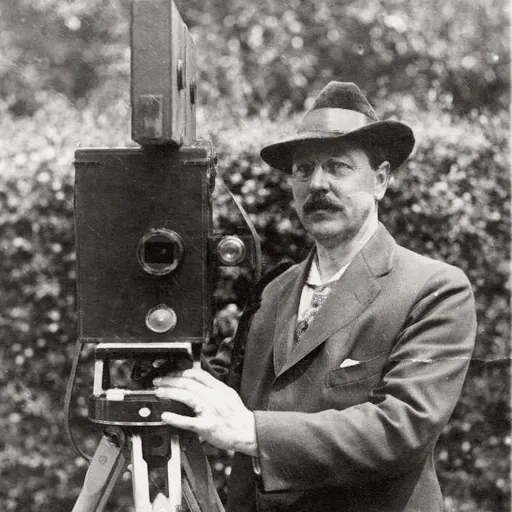
About Leon Douglass
Lived 1869 – 1940 (aged 71). Leon Douglass was an American inventor and businessperson, known for Inventor.
Leon Forrest Douglass (March 12, 1869 – September 7, 1940) was an American inventor and co-founder of the Victor Talking Machine Company who registered approximately fifty patents, mostly for film and sound recording techniques.
Life and professional career Douglass was born in rural Nebraska, near present-day Syracuse. His parents were Seymour James Douglass, a millwright and carpenter, and Mate (Fuller) Douglass. He attended grammar school in Lincoln, Nebraska, was apprenticed to a printer, at eleven was working as a telegraph messenger, and by seventeen was telephone exchange manager for the Nebraska Telephone Company in Seward.
Phonograph In 1888, Douglass saw a phonograph for the first time and was fascinated. He made his own and took it to Omaha to show it to E.A. Benson, president of the Nebraska Phonograph Co., who hired him as the company’s agent for the western part of the state. In 1889 he invented a nickel-in-the-slot attachment for the phonograph. Benson paid $500 for the patent and promoted Douglass to a job with the Chicago Central Phonograph Company, which he also owned and that was part of the Thomas Edison-affiliated North American Phonograph Company, distributor for the Edison Phonograph. In the early 1890s Douglass invented a machine for duplicating phonograph cylinders and became known as "Duplicate Doug." He sold this patent to Edward Easton, director of the American Graphophone Company and president of the Columbia Phonograph Company, moved to Washington D.C. and worked for Easton briefly before returning to the Chicago Central Phonograph Company as a manager in 1892. He was elected vice president and treasurer, and secured a concession for a hundred slot phonographs at the World's Columbian Exposition, better known as the 1893 Chicago World's Fair. At the fair he also met Peter Bacigalupi of Lima, Peru and San Francisco; he shipped phonographs to Lima for him and later traveled to San Francisco where he met his step-sister Victoria Adams, whom he married in 1897. After the Chicago fair closed, Douglass bought the hundred slot phonographs and secured a concession for the 1894 Midwinter Fair in San Francisco; this concession and the phonographs were ultimately taken over by Bacigalupi, who then used the machines to open a phonograph arcade on Market Street. Douglass said it was named after his wife, but others think it more likely Johnson chose the name to celebrate his engineering and legal triumphs.
In fall 1906, a few months after the birth of his son Eldridge, Douglass had a nervous breakdown followed by other health problems and became unable to work. He moved his family from Philadelphia to San Rafael, California. He wrote in his autobiography: I urged Mr. Johnson to accept my resignation. He refused and I was then elected to the office of the Chairman of the Board of Directors. I also urged Mr. Johnson to stop my salary of $25,000.00 per year, which they had kept up all during my illness, but Mr. Johnson replied that if the Victor Co. paid me that amount as long as I lived they could not pay for what I had done for them. Twice, in the early days, by my action alone, I had saved the Victor Co. from going out of business. Douglass named it Victoria Manor, in honor of his wife. He installed a workshop with lathes, milling machines, and drill presses in the basement, movie equipment on the first floor, and his laboratory workshop on the mezzanine. Since 1945 the house (now in Atherton) has been owned by the Menlo School and called Douglass Hall.
In 1932, at the invitation of the Smithsonian Institution, Douglass participated in a scientific expedition off Easter Island, where he filmed at depths up to 1,500 feet using his submarine cameras and also an underwater "flashlight" that he also patented. In the mid-1930s he participated in a classified US Navy operation filming the ocean floor near Pearl Harbor and other strategic sites in Hawaii. Duplication process for phonograph cylinders (early 1890s) Semi-cabinet, stand, record cabinet for phonograph (September 1903-December 1904) First successful subtractive color movie process (1916) Triple-scene dissolve movie camera (1921-1922) Spring-actuated cigarette lighter (1924) Zoom lenses anamorphic lens for wide-angle filming Special-effects movie cameras Underwater cameras Underwater "flashlight"
Don’t just read it —
keep it.
Full-length biographies made to live with: read them, listen on the way to work, watch them tonight.
- E-book
- Audio
- Video
Instant download · yours to keep · every purchase keeps this site free
Important facts
People in Leon Douglass's life
Named in this biography and alive at the same time



Related people
Same field, nearest in time

Contemporaries
People whose lives overlapped Leon Douglass's



Frequently asked questions
Who was Leon Douglass?
American inventor and film maker
When was Leon Douglass born?
Leon Douglass was born on 12 March 1869 in Nebraska.
When did Leon Douglass die?
Leon Douglass died on 7 September 1940 in San Francisco.
What was Leon Douglass's occupation?
Leon Douglass was an inventor and businessperson.
What was Leon Douglass known for?
Leon Douglass was known for Inventor.
What nationality was Leon Douglass?
Leon Douglass was American.
Sources & further reading
Cite this page
APA: Biography.guide. (2026). Leon Douglass. https://biography.guide/leon-douglass/
MLA: "Leon Douglass." Biography.guide, https://biography.guide/leon-douglass/.
Chicago: "Leon Douglass." Biography.guide. https://biography.guide/leon-douglass/.
Data last updated: 2026-09-22 · Spot an error? Report a correction.
Page generated 2026-09-27 05:09 UTC