
About Leo Loeb
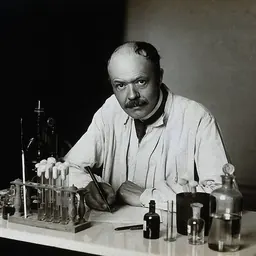
Lived 1869 – 1959 (aged 90). Leo Loeb was an American and German physician, pathologist and university teacher, known for Cancer.
Leo Loeb (September 21, 1869 – December 28, 1959), was a German-American physician, educator, and experimental pathologist.
Early life Loeb, son of a Jewish family from the German Eifel region, was born in 1869 in Mayen, Kingdom of Prussia. He was orphaned as a child and grew up in the care of an uncle. Because of ill health, Leo was educated in schools that were located in German "spa" towns. As a teenager, he enrolled at the University of Heidelberg, but his tenure there was short. Indeed, over the succeeding couple of years, he spent only brief periods at several universities, in Berlin, Freiburg, and Basel, unable to focus his interests. Finally, in 1890, Loeb entered the University of Zurich Medical School. Loeb became interested in blood coagulation and the growth properties of malignant cells. As an outgrowth of the latter topic, Loeb developed the cell culture technique as applied to both normal and abnormal tissues.
Loeb was next asked to join the faculty at McGill University in Montreal; however, that posting lasted only one year because of his inability to acclimatize himself to the harsh Canadian winter. He moved to the University of Pennsylvania in Philadelphia in 1903, beginning a series of important experiments on the influence on cancer growth by reproductive hormones.
Loeb was one of the co-founders of the American Association for Cancer Research in 1907, and served as its president in 1911-1912.
By 1910, Loeb had acquired a national reputation for his work on cancer. That work predated clinical application of the same concept in human breast cancer by several decades.
In 1915, Loeb was appointed as professor of comparative pathology at Washington University School of Medicine (WUSM). In 1924, Loeb was given the chairmanship of pathology at WUSM; thereafter, he continued his work on tissue transplantation and cell culture, as well as research on endocrine disease. Loeb was known as a patient, kind, and helpful mentor to younger colleagues in the department. This train of thought was reflected in another publication, in 1945, of a book entitled The Biological Basis of Individuality. Loeb proposed three levels of human thought-- "hypnosuggestion;" "reasoning thought;" and "thoughts and interests represented by problems of philosophy and science."
Personal life and death Having long deferred family life to concentrate on his research, Loeb Married Dr. Georgiana Sands, a practicing physician, in 1922, when he was 53. After their marriage, Georgiana became his scientific, administrative, and literary partner for the remainder of their lives together. They remained in St. Louis until his death at the age of 90 on December 28, 1959. He was elected to the United States National Academy of Sciences in 1937.
Don’t just read it —
keep it.
Full-length biographies made to live with: read them, listen on the way to work, watch them tonight.
- E-book
- Audio
- Video
Instant download · yours to keep · every purchase keeps this site free
Important facts
Related people
Same field, nearest in time




Contemporaries
People whose lives overlapped Leo Loeb's





Frequently asked questions
Who was Leo Loeb?
German–American pathologist
When was Leo Loeb born?
Leo Loeb was born on 21 September 1869 in Mayen.
When did Leo Loeb die?
Leo Loeb died on 28 December 1959 in St. Louis.
What was Leo Loeb's occupation?
Leo Loeb was a physician, pathologist and university teacher.
What was Leo Loeb known for?
Leo Loeb was known for Cancer.
What nationality was Leo Loeb?
Leo Loeb was American and German.
Sources & further reading
Cite this page
APA: Biography.guide. (2026). Leo Loeb. https://biography.guide/leo-loeb/
MLA: "Leo Loeb." Biography.guide, https://biography.guide/leo-loeb/.
Chicago: "Leo Loeb." Biography.guide. https://biography.guide/leo-loeb/.
Data last updated: 2026-09-20 · Spot an error? Report a correction.
Page generated 2026-09-27 05:29 UTC