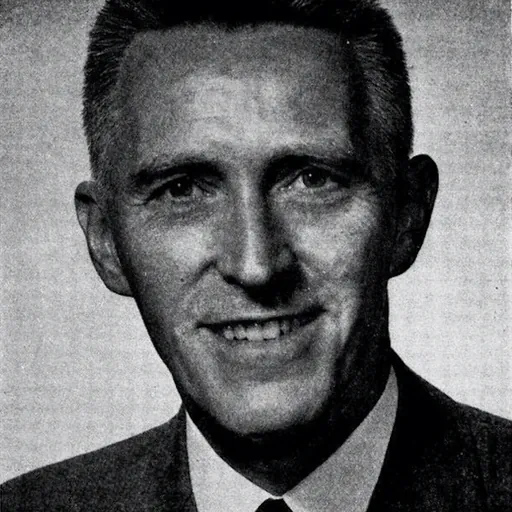
About Leo Hoegh
Lived 1908 – 2000 (aged 92). Leo Hoegh was an American lawyer, politician, governor and jurist.
Leo Arthur Hoegh ; March 30, 1908 – July 15, 2000) was a decorated U.S. Army officer, lawyer, and politician who served as the 33rd governor of Iowa from 1955 to 1957.
His record of public service included important contributions to his home state and to his country. His career in elective office came to an early end, after his willingness to raise taxes to jump-start improvements to Iowa's roads and schools alienated his conservative Republican allies, and handed Democratic gubernatorial nominee Herschel C. Loveless an issue to exploit.
Early life
Hoegh was born on a farm in Audubon, Iowa in 1908, to William Hoegh, who was the president of the farmer Savings Bank of Elkhorn, Iowa, and Annie (Johnson) Hoegh. He competed in swimming and was selected for membership the original Iowa Honor Society, forerunner to the national honor society, Omicron Delta Kappa.
Post-war activities
After the war, Hoegh returned to Iowa to resume his law practice in Chariton. Eager to return to public service at a higher level, he ran in the 1948 Republican primary against incumbent Republican Congressman Karl M. LeCompte. LeCompte won the primary and the general election.
Putting himself at odds with the more conservative factions that controlled the Iowa Republican Party in the decade after the end of the war, Hoegh became an active supporter of Former Minnesota Governor Harold Stassen in his bid for the 1948 Republican nomination for president, and former General Dwight Eisenhower in his bid for the 1952 Republican nomination for president.
Iowa Attorney General
In February 1953, he was appointed Iowa Attorney General by Governor William Beardsley, filling a position created by Beardsley's appointment of Robert L. Larson to the Iowa Supreme Court.
As chief executive, he championed the cause of education and orchestrated a major increase in funding for the state universities and the public schools. A supporter of labor unions, Hoegh urged repeal of the right-to-work law in the state.
To balance the budget while accomplishing his ambitious agenda, Hoegh sought to increase revenues by more than $31 million, to be collected through proposed increases in the taxes on beer, cigarettes and gasoline, a capital-gains tax and extension of the sales tax to include services. The Republican-controlled General Assembly approved enough tax increases to bring in $22 million a year, and Hoegh found himself labelled by his Democratic opponents as "High-Tax Hoegh." Meanwhile, his support for a union shop alienated a traditional ally of Iowa Republicans, the Iowa Manufacturers Association, without disturbing labor's allegiance to the Iowa Democratic Party.
In his race for re-election in 1956, Hoegh won the Republican primary. Two weeks before the election, Time Magazine placed Hoegh's face on its cover. The cover story ended with this prediction:
His principal problem is that he has caught the spirit of an era that is beginning to recognize the need for a resurgence of good local and state government—and, in doing so, he has perhaps stirred his quiet state too much. But if he has gone too far too fast, he can take a governor's small comfort from the conviction that one year—if not this year—his state will forget the anthills and look with satisfaction on the considerable movements of home-grown progressive government.
Hoegh lost to Democratic nominee Herschel C. Loveless, by 29,469 votes.
Post-Governorship Offices
In July 1957, President Dwight D. Eisenhower appointed him as federal administrator of civil defense. In 1958, Eisenhower appointed Hoegh director of the Office of Civil and Defense Mobilization. He was a member of the National Security Council, and helped to represent the United States at emergency planning meetings with NATO.
After John F. Kennedy's inauguration, Hoegh moved into the private sector, heading the backyard bomb-shelter division of Wonder Building Corporation of Chicago. and he returned to practicing law.
Later life
In 1964, he moved to Denver, then Chipita Park, and finally Colorado Springs. Hoegh moved his law practice to Chipita Park, Colorado, where he practiced from 1965 until his retirement in 1985. He died in Colorado Springs, Colorado in 2000, and was interred there at the Evergreen Cemetery.
Many of his ancestors reside in the Danish community of Elk Horn, Iowa and the extended areas of Audubon and Shelby County.
Don’t just read it —
keep it.
Full-length biographies made to live with: read them, listen on the way to work, watch them tonight.
- E-book
- Audio
- Video
Instant download · yours to keep · every purchase keeps this site free
Important facts
People in Leo Hoegh's life
Named in this biography and alive at the same time


Related people
Same field, nearest in time



Contemporaries
People whose lives overlapped Leo Hoegh's


Frequently asked questions
Who was Leo Hoegh?
American politician (1908-2000)
When was Leo Hoegh born?
Leo Hoegh was born on 30 March 1908 in Audubon County.
When did Leo Hoegh die?
Leo Hoegh died on 15 July 2000 in Colorado Springs.
What was Leo Hoegh's occupation?
Leo Hoegh was a lawyer, politician, governor and jurist.
What nationality was Leo Hoegh?
Leo Hoegh was American.
Sources & further reading
Cite this page
APA: Biography.guide. (2026). Leo Hoegh. https://biography.guide/leo-hoegh/
MLA: "Leo Hoegh." Biography.guide, https://biography.guide/leo-hoegh/.
Chicago: "Leo Hoegh." Biography.guide. https://biography.guide/leo-hoegh/.
Data last updated: 2026-09-20 · Spot an error? Report a correction.
Page generated 2026-09-27 05:09 UTC