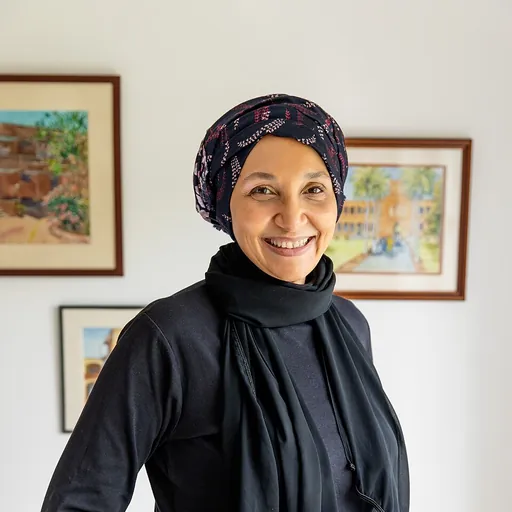
About Leila Aboulela
Born 1964. Leila Aboulela is a Sudanese novelist, writer and playwright.
Leila Fuad Aboulela (Arabic:ليلى فؤاد ابوالعلا; born 1964) is a fiction writer, essayist, and playwright of Sudanese origin based in Aberdeen, Scotland. She grew up in Khartoum, Sudan, and in 1990 moved to Scotland, where she began her literary career. As of 2023, Aboulela has published six novels and several short stories, which have been translated into fifteen languages. Her most popular novels, Minaret and The Translator (1999) both feature the stories of Muslim women in the UK and were longlisted for the International Dublin Literary Award and Orange Prize. Aboulela's works have been included in publications such as Harper's Magazine, Granta, The Washington Post and The Guardian. BBC Radio has adapted her work extensively and broadcast a number of her plays, including The Insider, The Mystic Life and the historical drama The Lion of Chechnya. The five-part radio serialization of her 1999 novel The Translator was short-listed for the Race In the Media Award (RIMA).
Aboulela was announced on 9 July 2025 as the winner of the PEN Pinter Prize, awarded annually by English PEN.
Early life and education Born in 1964 in Cairo, Egypt, to an Egyptian mother and a Sudanese father, Aboulela moved at the age of six weeks to Khartoum, Sudan, where she lived continuously until 1987. Aboulela's father comes from a prominent Sudanese family – his cousin is poet Hassan Awad Aboulela – and he studied at Victoria College in Egypt and Trinity College, Dublin. Her multicultural upbringing was marked by summer vacations in Cairo, where she was able to form a connection with her mother's family and absorb Egyptian culture through food, popular media, and film. Aboulela grew up speaking both English and Arabic; however, she recalls being the victim of bullying at school due to her use of colloquial Egyptian Arabic, which she learned from her mother.
Personal life As of 2012, Aboulela lives in Aberdeen, Scotland. Her husband, Nadir Mahjoub, an oil engineer, is half-Sudanese, half-British, a younger brother of the novelist Jamal Mahjoub, and she counts among the influences on her writing his English mother, the late Judith Mahjoub. In 1990, Aboulela moved to Aberdeen with her husband and children, a move she cites as the inspiration for her first novel, The Translator. Aboulela began writing in 1992 while working as a lecturer at Aberdeen College and later as a research assistant at the University of Aberdeen. In 2006, she moved back to Khartoum to care for her ailing father, who died in 2008. Aboulela is a devout Muslim, and her faith informs much of her written work.
Literary career Aboulela began writing at the age of 28, following a move to Aberdeen, Scotland, with her two young children spurred by her husband's work in the oil rigs. The anthology includes several genres such as autobiography, memoir, letters, short stories, novels, poetry, drama, humour, journalism, essays and speeches.
In a 2023 interview, Aboulela expressed her views on African historical novels and her motivation for using sources written in African languages:
Novels
The Translator: Originally published in 1999, The Translator, a Muslim retelling of Jane Eyre, is Aboulela's first novel. It tells the story of a Sudanese widow in Scotland who works as a translator and her relationship with her secular Scottish employer. Minaret: Published in 2005, Minaret is centred on Najwa, who was forced to flee Sudan and live in exile in London following a coup that overthrew the regime her father, a minister, served under. Najwa's story is one of culture shock, love, islamophobia, and immigration. It also describes a young woman's journey to survive and find a home in a new, unfamiliar environment. Lyrics Alley is directly inspired by the life of her uncle, poet Hassan Awad Aboulela. The Kindness of Enemies: Published in 2015, The Kindness of Enemies depicts the story of a half-Russian, half-Sudanese professor who embarks on a journey to document the life of a Muslim historical figure, Imam Shamil, who gained notoriety through his leading role in the anti-Russian resistance movement of the Caucasian War. Set in 2010, the book also tackles the theme of life as a Muslim in the post-9/11 era. The trip evolves into one of adventure and self discovery for the women. The freedom afforded to them through the distance from their homes and the lush Scottish landscape inspires them to reflect on their lives and the decisions which brought them to where they are.
Short-story collections Coloured Lights: Originally published in 2001, Coloured Lights is Aboulela's first short-story collection. It contains eleven short stories. The collection features the stories of young Sudanese women in varying settings, as they navigate their lives in search of meaning and belonging. Many of the stories depict the immigrant experience and the challenges of transitioning from life in the East to the culture of the West. Aboulela's short story "The Museum" – which is included in Coloured Lights – was awarded the inaugural Caine Prize for African Writing in 2000. It recounts the story of a Sudanese student in Aberdeen and her first date with her Scottish classmate. The titular museum refers to the story's critique of the exhibition of African art in Scottish museums and the colonial legacy of institutions. Depicting tales of multicultural relationships, friendships, and loss, Elsewhere, Home is a collection of stories that follow the lives of characters as they transform and reinvent themselves. The stories are set in Abu Dhabi, Aberdeen, Edinburgh, and London. The Mystic Life is an adaptation of a story from her short-story collection, Coloured Lights, while The Lion of Chechnya recounts the story of Imam Shamil (1797–1871), a Muslim political leader and the subject of her novel, The Kindness of Enemies. Her prose impressed Kim Hedges of the San Francisco Chronicle, who wrote: "Aboulela's prose is amazing. She handles intense emotions in a contained yet powerful way, lending their expressions directness and originality, and skillfully capturing the discrete sensory impressions that compound to form a mood."
She is recognized for her nuanced depictions of Muslim immigrants, the intricacies of inter-cultural relationships, Islam, and female characters who subvert social expectations.
Among her works, her second novel Minaret (2005) has drawn the most critical attention. Minaret was lauded as a "brilliant success" and a "beautiful, daring, challenging novel" by Mike Phillips writing for The Guardian.
She is considered an African, Arab, Scottish, and diasporic female author by her audience of critics, literary prize boards, and researchers. Further, this novel was selected by Brittle Paper literary magazine as one of the 100 Notable African Books of 2023.
Don’t just read it —
keep it.
Full-length biographies made to live with: read them, listen on the way to work, watch them tonight.
- E-book
- Audio
- Video
Instant download · yours to keep · every purchase keeps this site free
Important facts
People in Leila Aboulela's life
Named in this biography and alive at the same time



Related people
Same field, nearest in time





Contemporaries
People whose lives overlapped Leila Aboulela's


Frequently asked questions
Who is Leila Aboulela?
Sudanese writer and playwright
When was Leila Aboulela born?
Leila Aboulela was born in 1964 in Cairo.
What is Leila Aboulela's occupation?
Leila Aboulela is a novelist, writer and playwright.
What nationality is Leila Aboulela?
Leila Aboulela is Sudanese.
Sources & further reading
Cite this page
APA: Biography.guide. (2026). Leila Aboulela. https://biography.guide/leila-aboulela/
MLA: "Leila Aboulela." Biography.guide, https://biography.guide/leila-aboulela/.
Chicago: "Leila Aboulela." Biography.guide. https://biography.guide/leila-aboulela/.
Data last updated: 2026-09-21 · Spot an error? Report a correction.
Portrait: Wikimedia Commons · author & licence
Page generated 2026-09-27 05:01 UTC