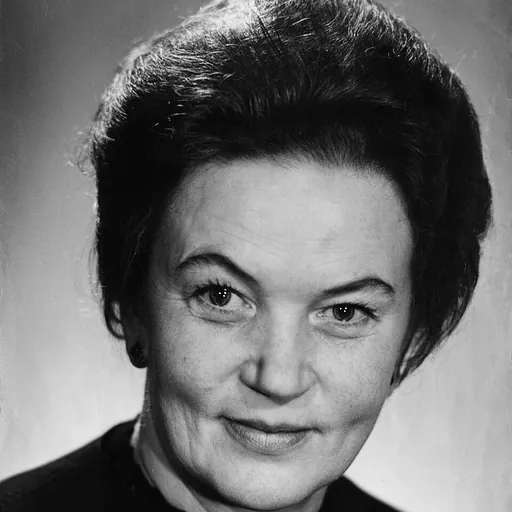
About Leida Laius
Lived 1923 – 1996 (aged 73). Leida Laius was a Russian and Estonian film director, director, screenwriter and actor.
Leida Laius (26 March 1923 – 6 April 1996) was an Estonian film director. She is widely received as one of the most renowned filmmakers in Estonian cinema. In 1995 she was honored by the Estonian Cultural Foundation with the Lifetime Achievement Award in special recognition of her contributions to the cultural history of Estonia.
Life Leida Laius was born in Horoshevo, Yamburgsky Uyezd into an Estonian farming family and grew up in Jamburg, later renamed Kingisepp, near Saint Petersburg. Her mother Armanda (née Sepp) came from an upper-middle-class family in Narva. Her father Richard was deported to a labor camp as a kulak during the Stalin era in the late 1930s and executed there as part of the so-called Great Purge.
Leida Laius volunteered for the Red Army during World War II and served as a nurse in the field hospital for the lightly wounded No. 3826 of the 22nd Army and as a librarian. She was a member of the Komsomol and a non-commissioned officer in the administrative service. For her military service, she was awarded the Medal "For Battle Merit" in 1944, the Medal "For the Victory over Germany in the Great Patriotic War 1941–1945" in 1945 and the Order of the Patriotic War second Class in 1985.
After the Soviet reoccupation of Estonia in 1944, she came to Tallinn. From 1945 to 1947 she worked as an inspector in the Ministry of Food Industry, from 1947 to 1949 as an official in the office of the Architects' Association and from 1950 to 1951 as an inspector in the theater department of the Estonian Ministry of Culture. From 1960, she worked at Tallinnfilm. In 1962, Laius graduated from the Gerasimov Institute of Cinematography (then the All-Union State Institute of Cinematography), the state film school in Moscow, with a diploma in directing.
Laius died in Tallinn on 6 April 1996, age 73 and was buried next to her mother at Pärnamäe Cemetery in the Pirita district of Tallinn.
Eva Näripea, the director of the Estonian Film Archives, compared Leida Laius's films to the new narrative forms of the so-called "Thaw Cinema", an era of a new wave of cinema of the 1960s in the Soviet Union. The Estonian film critic Olev Remsu rated the film Libahunt as one of the ten best films of Estonian cinema.
Recognition
Jüri Sillart, who worked as a cinematographer on Varastatud kohtumine, Laius' last film, released a documentary about the film director in 2002, titled Leida's Story (original title: Kairiin).
On the occasion of her 100th birthday in 2023, an extensive retrospective of Leida Laius' life and work was held in Tallinn and Tartu, including film screenings, discussion events and exhibitions of set photographs from the Estonian National Archives' collection in the Elektriteatri and Sõprus cinemas. Her films were also made available on streaming platforms. In this context, a monument dedicated to her and created by the sculptor Flo Kasearus was unveiled in Lembitu Park in Tallinn on March 26, 2023.
The Estonian Film Museum presented a year-long exhibition titled Leida Laius. Lõpetamata naeratus (″Leida Laius. The Unfinished Smile″), which opened on March 31, 2023. On display were materials and objects from the film collection of the Estonian National Archives from Laius's private life and her film sets, which had not been accessible to the public until then. These included documents and materials from the planning phase of her films to their realization, screening and reception.
The 57th Karlovy Vary International Film Festival 2023 screened the film Stolen Meeting (Varastatud kohtumine) in the Out of the Past series. The film had been restored in 2022 with the support of A Season of Classic Films, an initiative of the Association des Cinémathèques Européennes, which is part of the Creative Europe MEDIA program.
The 75th Berlin International Film Festival 2025 will once again screen the film Games for Schoolchildren (Naerata ometi), which had won an award at the 1987 edition of the festival, in a 4K digitized and restored version as part of the Berlinale Classics series. The Estonian National Archives digitized the feature film on behalf of the Estonian Film Institute.
The 54th Festival La Rochelle Cinema 2026 will provide a retrospective of Leida Laius' works notably including screenings of Sündis Inimene, Lapsepõlv and Kodulinna Head Vaimud courts as well as Libahunt, Ukuaru, Kõrboja Peremees, Naerata Ometi and Varastatud Kohtumine films.
Filmography Õhtust hommikuni (short film, 1962) Mäed kui valged elevandid (1963) Mäeküla piimamees (1965) Libahunt (1968) Ukuaru (1973) Sündis inimene (documentary, 1975) Lapsepõlv (documentary, 1976) Jäljed lumel (documentary, 1978) Kõrboja peremees (1979) Kodulinna head vaimud (documentary, 1983) Naerata ometi (1985) (with Arvo Iho) Varastatud kohtumine (1988)
Awards (Selection)
1995: Lifetime Achievement Award of the Estonian Cultural Foundation
Naerata ometi 1986 Grand Prize at the All-Union Film Festival in Alma Ata 1986 Best Feature Film and Best Children's and Youth Film at the Soviet-Estonian Film Festival 1987 Berlin International Film Festival — UNICEF prize 1990 Prix Graine de Cinéphage, Festival International de Films de Femmes (FIFF), Créteil
Varastatud kohtumine 1989: Best Feature Film at the 5th Women in Film Festival and the presentation of the Lillian Gish Awards, held at the Directors Guild of America, Los Angeles 1990: Best Feature Film, Festival of Female Film Directors, Venice
Don’t just read it —
keep it.
Full-length biographies made to live with: read them, listen on the way to work, watch them tonight.
- E-book
- Audio
- Video
Instant download · yours to keep · every purchase keeps this site free
Important facts
People in Leida Laius's life
Named in this biography and alive at the same time



Related people
Same field, nearest in time


Contemporaries
People whose lives overlapped Leida Laius's
Frequently asked questions
Who was Leida Laius?
Estonian film director (1923-1996)
When was Leida Laius born?
Leida Laius was born on 26 March 1923 in Yamburgsky Uyezd.
When did Leida Laius die?
Leida Laius died on 6 April 1996 in Tallinn.
What was Leida Laius's occupation?
Leida Laius was a film director, director, screenwriter and actor.
What nationality was Leida Laius?
Leida Laius was Russian and Estonian.
Sources & further reading
Cite this page
APA: Biography.guide. (2026). Leida Laius. https://biography.guide/leida-laius/
MLA: "Leida Laius." Biography.guide, https://biography.guide/leida-laius/.
Chicago: "Leida Laius." Biography.guide. https://biography.guide/leida-laius/.
Data last updated: 2026-09-23 · Spot an error? Report a correction.
Portrait: Wikimedia Commons · author & licence
Page generated 2026-09-27 05:05 UTC