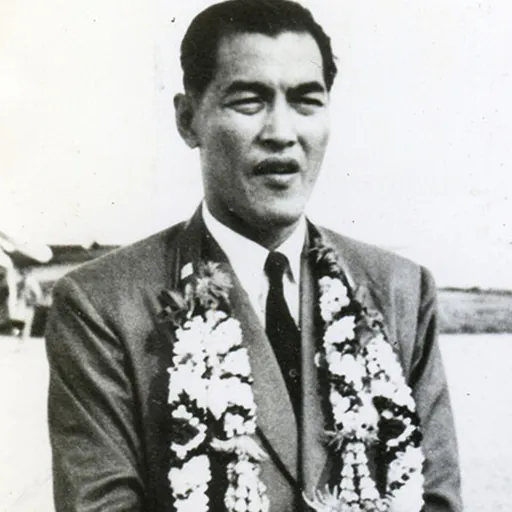
Lee Wai Tong
Chinese (Republic of China) footballer, Republic of China (Taiwan) football coach
About Lee Wai Tong
Lived 1905 – 1979 (aged 73). Lee Wai Tong was a Chinese and Taiwanese association football player and association football coach.
Lee Wai Tong (; 16 October 1905 – 4 July 1979 ) was a Hong Kong and Chinese international association football player, head coach, and former Vice President of FIFA. He is often regarded as the greatest Chinese footballer, due to his accomplishments in winning several Far Eastern Games titles with the national team of the Republic of China as well as captaining the national football squad on a 13-year unbeaten run in competitive games from 1923 to 1936, a streak that ended at their first ever Olympic tournament (held in Berlin).
This was also followed by having an extremely successful club career as a forward with the Hong Kong club South China where he won eight league titles with them, helping establish the club as the most successful team in the territory's history at the time. After his retirement, he moved into management where he guided the national men's football team of the Republic of China (which later played as Taiwan and Chinese Taipei) to win the 1954 Asian Games. Lee, nicknamed the "King of Asian football", was said to have scored at least 1,260 goals during his 25-year playing career,
Early life Lee Wai Tong poses with various trophies he won over his career. Lee Wai Tong was born in Tai Hang, Hong Kong, just outside the city, as the third child to a construction firm owner before he moved back to his parents home of Ng-Wah County in Mei-Chow, Kwangtung, China at the age of four. His father was born in Hong Kong while mother was , from Hsiang-Shan, Kwangtung Province (now Zhongshan). It was there that he was informally taught how to play football until he moved back to Hong Kong and was formally trained at Queen's College, Hong Kong. After these successes Lee returned to China and joined Fudan University in Shanghai as an athletic director. This allowed him the opportunity to join Loh Hwa, a gregarious team who were built from St. John's University, Shanghai, Shanghai Jiao Tong University, University of Shanghai, Jinan University and his own Fudan University sports team where they predominantly played in local and regional championships because they offered the only annual competitions within China during the amateur era.
In 1931, Lee returned to South China and won the 1932–33 Hong Kong First Division League title for the club. This would soon be followed by winning the 1934–35 and 1935–36 league titles, which was the first time they were able to retain the title.
After the Olympic Games, his football career was cut short by the Second Sino-Japanese War and World War II. Initially, Lee continued with his club career with South China until Hong Kong was also occupied by the Japanese. Lee was able to escape to Kwangtung (Guangdong) and joined the Chinese Army where he spent the war playing exhibition games to raise money for the war effort.
International career In May 1923, at the age of 17, Lee was called up to the China national team to represent them in the football tournament of the 1923 Far Eastern Championship Games held in Osaka, Japan. a record that still stands and only Pelé came the closest to breaking it (17 years and 241 days). China won the championship and Lee was considered the young stand-out star of the tournament.
Lee and China would go on a 13-year unbeaten run in competitive games from 1923 to 1936.
In total, Lee played 13 matches for China, scoring 13 goals.
In 1948 the China national team reappointed Lee as coach, this time for the 1948 Summer Olympics. On a self-financed training course in the Philippines and Thailand, he took the team away for three months while they prepared for the trip to London. At the tournament, China faced Turkey in the first round and lost 4-0. After the defeat Lee returned to China in the middle of the Chinese Civil War and did not coach until after the conflict. By then his team had been split into two, the Republic of China team (later renamed Chinese Taipei as the team was unable to use China in the FIFA membership) and the People's Republic of China team (which is ). In 1954 Lee decided to join the ROC team as their first permanent coach and lead them to win the 1954 Asian Games. He would continue to coach the team at the 1958 Asian Games where he guided the team to win the tournament once more by beating South Korea 3–2 in the final.
Along with his stint as coach, Lee was elected as a Secretary-General of the Asian Football Confederation in 1954. In 1965 he became the Vice President of FIFA, being the first ethnic Chinese person to reach that position.
In 1979, ROC President Chiang Ching-kuo issued a decree praising Lee for his contributions to football on Taiwan.
Honours
Player South China Hong Kong First Division: 1923–24, 1932–33, 1934–35, 1935–36, 1937–38, 1938–39, 1939–40, 1940–41
Voetbalbond Batavia en Omstreken (VBO) Dutch East Indies Championship: 1933
UMS Batavia HNVB Chineesche Stedenwedstrijden: 1932-1933
Republic of China Far Eastern Games: 1923, 1925, 1927, 1930, 1934
Manager Republic of China AFC Asian Cup: 3rd place, 1960 Asian Games: Gold medal, 1954, 1958
Don’t just read it —
keep it.
Full-length biographies made to live with: read them, listen on the way to work, watch them tonight.
- E-book
- Audio
- Video
Instant download · yours to keep · every purchase keeps this site free
Important facts
People in Lee Wai Tong's life
Named in this biography and alive at the same time


Related people
Same field, nearest in time



Contemporaries
People whose lives overlapped Lee Wai Tong's





Frequently asked questions
Who was Lee Wai Tong?
Chinese (Republic of China) footballer, Republic of China (Taiwan) football coach (1905-1979)
When was Lee Wai Tong born?
Lee Wai Tong was born on 16 October 1905 in Tai Hang.
When did Lee Wai Tong die?
Lee Wai Tong died on 4 July 1979 in Causeway Bay.
What was Lee Wai Tong's occupation?
Lee Wai Tong was an association football player and association football coach.
What nationality was Lee Wai Tong?
Lee Wai Tong was Chinese and Taiwanese.
Sources & further reading
Cite this page
APA: Biography.guide. (2026). Lee Wai Tong. https://biography.guide/lee-wai-tong/
MLA: "Lee Wai Tong." Biography.guide, https://biography.guide/lee-wai-tong/.
Chicago: "Lee Wai Tong." Biography.guide. https://biography.guide/lee-wai-tong/.
Data last updated: 2026-09-21 · Spot an error? Report a correction.
Portrait: Wikimedia Commons · author & licence
Page generated 2026-09-27 04:59 UTC