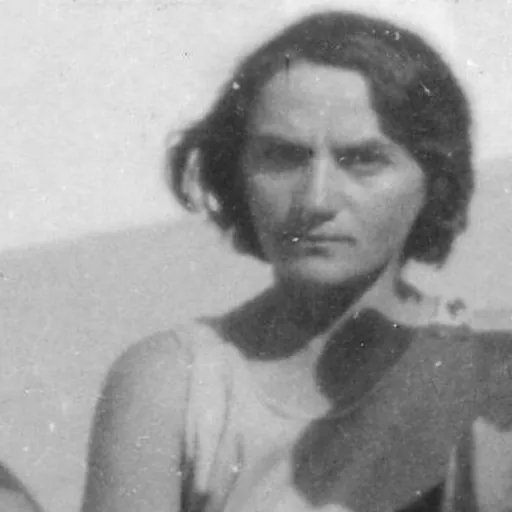
About Leah Bergstein
Lived 1902 – 1989 (aged 86). Leah Bergstein was an Israeli choreographer and dancer, known for Israeli folk dancing.
Leah Bergstein (; October 23, 1902 - 1989) of Galician Jews origin was among the first choreographers in Mandatory Palestine who created festival dances at kibbutzim. Bergstein is considered one of the "mothers" of early Israeli folk dance, inventing a new style of movement and laying the foundation of folk dance emerging as an Israeli cultural tradition. She was the only professional dancer to work in the original folk dance movement at the time.
Early life
Family
Bergstein was born in Bilshivtsi in Galicia (now in Ukraine). She was the daughter of Moshe Bergstein and Liba (née Shor). She had six siblings: David, Isaac, Effie, Haya Dirnal, Hannah Broner, and Rivka. When attending the Arab village festivity, Bergstein noted the ways in which women participated in the dabke, a traditionally male-dominant dance, from the Sheikh's wife's Laban-like sword dance and a girl's delicate walk through a circle of men dancing. Beginning in 1929, the shearing festivity was only held for two consecutive years, but it is nonetheless seen as a turning point for creating kibbutz festivities.
The Omer Festival
Celebrated on Passover eve, the Omer harvest festival, revived by Bergstein and Shelem at Ramat Yohanan, commemorated the ancient ritual cutting of the wheat. Bergstein built a stage in the field and covered the planks with wheat to create the illusion of dancing on the tops of wheat. This festival marked an important moment in the connection between the people and the land. Building upon the traditions of ancient ceremonies, Bergstein and Shelem added dances and songs to the old material, expanding the festivities to reflect contemporary values. Gurit Kadman, a festival folk dance organizer, once said Bergstein's Omer Festival was "the creation of the most original holiday in Israel, and the holiday dances are perhaps the most Israeli ones ever created." When Israel became independent, Bergstein added the dance "Hen Yerunan" (Also It Will Be Sung) to the festivities. Bergstein's choreography to "Masekhet ha-Omer" (Omer Pageant) has been performed outside of the context of the rural festival.
The Harvest Festival/The Water Festival The songs and dances in this festival expressed the joy of the harvest and Simchat Beit HaShoeivah. Bergstein's choreography included a dance with pitchers. In later years, the festival was renamed the Water Festival and celebrated around the swimming pool at Ramat Yohanan.
The Festival of First Fruits (Shavuot) In the 1940s, Bergstein and Shelem created a ceremony to celebrate Shavuot. The festival depicted the pilgrimage of the Jews who brought the Bikkurim to the steps of the Temple.
Tu BiShvat Bergstein choreographed dances for Tu BiShvat to celebrate the arrival of spring. Bergstein used various popular songs of the time for this festival.
Dissemination of Bergstein's dances Working in Tel Aviv, Bergstine solidified her belief in imbuing her work with a holiness of place, rather than creating for the stage.
Bergstein founded the Ramat Yohanan Dance Troupe and after the group dissolved and was replaced by the Beni ha-Ilhud Troupe, Bergstein continued to impart her ideas to the next generation through the second troupe at Ramat Yohanan.
Bergstein's dances have inspired subsequent Israeli folk-dance choreographers. She is part of a lineage of dancers and choreographers, including Gurit Kadman, Rivka Sturman, Sara Levi-Tanai, Yardena Cohen, Tirza Hodes, Shalom Hermon, Yoav Ashriel, Yonatan Karmon, and Moshiko (Moshe Itzhak-Halevy). Although Bergstein considered her dances to be inseparable parts of her pageants, they have become lasting features of Israeli folk dance and are still taught and performed around the world today.
Personal life Bergstein had three serious romantic relationships before her daughter Rahel was born in 1940, and Bergstein remained a single mother.
Don’t just read it —
keep it.
Full-length biographies made to live with: read them, listen on the way to work, watch them tonight.
- E-book
- Audio
- Video
Instant download · yours to keep · every purchase keeps this site free
Important facts
People in Leah Bergstein's life
Named in this biography and alive at the same time




Related people
Same field, nearest in time


Contemporaries
People whose lives overlapped Leah Bergstein's




Frequently asked questions
Who was Leah Bergstein?
Israeli choreographer
When was Leah Bergstein born?
Leah Bergstein was born on 23 October 1902 in Bilshivtsi.
When did Leah Bergstein die?
Leah Bergstein died on 14 May 1989 in Ramat Yohanan.
What was Leah Bergstein's occupation?
Leah Bergstein was a choreographer and dancer.
What was Leah Bergstein known for?
Leah Bergstein was known for Israeli folk dancing.
What nationality was Leah Bergstein?
Leah Bergstein was Israeli.
Sources & further reading
Cite this page
APA: Biography.guide. (2026). Leah Bergstein. https://biography.guide/leah-bergstein/
MLA: "Leah Bergstein." Biography.guide, https://biography.guide/leah-bergstein/.
Chicago: "Leah Bergstein." Biography.guide. https://biography.guide/leah-bergstein/.
Data last updated: 2026-09-23 · Spot an error? Report a correction.
Portrait: Wikimedia Commons · author & licence
Page generated 2026-09-27 05:05 UTC