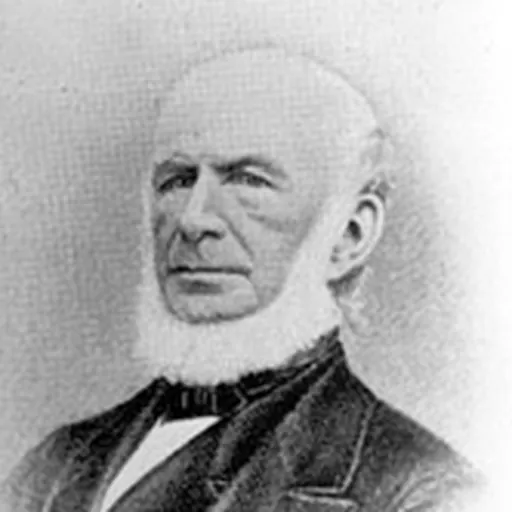
About Lawrence Brainerd
Lived 1794 – 1870 (aged 76). Lawrence Brainerd was an American politician and banker.
Lawrence Brainerd (March 16, 1794 – May 9, 1870) was an American businessman, abolitionist and United States Senator from Vermont. A longtime anti-slavery activist, after leaving the Jacksonians in the 1830s, Brainerd was active in the Whig, Liberty, and Free Soil parties, and was one of the organizers of the Republican Party when it was formed as the main anti-slavery party in the mid-1850s. Brainerd's longtime commitment to the cause of abolition was recognized in 1854, when opponents of slavery in the Vermont General Assembly chose him to fill a five-month vacancy in the United States Senate.
A native of East Hartford, Connecticut, Brainerd was raised by an uncle from the age of nine, and grew up in Troy, New York and St. Albans, Vermont. He taught school and worked as a store clerk, then began a business career of his own while still a teenager. He operated a successful store, then expanded his holdings to include a successful farm, as well as interests in banking, railroads, railroad construction, and steamships on Lake Champlain. Brainerd had extensive real estate holdings in and around St. Albans, including farms where he raised horses. In 1856, he was chosen to serve as president of the Vermont Agricultural Society. Brainerd became involved in the Congregational church at a young age and was a prominent advocate of temperance.
Brainerd became active in politics first as a Jacksonian, and he represented St. Albans in the Vermont House of Representatives from 1834 to 1835. An opponent of slavery, Brainerd joined the Whigs, but became dissatisfied with the party's attempts to chart a middle ground on the issue, and became an adherent of the abolitionist Liberty Party, and later the Free Soil Party. Brainerd was the unsuccessful Liberty Party candidate for governor of Vermont in 1846, 1847, 1848, 1852, and 1854, but his candidacies served to increase awareness of the abolitionist position on slavery. In October 1854, Brainerd's years of advocacy in the cause of anti-slavery were recognized when anti-slavery Whigs, Liberty Party members, and Free Soil Party members in the Vermont General Assembly combined to elect Brainerd to fill a short term vacancy in the United States Senate. He served until March 1855, and was succeeded by Jacob Collamer.
In 1855, Brainerd was one of the organizers of the new Republican Party when it was created as the main anti-slavery political organization. He served as the first chairman of Vermont's Republican Party, and was one of the handful of state chairmen who issued the call for the party's first national convention in 1856. Brainerd was a delegate, and called the convention to order as its temporary chairman.
Brainerd died in St. Albans on May 9, 1870. He was buried at Greenwood Cemetery in St. Albans.
Early life Brainerd was born in East Hartford, Connecticut on March 16, 1794, the fifth of thirteen children born to Ezra Brainerd and Mabel (Porter) Brainerd. In 1803, Brainerd went to Troy, New York to reside with his uncle, Joseph S. Brainerd. During the war, the area around St. Albans and Swanton was contested, with smugglers vying to move goods to the Canadian side of the border and militia patrols attempting to interdict their activities. In addition, British and Canadian forces raided northern Vermont several times during the war, and American soldiers and Vermont militia conducted raids on the Canadian side of the border. His membership in Vermont's militia continued for several years, and he was promoted to captain during his service.
In 1816, Brainerd went into business as the owner of a store, and his venture proved successful. His early efforts to expand his holdings included the purchase of 1,200 acres of swampland near Lake Champlain, which he drained, improved, and developed into a successful sheep farm. Because he was opposed to slavery, Brainerd used his home and other properties as hiding places for runaway slaves attempting to escape to Canada on the Underground Railroad. Brainerd, whose size, strength, and skills as an outdoorsman were the subject of local renown, successfully hunted the wolf. Brainerd became increasingly opposed to slavery, and left the Jacksonians for the Whigs. Brainerd was the unsuccessful Free Soil candidate for governor of Vermont in 1846, 1847, 1852, 1853, and 1854. In October, he was chosen by the Vermont General Assembly to fill a United States Senate vacancy, which had occurred when Senator William Upham died in January 1853. The Vermont General Assembly failed to choose a successor after Upham's death, so in December 1853 the governor appointed former Senator Samuel S. Phelps to fill the vacancy. Phelps served until the U.S. Senate resolved in March 1854 that he was not entitled to his seat, reasoning that while the governor could make an appointment while the state legislature was not in session, it fell to the legislature to make a selection if it was in session. When the new legislative session began in October 1854, anti-slavery members of the legislature honored Brainerd's years of commitment to their cause by choosing him to succeed Phelps. Brainerd was not a candidate for election to a full term, and served from October 14, 1854, to March 3, 1855. He was succeeded by Jacob Collamer and returned to his banking and business interests.
Later life In 1855, Brainerd was one of the organizers of the new Republican Party, which was founded as the country's main anti-slavery political organization. Brainerd was a delegate, and as the temporary chairman he called the convention to order for its first session. When Vermont's electors met in December to cast their ballots, Brainerd was chosen as their chairman. Afterwards, Brainerd and the Vermont delegation supported Abraham Lincoln, who received the nomination on the third ballot.
Death and burial Brainerd remained active in his business ventures until his death in St. Albans on May 9, 1870. He was buried at Greenwood Cemetery in St. Albans.
Family In 1819, Brainerd married Fidelia B. Gadcomb.
Don’t just read it —
keep it.
Full-length biographies made to live with: read them, listen on the way to work, watch them tonight.
- E-book
- Audio
- Video
Instant download · yours to keep · every purchase keeps this site free
Important facts
Family & relationships
People in Lawrence Brainerd's life
Named in this biography and alive at the same time


Related people
Same field, nearest in time


Contemporaries
People whose lives overlapped Lawrence Brainerd's





Frequently asked questions
Who was Lawrence Brainerd?
American politician (1794-1870)
When was Lawrence Brainerd born?
Lawrence Brainerd was born on 16 March 1794 in East Hartford.
When did Lawrence Brainerd die?
Lawrence Brainerd died on 9 May 1870 in Saint Albans.
What was Lawrence Brainerd's occupation?
Lawrence Brainerd was a politician and banker.
What nationality was Lawrence Brainerd?
Lawrence Brainerd was American.
Sources & further reading
· Wikipedia: Lawrence Brainerd
Cite this page
APA: Biography.guide. (2026). Lawrence Brainerd. https://biography.guide/lawrence-brainerd/
MLA: "Lawrence Brainerd." Biography.guide, https://biography.guide/lawrence-brainerd/.
Chicago: "Lawrence Brainerd." Biography.guide. https://biography.guide/lawrence-brainerd/.
Data last updated: 2026-09-21 · Spot an error? Report a correction.
Portrait: Wikimedia Commons · author & licence
Page generated 2026-09-27 04:59 UTC