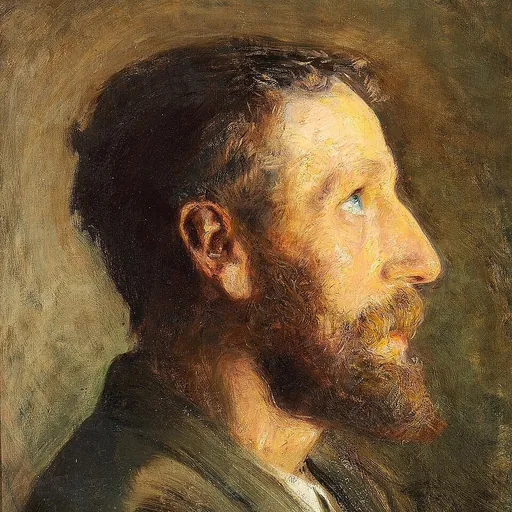
About Laurits Andersen Ring
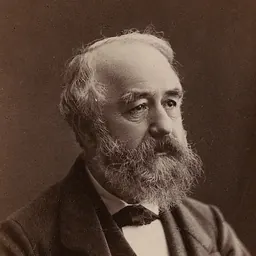
Lived 1854 – 1933 (aged 79). Laurits Andersen Ring was a Danish painter and ceramicist.
Laurits Andersen Ring (; 15 August 1854 – 10 September 1933) was one of the foremost Danish painters of the turn of the 20th century, who pioneered both symbolism and social realism in Denmark. Considered one of the masterpieces of Danish culture, his painting Summer Day by Roskilde Fjord was included in the 2006 Danish Culture Canon.
Life Ring was born as Laurits Andersen in a village named Ring in southern Zealand. Ring's parents were wheelmaker and carpenter Anders Olsen (1816–83) and farmer's daughter Johanne Andersdatter (1814–95). In 1869, he became a painter's apprentice because his older brother was to take over the father's workshop. In 1873, while working in Copenhagen Laurits decided to take classes in painting, and after two years of private studies he was accepted at the Danish Academy of Arts in 1875 and studied briefly with painter P. S. Krøyer. He was never content with the academy and disliked the strict training in classical disciplines.
Upon his return from Italy, he started working on a series of paintings with fellow painter Sigrid Kähler as a model. She was the daughter of ceramic artist Herman Kähler. In 1896 Ring married Kähler, who was only 21 years old at the time (he was 42). Living together in Karrebæksminde the couple had three children before Kähler died in 1923, at age 49. In 1900, he received the bronze medal at the World's Fair in Paris for his painting In the Garden Doorway, the Artist's Wife (I Havedøren, 1887).
For a while, he lived at Baldersbrønde near Hedehusene in the old school building, which was later to be the home of another painter, Ludvig Find. Ring produced several paintings from these towns. By 1913, Ring was a notable member of Denmark's artistic community and a censor at the Charlottenborg exhibitions. He had a house built at Sankt Jørgensbjerg in Roskilde, overlooking the fjord - here he spent the last decade of his life, before his death in 1933.
The year after Ring's death, the author Peter Hertz published a biography in which he summarized Ring's life and work: "His oeuvre remains as his life and essence: The still water of profound depth".
Ring drew on the Danish tradition of "almue" (folk) art, such as the work of J. th. Lundbye, but he also incorporated influences from more modernist painters such Paul Gauguin, Jean François Raffaëlli and Jean-François Millet. Early scholarship discussed whether Ring was best to be considered a realist or a symbolist painter, but later scholars have accepted that the two aspects of his work are equally important and complement each other.
The painting of Ring's wife, Sigrid Kähler, is surrounded by subtle symbols indicating his love for her, such as the myrtle branches above her head, a symbol of Aphrodite according to the Ancient Greeks, and used in Denmark to adorn the bride at weddings.
As a painter, Ring never distanced himself from his humble origin, but rather made it his dominant theme, depicting the reality of rural life. This is visible for example in his painting Gleaners (Axsamlere 1887) showing how the rural poor would pick up the grain left behind by the increasingly industrial methods of harvesting, a motif first made famous by Millet. Most of his paintings depict the village life and landscapes of southern Zealand from Præstø to Næstved. In his landscape painting, he was also inspired by psychological symbolism, infusing the landscapes with an otherworldly mystique and "strange mixtures of mood". This style has been described as "anti-naturalism".
Inspired by authors such as J.P. Jacobsen and the ideas of the Modern Breakthrough, Ring became an atheist, and his painting began to explore motifs and symbolism that contrasted forces of life and death. Even in his depictions of rural laborers Ring always played on the deeper symbolic and abstract meanings, so that his work The Harvester (I Høst 1884) becomes a depiction not just of a working man, nor of his brother who was the model, but of the cycle of life as symbolized by the scythe cutting the ripe corn.
Ring's consistent engagement with the unpleasant realities of life caused one critic to dub him "the Apostle of the Hideous". Others have interpreted the drive towards unsentimental realism as an expression of Ring's atheist life stance. Ring himself quipped on his 40th birthday that "Life is short - Art is long".
Ring's circles of motifs
His entire work demonstrates a division between an attachment to tradition and the spirit of modernity. Many of his paintings depict crossings and thresholds: the space between waiting and leaving in a doorway, at a window or at a railroad crossing. Sometimes more than one circle of motif is present in a painting, e.g. Runesten ved Roskilde Landevej, which contains both the threshold and the road as circle of motif.
Portrayals of rural laborers
Like Erik Henningsen and H. A. Brendekilde L.A. Ring painted social realistic portrayals of rural laborers, but not as noteworthy as Henningsen's En såret arbejder and Brendekilde's Udslidt. Ring does not attempt to cause pity or seek sympathy for the weak. Ring made a number of monumental portrayals of laborers, Harvest from 1885, Drænrørsgraverne also from 1885, Arbejdere ved en vandledning ved Søndersø from 1891, Teglværksarbejdere, Ladby Teglværk from 1892 and Sædemanden from 1910. They are all painted in the large format approximately 185 x 111,5 cm except from Drænrørsgraverne with the smaller format 142,5 x 111,5 cm.
The paintings all have a high horizontal line and the people do not tower into the sky in accordance with Ring's atheist attitude. Rather, they stay at the ground and have furthermore absorbed colour from the surroundings.
Death
After the death of the brother in 1886 and until the return from Italy in 1895 Ring was very preoccupied with death and that left traces in his world of motifs as well in the landscape paintings as in the figure paintings. During the travel to Italy 1893-95 Ring had plans to paint a "dødedans" (dance of death). However, the idea was discarded and was instead incorporated in Efter solnedgang, "Nu skrider Dagen under, og Natten vælder ud, which represent the culmination of Ring's preoccupation with death as a motif in painting.
The Road
In Ring's art the road and the path are recurring themes, and other lines such as creeks, rivers and estuaries, the open sea and modern elements e.g. bridges, railway tracks and telephone cables are used as main motifs. The roads lead the eye into the paintings and out again, as a symbol of the human existence.
Threshold
Ring often uses doors and windows as thresholds. In some of the threshold paintings the person depicted is in a hesitant position in front of the doorway or window waiting to be able to connect with the outside world.
In other motifs it is the ultimate threshold before death, as seen in Den syge mand and På kirkegården i Fløng. Another threshold motif is the meeting between old and new, e.g. in The Railroad guard and Runesten ved Roskilde Landevej.
Landscapes
Ring in particular painted landscapes, but in the beginning of his career it was not the landscape painting that dominated his art. Up until 1887 there were about 10 landscape paintings out of approximately 90 works of art in his repertoire. From 1888 and until his death in 1933 the landscape painting however made up about three quarters of his production.
Reception and exhibitions Since 1951 Ring's works have been described in more than 150 articles, newspapers, journals and books. Furthermore, there has been several exhibitions in Denmark and abroad showcasing Ring's works of art: a Danish-Swedish travelling exhibition in 1973 with 46 works, the exhibition "Northern Light" in 1982-83 at three locations in USA, a large-scale exhibition at Orddrupgaard with 100 works of art, "Nordiske Stemninger" (Nordic Moods) in 2003 at Blaafarveværket, Norway with 42 works of art and lastly "På Kanten af Verden" (On the Edge of the World ) in 2006-07 at The National Gallery of Denmark in Copenhagen (42 works of art) and Randers Kunstmuseum (85 works of art).
Gallery
Don’t just read it —
keep it.
Full-length biographies made to live with: read them, listen on the way to work, watch them tonight.
- E-book
- Audio
- Video
Instant download · yours to keep · every purchase keeps this site free
Important facts
Family & relationships
People in Laurits Andersen Ring's life
Named in this biography and alive at the same time


Related people
Same field, nearest in time

Contemporaries
People whose lives overlapped Laurits Andersen Ring's




Frequently asked questions
Who was Laurits Andersen Ring?
Danish artist (1854-1933)
When was Laurits Andersen Ring born?
Laurits Andersen Ring was born on 15 August 1854 in Ring.
When did Laurits Andersen Ring die?
Laurits Andersen Ring died on 10 September 1933 in Sankt Jørgensbjerg Parish.
What was Laurits Andersen Ring's occupation?
Laurits Andersen Ring was a painter and ceramicist.
What nationality was Laurits Andersen Ring?
Laurits Andersen Ring was Danish.
Sources & further reading
· Wikipedia: Laurits Andersen Ring
Cite this page
APA: Biography.guide. (2026). Laurits Andersen Ring. https://biography.guide/laurits-andersen-ring/
MLA: "Laurits Andersen Ring." Biography.guide, https://biography.guide/laurits-andersen-ring/.
Chicago: "Laurits Andersen Ring." Biography.guide. https://biography.guide/laurits-andersen-ring/.
Data last updated: 2026-09-23 · Spot an error? Report a correction.
Portrait: Wikimedia Commons · author & licence
Page generated 2026-09-27 05:07 UTC