
About László Krasznahorkai
Born 1954. László Krasznahorkai is a Hungarian screenwriter, novelist, writer and visiting docent.
László Krasznahorkai (born 5 January 1954) is a Hungarian writer, novelist and screenwriter. Krasznahorkai is known for his difficult and demanding novels, often labeled postmodern, which explore dystopian and melancholic themes. Several of his works, including his novels Satantango and The Melancholy of Resistance (1989), have been adapted into feature films by the director Béla Tarr.
In 2025, he was awarded the Nobel Prize in Literature "for his compelling and visionary oeuvre that, in the midst of apocalyptic terror, reaffirms the power of art".
Early life and education László Krasznahorkai was born into a middle-class family on 5 January 1954 in Gyula, eastern Hungary. His father, György Krasznahorkai, was a lawyer, and his mother, Júlia Pálinkás, was a social security administrator. explaining that his father initially concealed their Jewish roots from him, revealing it only when he was around 11 years old. His paternal grandfather changed the family name from Korim (or Korin) to Krasznahorkai in 1931.
From 1968 to 1972, he attended in Gyula, specializing in Latin. During his teenage years, he performed as a pianist in various jazz and beat ensembles. but he suspended his studies after three weeks as he did not feel a sense of belonging to the legal profession. Afterwards, he spent a period changing location every few months in an effort to avoid a second year of military duty. During this time, he took on various jobs as a stable boy, a cultural educator and a miner. His thesis focused on the work of writer Sándor Márai following his emigration from Hungary. During his studies, he worked at the publishing house as a documenter from 1977 to 1982. An English translation of the novel later received the Best Translated Book Award in 2013. After the fall of the Eastern Bloc, he began living reclusively in various locations worldwide. His first extended trip to East Asia in 1990 profoundly influenced his work; his experiences in Mongolia and China informed the books The Prisoner of Urga and Destruction and Sorrow Beneath the Heavens. He later spent six months in Kyoto in 1996, 2000, and 2005, with the aesthetics and literary theory of the Far East causing significant shifts in his style and themes. While writing War and War, he traveled extensively across Europe and received assistance from the American poet Allen Ginsberg, whom he credited with providing valuable advice while staying at his New York apartment.
Critical recognition and collaborations His novel The Melancholy of Resistance (1989) received the German Bestenliste-Prize for the best literary work of the year in 1993. In 1996, he was a fellow at the Wissenschaftskolleg in Berlin. He has also collaborated with artist Max Neumann on illustrated works such as the novella Chasing Homer (2021), which was released with an original score by jazz musician Szilveszter Miklós.
His novel Seiobo There Below won the Best Translated Book Award in 2014. In 2015, he became the first Hungarian author to receive the Man Booker International Prize.
In 2024, the Austrian National Library in Vienna acquired Krasznahorkai’s literary archive (Vorlass), which is now preserved in its Literature Archives.
Views Russian invasion of Ukraine Krasznahorkai expressed strong condemnation of the Hungarian government's policy on the Russian invasion of Ukraine. He described Prime Minister Viktor Orbán's framing of the conflict as an "internal Slavic affair" as morally indefensible and historically incoherent, given Hungary's own past invasions by Russia. Krasznahorkai argued that neutrality in the face of aggression amounts to complicity and likened the Orbán government's reasoning to a form of psychological denial. He characterized the regime as "a psychiatric case," motivated by a fatalistic and self-destructive logic that, in his words, accepts the death of one's own child to spare one's mother, only to result in the death of both.
Personal life Krasznahorkai was married to his first wife, Anikó Pelyhe, from 1990 until their divorce. In 1997, he married Dóra Kopcsányi, a sinologist and graphic designer.
After living for several years in Berlin, where he held the S. Fischer Guest Professorship at the Free University of Berlin for one semester, he returned to Hungary.
Works Novels
Novellas 2009: The Last Wolf (Az utolsó farkas), translated by George Szirtes (New Directions, 2016; paired with John Batki's translation of "Herman" and "The Death of a Craft" from Relations of Grace). 2010: Animalinside (Állatvanbent), together with Max Neumann, collage of prose and pictures, translated by Ottilie Mulzet (New Directions, 2011; Sylph Editions, 2012). 2018: Spadework for a Palace (Aprómunka egy palotaért), translated by John Batki (New Directions, 2022). 2019: Chasing Homer (Mindig Homérosznak), with illustrations by Max Neumann, translated by John Batki (New Directions, 2021).
Short story collections
Includes: "The Last Boat", "The Bogdanovich Story", "Trapped Rye", "Heat", "Herman: The Game Warden", "The Death of a Craft", "In the Barber's Grasp" and "The Station Seeker". 2013: The World Goes On (Megy a világ). Translations by John Batki, George Szirtes and Ottilie Mulzet (New Directions, 2017).
Individual short stories 1984: "The Bogdanovich Story" ("El Bogdanovichtól"). Trans. Eszter Molnár, in Thy Kingdom Come: 19 Short Stories by 11 Hungarian Authors (pp. 64–79). 1986: "The Last Boat" ("Az utolsó hajó"). Trans. Eszter Molnár, in Thy Kingdom Come: 19 Short Stories by 11 Hungarian Authors (pp. 53–63); later by George Szirtes in Music & Literature No. 2 (2013) 1998: "Isaiah Has Come" ("Megjött Ézsaiás"). Translated by George Szirtes, included in War and War. 1999: "Dumb to the Deaf" ("Néma a süketnek"). Trans. Eszter Molnár, in The Hungarian Quarterly, Summer 2000 (pp. 49–55). 2010: "The Bill: For Palma Vecchio, at Venice" ("Számla: Palma Vecchiónak, Velencébe"), translated by George Szirtes (Sylph Editions, 2013) and included in The World Goes On.
Essays, interviews and other works 1993: The Universal Theseus (A Théseus-általános), three fictional lectures. Translated by John Batki, included in The World Goes On. 2001: Evening at Six: Some Free Exhibition-Opening Speeches (Este hat; néhány szabad megnyitás), essays. 2003: Krasznahorkai: Conversations (Krasznahorkai Beszélgetések), interviews. 2012: He Neither Answers Nor Questions: Twenty-five Conversations on the Same Subject (Nem kérdez, nem válaszol. Huszonöt beszélgetés ugyanarról.), interviews. 2013: Music & Literature No. 2, book length special issue of the magazine with texts by Krasznahorkai and essays on his work by Béla Tarr and Max Neumann. 2017: The Manhattan Project, a literary diary with a photographic essay, translated by John Batki (Sylph Editions, 2017).
Screenplays for films 1988: Damnation (Kárhozat), directed by Béla Tarr. 1989: The Last Boat (Az utolsó hajó), directed by Béla Tarr. 1994: Sátántangó, directed by Béla Tarr. 1997–2001: Werckmeister Harmonies (Werckmeister harmóniák), directed by Béla Tarr. 2007: The Man from London (A Londoni férfi), directed by Béla Tarr. 2011: The Turin Horse (A torinói ló), directed by Béla Tarr.
Operas based on his novels Péter Eötvös, Valuska, libretto by Mari Mezei and Kinga Keszthelyi, Budapest, Eiffel Műhelyház 2023. Marc-André Dalbavie, Mélancolie de la résistance, libretto by Guillaume Métayer with the help of the director David Marton, Staatsoper Berlin, June-July 2024.
Awards and honors Krasznahorkai has been honored with numerous literary prizes, including the 2025 Nobel Prize in Literature as the second Hungarian author after Imre Kertész. 1983: 1987–1988: Fellowship of the DAAD Artists-in-Berlin Program 1993: Preis der SWR-Bestenliste for The Melancholy of Resistance 1998: 2010: for his complete work but in particular for A Mountain to the North, a Lake to the South, Paths to the West, a River to the East 2012: in Hungarian literature 2013: Best Translated Book Award, winner for Satantango, translated by George Szirtes 2014: America Award for a lifetime contribution to international writing 2014: Best Translated Book Award, winner for Seiobo There Below, translated by Ottilie Mulzet. First author to win two BTBA awards. 2014: Vilenica Prize (Vilenica International Literary Festival, Slovenia) 2015: Man Booker International Prize 2015: The New York Public Library's Dorothy and Lewis B. Cullman Center for Scholars and Writers Fellow 2017: for Baron Wenckheim's Homecoming 2019: National Book Award for Translated Literature (U.S.) for Baron Wenckheim's Homecoming 2020: Literature.gr Phrase of the Year Prize 2018 2021: Austrian State Prize for European Literature 2022: Milovan Vidaković Award (Novi Sad, Serbia) 2024: Prix Formentor 2025: Nobel Prize in Literature
Don’t just read it —
keep it.
Full-length biographies made to live with: read them, listen on the way to work, watch them tonight.
- E-book
- Audio
- Video
Instant download · yours to keep · every purchase keeps this site free
Important facts
People in László Krasznahorkai's life
Named in this biography and alive at the same time
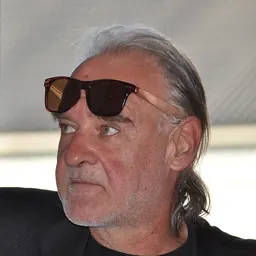





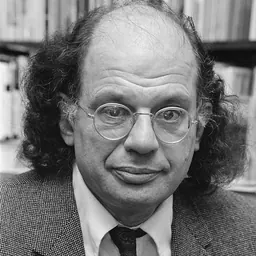

Related people
Same field, nearest in time

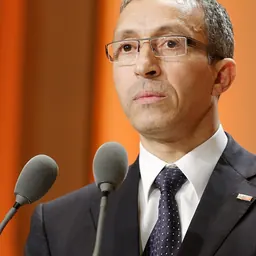
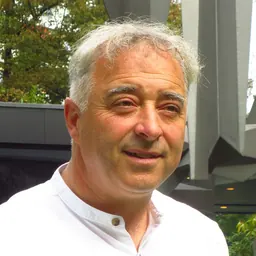

Contemporaries
People whose lives overlapped László Krasznahorkai's


Frequently asked questions
Who is László Krasznahorkai?
Hungarian novelist and screenwriter
When was László Krasznahorkai born?
László Krasznahorkai was born on 5 January 1954 in Gyula.
What is László Krasznahorkai's occupation?
László Krasznahorkai is a screenwriter, novelist, writer and visiting docent.
What nationality is László Krasznahorkai?
László Krasznahorkai is Hungarian.
Sources & further reading
· Wikipedia: László Krasznahorkai
· DBpedia: László Krasznahorkai
Cite this page
APA: Biography.guide. (2026). László Krasznahorkai. https://biography.guide/laszlo-krasznahorkai/
MLA: "László Krasznahorkai." Biography.guide, https://biography.guide/laszlo-krasznahorkai/.
Chicago: "László Krasznahorkai." Biography.guide. https://biography.guide/laszlo-krasznahorkai/.
Data last updated: 2026-09-20 · Spot an error? Report a correction.
Page generated 2026-09-27 05:18 UTC