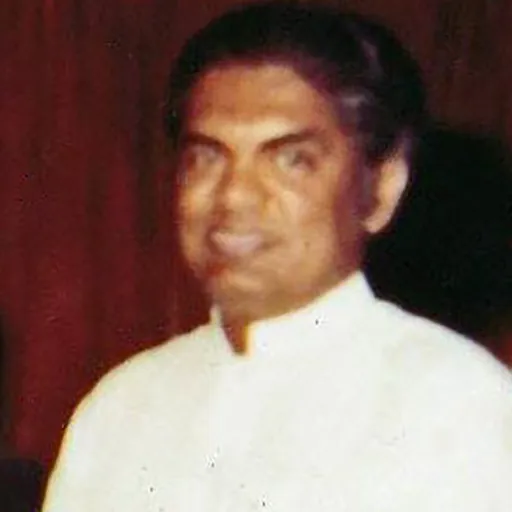
About Lalith Athulathmudali
Lived 1936 – 1993 (aged 56). Lalith Athulathmudali was a Sri Lankan politician and lawyer.
Lalith William Samarasekera Athulathmudali, PC (; 26 November 1936 – 23 April 1993), known as Lalith Athulathmudali, was a Sri Lankan politician. He was a prominent member of the United National Party, who served as Minister of Trade and Shipping; Minister National Security and Deputy Minister of Defence; Minister of Agriculture, Food and Cooperatives and finally Minister of Education. Following a failed impeachment of President Ranasinghe Premadasa, he was removed from the UNP and formed his own party, the Democratic United National Front. He was assassinated under mysterious circumstances in 1993.
Early life and education Born to a family of lawyers hailing from Kalutara District, his father D. D. Athulathmudali was a member of the State Council of Ceylon and his mother was Srimathi Samarasekera Athulathmudali. He had two siblings, a brother Dayanthe who became an electrical engineer and a sister Sujaee who became a Physician.
Athulathmudali received his primary education at St. John's College Panadura and Royal Primary School; before moving to Royal College Colombo from 1948 to 1955 for his secondary education, where he won the Steward Prize and excelled in athletics.
Minister of National Security
In 1984, he was appointed Minister of National Security and Deputy Minister of Defense. He started reforms in both the police and army. During his tenure the armed forces were expanded and reequipped, with the army increasing from 6,000 to 24,000. The most controversial of his measures was to call for Israeli assistance. He organised several offensives against territories held by the LTTE including the Vadamarachchi Operation and was apposed to the Indo-Sri Lanka Accord.
He was severely wounded in a grenade attack inside the Parliament complex in 1987. The biggest debacle of his political career came in May 1988 when he declared a truce with the rebellion JVP. The main brokers of the so-called truce were a lawyer called Kelly Senanayake and Fr Thissa Balasooriya who later found had no mandate to represent JVP. He received the portfolio of Trade and Shipping again in 1988. His status in government changed upon Jayewardene's retirement in 1988, he tried to obtain the UNP's nomination for the presidential election, but was defeated by Ranasinghe Premadasa who went on to win the presidency.
Minister of Agriculture and Education In 1989, he was appointed UNP chief organizer for the Colombo electorate and was elected to parliament in the 1989 general election. Premadasa retained Athulathmudali in his cabinet, but demoted him by appointing him as Minister of Agriculture, Food and Cooperatives. In the following year, he was appointed Minister of Education, in which capacity he remained until 1991.
Conflict with Premadasa Athulathmudali became disenchanted with Premadasa's leadership and soon ran into conflict with Premadasa. Premadasa tried to have Athulathmudali removed from his UNP party positions and accused him of being one of the cabinet ministers behind the Burning of Jaffna library in 1981. Athulathmudali resigned his cabinet position in August 1991 and in September 1991 he and several UNP MPs brought forth a motion to impeach Premadasa. The impeachment which was supported by members of the UNP and other parties in the opposition failed as Premadasa adjourned Parliament and the Speaker Mohamed dismissed the impeachment stating a lack of signatures. Premadasa expelled Athulathmudali and Gamini Dissanayake from the UNP.
Athulathmudali together with Dissanayake formed a new party, the Democratic United National Front with both serving as joint president in November 1991. Under the DUNF, Athulathmudali handed over his papers to contest the 1993 Provincial elections seeking the chief ministership of the Western Province Council.
Assassination
Athulathmudali was shot dead on 23 April 1993 after an election rally at Kirulapana. While the Sri Lankan police initiated an investigation, the government also invited a team of experts from the Scotland Yard to carry out an independent investigation. A body of a youth named Ragunathan alias Appiah Balakrishnan, a member of the LTTE was found near the scene (down Mugalan road). He had one non-fatal gun shot wound on his back and had also ingested cyanide via a capsule (Suicide pill- Potassium Cyanide necklace worn by LTTE cadres). Forensic evidence also showed that Athulathmudali's armed bodyguard Tilak Shantha shot the assassin as Tilak's gun matched with the bullet found in Ragunathan's back. She was the president of the Sri Lanka Cancer Society. He met his second wife Srimani De Seram in March 1978, when she was attached to UNCTAD in Switzerland. She was a friend of his brother Dayantha Athulathmudali. They got married in December 1981 in Geneva. They had one daughter, Serela Athulathmudali.
Historical reputation and legacy SLIIT Lalith Athulathmudali Auditorium Commemorative Plaque. Athulathmudali is considered one of the most distinguished Sri Lankan statesmen in recent history. He is still remembered by many in Sri Lanka as a gentlemen and as one of the few well educated politicians of that era. In his honour a statue and memorial has been erected in Colombo. His contribution to the education of the country is eminence, the Mahapola Fund he established has greatly contributed to the development of higher education and provides scholarships for needy students annually. The Lalith Athulathmudali Auditorium at the Sri Lanka Institute of Information Technology and the Lalith Athulathmudali Memorial Prize which is one of the prestigious prizes awarded annually at Royal College, Colombo (his alma mater) (awarded for the Most Outstanding Royalist (Student of Royal College) of the Year are named in his honour.
Monuments and memorials The statue of Lalith William Samarasekera Athulathmudali is located at in Colombo, Sri Lanka.
Don’t just read it —
keep it.
Full-length biographies made to live with: read them, listen on the way to work, watch them tonight.
- E-book
- Audio
- Video
Instant download · yours to keep · every purchase keeps this site free
Important facts
Family & relationships
People in Lalith Athulathmudali's life
Named in this biography and alive at the same time


Related people
Same field, nearest in time






Contemporaries
People whose lives overlapped Lalith Athulathmudali's





Frequently asked questions
Who was Lalith Athulathmudali?
Sri Lankan politician
When was Lalith Athulathmudali born?
Lalith Athulathmudali was born on 26 November 1936 in Colombo.
When did Lalith Athulathmudali die?
Lalith Athulathmudali died on 23 April 1993 in Colombo.
What was Lalith Athulathmudali's occupation?
Lalith Athulathmudali was a politician and lawyer.
What nationality was Lalith Athulathmudali?
Lalith Athulathmudali was Sri Lankan.
Sources & further reading
· Wikipedia: Lalith Athulathmudali
· DBpedia: Lalith Athulathmudali
Cite this page
APA: Biography.guide. (2026). Lalith Athulathmudali. https://biography.guide/lalith-athulathmudali/
MLA: "Lalith Athulathmudali." Biography.guide, https://biography.guide/lalith-athulathmudali/.
Chicago: "Lalith Athulathmudali." Biography.guide. https://biography.guide/lalith-athulathmudali/.
Data last updated: 2026-09-22 · Spot an error? Report a correction.
Portrait: Wikimedia Commons · author & licence
Page generated 2026-09-27 05:04 UTC