
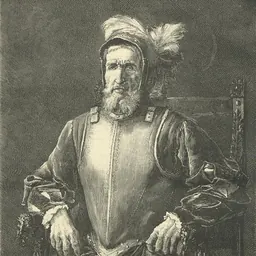
Lakandula
Lakan of Tondo
About Lakandula
Lived 1503 – 1589 (aged 85).
Name and title Over time, the Lakandula's name has come to be written in several ways. However, according to the firsthand account written in Spanish by Hernando Riquel, the royal notary who accompanied Miguel López de Legazpi, the Lord of Tondo specifically identified himself as "Sibunao Lacandola, lord of the town of Tondo"
In its current Tagalog form, means "gentleman".
Another common variation of the name is Gat Dula (alternatively spelled as a single word, Gatdula). Historically, the prefix Gat, a shortened version of the Tagalog honorific "Pamagat", meant "nobleman." Hence, Gatdula would literally read "Nobleman of the Palace", meaning essentially the same thing as the Kapampangan version, Lakandula. Alternatively, rather than a surname per se, Dula may have referred to a family group or clan, but there does not neem to be any historical evidence to support this postulation. Historian Jose N. Sevilla y Tolentino, theorized that "Dula" was not a personal name at all, but a local word that meant something akin to "Palace". While he may not have ruled from a literal palace, this would have indicated the Lakan's seat of power. As such, the "Lakandula" would have been the local language title for the "Lord of the Palace" and ruler of Tondo. Analogously, contemporary Rajah Ache was referred to as Rajah Matanda (Old Rajah), while Rajah Sulayman was sometimes referred to as Rajah Muda or Rajamora (Young Rajah). and Filipino historian and national artist for literature Nick Joaquin takes pains to point out that the term Lakan, not Rajah, was used by the rulers of Tondo.
On May 18, 1571, the native nobility of Luzon, Rajah Sulayman, Rajah Matanda, and Lakandula, acknowledged the sovereignty of Spain over the islands and proclaimed themselves to be vassals of Spain. On the following day, May 19, Legazpi landed in Manila and took ceremonial possession of the land in the presence of Soliman, Matanda, and Lakandula. To celebrate the event, the Spanish discharged Manila's artillery and arquebuses as part of the ceremony. A month later, Tarik Sulayman of Macabebe attacked Manila, convincing Rajah Sulayman to join the battle against Legazpi. Macabebe and Sulayman's forces were defeated, and the Datu of Macabebe was killed in what history would record as the Battle of Bangkusay Channel. (The similarity of names has caused some confusion between these two leaders, but Tarik Sulayman and Rajah Sulayman were different individuals – one survived the battle, and the other did not.)
Death Mentions of Lakandula's death are few, but Scott indicates that he died in 1575, "three years after" Legazpi and Rajah Matanda, who both died in 1572. According to local oral histories, this site eventually became the site of the Sto Niño of Tondo Parish church.
Documentary sources Primary documentary sources about Lakandula are sparse, so much so that there has been debate about the actual name of the Lakan. Dery identifies three types of sources regarding Lakandula:
Later descendants In 1990, Filipino historian Luciano P. R. Santiago wrote an article for the Philippine Quarterly of Culture and Society which details the identities and life stories of some of the descendants of Lakandula, mostly based on the "Lacandola Documents," a collection of legal documents held by the Philippine National Archives. Another Filipino historian, Luis Camara Dery, in his 2001 book "A History of the Inarticulate", notes that a purported 1539 document called the "Will of Fernando Malang Balagtas," which, although its exact provenance has been determined to be doubtful, corroborates the information from the Lacandola documents. The Lacandola of Arayat came from one of the grandchildren of Lakandula of Tondo named Dola, who is from San Luis, Pampanga. When Dola married, she insisted to use the surname Lacandola for her children to maintain connection with his grandfather from Tondo and partly, to hide from Spanish authorities.She was married to a Spanish mestizo surnamed Reyes. Eventually, the Reyes-Lacandola was married into a Macapagal.
Dery, Scott, and Santiago recount that the privileges accorded to the descendants of Lakandula had been discontinued for a while in the aftermath of Lakandula's death, because some of the descendants came into conflict with the Spanish authorities. According to Dery, the Balagtas document recounts that these privileges were restored when a Juan Macapagal, who claimed to be a great grandson of Lakandula (through Dionisio Capulong's son Juan Gonzalo Capulong), aided the Spanish authorities in suppressing the 1660 Maniago revolt, the 1660-1661 Malong revolt, and the 1661 Almazan revolt, performing his role as Master-of-Camp and Datu of Arayat.
In 1758, A Gremio de Lakandulas was created to safeguard the rights and privileges of the Kapampangan descendants of Lakandula as assured by the Spanish crown. During the British invasion of 1762–1764, the descendants of Lakandula, concentrated in the province of Pampanga, formed a company of volunteers to fight the British and were granted autonomy by Governor General Simon de Anda.
Macapagal (rare variant: Makapagal) is a Filipino surname derived from the Kapampangan language. By Santiago's genealogical reckoning, prominent Lakandula descendants of the 20th century include the former Philippine Presidents Diosdado Macapagal and Gloria Macapagal Arroyo, former Philippine Senate President Jovito Salonga, international stage celebrity Lea Salonga, pioneer Filipino industrialist Gonzalo Puyat, and former Philippine Senate President Gil Puyat.
Legacy
The Order of Lakandula is one of the highest honors given by the Republic of the Philippines. It is an order of political and civic merit, awarded in memory of Lakandula's dedication to the responsibilities of leadership, prudence, fortitude, courage and resolve in the service of one's people. The was the destroyer escort / frigate and is the only ex-USN Edsall-class destroyer escort that served the Philippine Navy. It was also the flagship of the Philippine Navy from 1981 to 1988. Struck from the Navy List in 1988, it was still in use as a stationary barracks ship in Subic Bay as of 1999. A number of Lakandula elementary and secondary schools are named after Lakandula, notably in the City of Manila, and the Province of Pampanga, both closely associated with Banaw Lakandula.
Don’t just read it —
keep it.
Full-length biographies made to live with: read them, listen on the way to work, watch them tonight.
- E-book
- Audio
- Video
Instant download · yours to keep · every purchase keeps this site free
Important facts
People in Lakandula's life
Named in this biography and alive at the same time

Contemporaries
People whose lives overlapped Lakandula's






Frequently asked questions
Who was Lakandula?
Lakan of Tondo
When was Lakandula born?
Lakandula was born on 16 December 1503.
When did Lakandula die?
Lakandula died on 21 March 1589.
Sources & further reading
Cite this page
APA: Biography.guide. (2026). Lakandula. https://biography.guide/lakandula/
MLA: "Lakandula." Biography.guide, https://biography.guide/lakandula/.
Chicago: "Lakandula." Biography.guide. https://biography.guide/lakandula/.
Data last updated: 2026-09-20 · Spot an error? Report a correction.
Page generated 2026-09-27 05:05 UTC