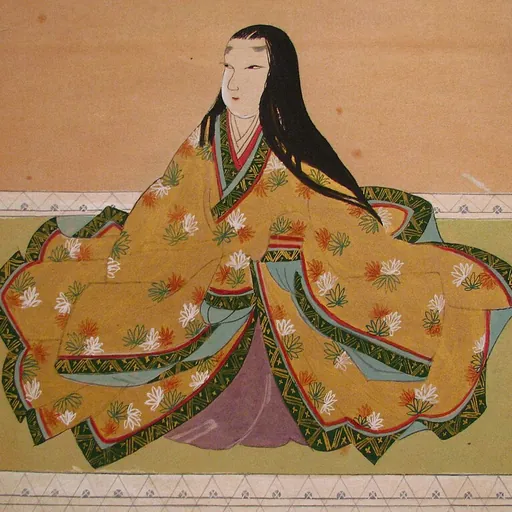
About Lady Saigō
Lived 1552 – 1589 (aged 36–37). Lady Saigō was a Japanese consort.
Lady Saigō ( or ; 1552 – 1 July 1589), also known as Oai, was one of the concubines of Tokugawa Ieyasu, the samurai lord who unified Japan at the end of the sixteenth century and then ruled as shōgun. She was also the mother of the second Tokugawa shōgun, Tokugawa Hidetada. Her contributions were considered so significant that she was posthumously inducted to the Senior First Rank of the Imperial Court, the highest honor that could be conferred by the Emperor of Japan.
During their relationship, Lady Saigō influenced Ieyasu's philosophies, choice of allies, and policies as he rose to power during the late Sengoku period, and she thus had an indirect effect on the organization and composition of the Tokugawa shogunate. Although less is known of her than some other figures of the era, she is generally regarded as the "power behind the throne", and her life has been compared to a "Cinderella story" of feudal Japan.
Once she was in a respected and secure position as the official concubine and mother to Ieyasu's heir, Lady Saigō used her influence and wealth for charitable purposes. A devout Buddhist, she donated money to temples in Suruga Province, where she resided as the consort of Ieyasu, first in Hamamatsu Castle and later in Sunpu Castle. As she was quite near-sighted, she also established a charitable organization that assisted visually impaired women with no other means of support. Lady Saigō died at a fairly young age, under somewhat mysterious circumstances. Although murder was suspected, no culprit was identified.
Lady Saigō bore four children: she had a son and a daughter (Saigō Katsutada and Tokuhime) while married, and she later bore two sons as the consort of Tokugawa Ieyasu: Tokugawa Hidetada and Matsudaira Tadayoshi. Among the descendants of Lady Saigō was the Empress Meishō (1624–1696), one of very few women to accede to the Chrysanthemum Throne as empress regnant.
Name The term "Saigō-no-Tsubone", used in most historical texts, is an official title rather than a name. As an adult she was adopted into the Saigō clan, so she was permitted to use the surname. Later, when she was named first consort of Tokugawa Ieyasu, the title "tsubone" (pronounced ) was appended to the surname. The title was one of several titular suffixes conferred on high-ranking women (others include -kata and -dono). The bestowal of a title depended on social class and the relationship with her samurai lord, such as whether she was a legitimate wife or a concubine, and whether or not she had had children by him. The word tsubone indicates the living quarters reserved for ladies of a court, and it became the title for those who had been granted private quarters, such as high-ranking concubines with children. and is commonly translated to the English title "Lady".
Though Lady Saigō's given name does not appear in surviving documents from the time, there is good evidence it was Masako , but this name is very rarely used. Her most commonly used name was Oai ( or , meaning "love") and most sources agree this was a nickname she gained as a child. Intimate friends and family would call her Oai throughout her life, and it is the name most often used in modern popular cultural references. Following death, she was bestowed with a Buddhist posthumous name, and an abbreviation of that name, Hōdai-in , is sometimes used out of pious respect. Following the untimely death of Kiyoyasu in 1536, and the ineffectual leadership and early death of Matsudaira Hirotada (1526–1549), the leaderless Matsudaira clan finally submitted to Imagawa Yoshimoto (1519–1560) of Suruga Province, east of Mikawa. When the Matsudaira fell to the Imagawa, the clans of their retainers, which included the Saigō, likewise submitted to the Imagawa. The executions did not deter the Saigō, and in 1562 the Imagawa launched punitive invasions of east Mikawa and attacked the two main Saigō castles. Masakatsu was killed in the battle of Gohonmatsu Castle; his eldest son Motomasa was killed during the battle for Wachigaya Castle.
Neither the name of Lady Saigō's mother nor her dates of birth or death are recorded in any existing documents, although it is known that she was the elder sister of Saigō Kiyokazu. Lady Saigō's father was of Tōtōmi Province, under direct control of the Imagawa clan. The marriage between Tadaharu and his wife was very likely arranged by the Imagawa clan. and very likely given the name of Masako soon after birth. but Tadaharu may have been assigned to Nishikawa Castle as an agent of the Imagawa. Masako spent her childhood with her two siblings in bucolic eastern Mikawa Province, and at some point gained the nickname Oai. In 1554, her father Tadaharu died in the Battle of Enshu-Omori, between the Imagawa and the Hōjō clan. Two years later her mother married Hattori Masanao; the union resulted in four children, though only two survived to adulthood.
Some sources state that upon reaching "adulthood" Oai married, but was widowed soon afterward. Oai bore two children by Yoshikatsu: their son, Saigō Katsutada, was born about 1570; they also had a daughter, possibly named Tokuhime.
In 1571, Saigō Yoshikatsu was killed at the Battle of Takehiro, fighting the invading forces of the Takeda clan led by Akiyama Nobutomo. Soon after Yoshikatsu's death, Oai was formally adopted by her uncle, Saigō Kiyokazu, then the head of the Saigō clan, though she chose to live with her mother in the house of her stepfather. It is believed she caught his eye on that occasion, but as she was still married, nothing came of it at the time. Later, during the 1570s, it is believed that friendship and genuine affection developed between the two. However, it is also known that he valued personal merit over bloodlines. During this time, Ieyasu had a house built in eastern Mikawa, far from the residence of his wife, the Lady Tsukiyama, in Okazaki. The marriage between Ieyasu and Lady Tsukiyama had been arranged by her uncle, Imagawa Yoshimoto, ostensibly to help cement ties between the two clans, though Ieyasu found it difficult to live with his wife's jealousy, tempestuous moods, and eccentric habits.
Starting around the time of the Battle of Mikatagahara (1573), perhaps in its aftermath, Ieyasu began to confide in Oai and sought her counsel on various matters. It may have been during this period that the two commenced an amorous relationship. Oai is credited with advising Ieyasu as the Battle of Nagashino (1575) approached, a major turning point in both Ieyasu's career and the history of Japan. It is also thought that Ieyasu continued to seek her advice concerning other battles and alliances, even as late as the Komaki-Nagakute Campaign (1584). These women usually relied on their physical attributes and sexual prowess to keep their lord's attention, and some resorted to the use of aphrodisiacs.
While Ieyasu's marriage was arranged for political reasons, and many of his later concubines were chosen in the same spirit, it is thought that he chose his relationship with Lady Saigō.
In the same year, Oda Nobunaga was informed that Lady Tsukiyama had conspired against him with the Takeda clan. Although evidence was weak, Ieyasu re-assured his ally by having his wife executed by the shore of Lake Sanaru in Hamamatsu. Tokugawa Nobuyasu, Ieyasu's first son by Lady Tsukiyama, was held in confinement until Ieyasu ordered him to commit seppuku. With their deaths, Lady Saigō's position at court was unassailable. With the death of Nobuyasu, Hidetada became Ieyasu's heir apparent.
Ieyasu's fourth son, the second by Lady Saigō, was born on 18 October 1580. He would become known as Matsudaira Tadayoshi, after he was adopted by Matsudaira Ietada, the head of the Fukōzu branch of the Matsudaira clan. In the same year, Lady Saigō had a temple founded in her mother's memory, indicating she had died by that point. The women were granted membership to the guild-like organization, and musicians with apprentices were dispatched to various destinations. They played pieces from a sanctioned repertoire, and operated under a strict code of rules on behavior and permissible business transactions intended to maintain an upstanding reputation.
Death
Within a short time after taking up residence in Sunpu Castle, Lady Saigō's health began to deteriorate. It was said that "physical and emotional hardships" were taking their toll on her health, but nothing could be done to help her.
By the time of her death, Lady Saigō was treated as Ieyasu's wife in deed if not in word. The remains of Lady Saigō were interred at Ryūsen-ji.
Legacy Tokugawa Ieyasu continued his campaigns allied with Toyotomi Hideyoshi. After their victory at the siege of Odawara Castle in 1590, Ieyasu agreed to relinquish all of his domains to Hideyoshi in exchange for the Kantō region to the east. Hideyoshi died in 1598. By 1603, Ieyasu had recovered Sunpu Castle and completed his unification of Japan, and had been named shōgun by the Emperor. The following year, he had Ryūsen-ji moved from Yunoki to Kōyamachi near Sunpu Castle and attended Buddhist funeral rites conducted in honor of the late Lady Saigō on the anniversary of her death. To mark the occasion, Ieyasu presented the temple priests with the katana he inherited from his father, and a portrait of himself as he looked at the time. These items can still be viewed at the temple in Shizuoka city. These ceremonies were meant to help her spirit achieve buddha status. He also saw to it that she was made the honored tutelary patron of the temple by having her posthumous name changed and the first three characters appended to the name of the temple. Today, the temple Ryūsen-ji is known mainly by that appellation, Hōdai-in . The new name was then inducted into the Lower First Rank of the Imperial Court.
In 1938, the mausoleum of Lady Saigō at Hōdai-in, which consisted of a five-tiered stupa over her grave and a sanctuary for the veneration of her spirit, was designated an Important Cultural Property. The designation was rescinded after the entire temple complex was destroyed in the Great Shizuoka Fire on 15 January 1940. Aside from this, Lady Saigō also became connected to the Imperial line. In 1620, Hidetada's daughter, Tokugawa Masako (1607–1678), married Emperor Go-Mizunoo and entered the Imperial palace. As empress consort, Masako helped maintain the Imperial Court, supported the arts, and significantly influenced the next three monarchs: the first was her daughter, and the two that followed, Emperors Go-Kōmyō and Go-Sai, were sons of Emperor Go-Mizunoo by different concubines. The daughter of Masako, and thus great-granddaughter of Lady Saigō, was Princess Okiko (1624–1696), who acceded to the Chrysanthemum Throne in 1629 as Empress Meishō. She reigned for fifteen years as the 109th monarch of Japan, the seventh of only eight empresses regnant in the history of Japan, until she abdicated in 1643.
Don’t just read it —
keep it.
Full-length biographies made to live with: read them, listen on the way to work, watch them tonight.
- E-book
- Audio
- Video
Instant download · yours to keep · every purchase keeps this site free
Important facts
Family & relationships
People in Lady Saigō's life
Named in this biography and alive at the same time


Related people
Same field, nearest in time



Contemporaries
People whose lives overlapped Lady Saigō's


Frequently asked questions
Who was Lady Saigō?
Japanese consort
When was Lady Saigō born?
Lady Saigō was born in 1552 in Nishikawa Castle.
When did Lady Saigō die?
Lady Saigō died on 1 July 1589 in Sunpu Castle.
What was Lady Saigō's occupation?
Lady Saigō was a consort.
What nationality was Lady Saigō?
Lady Saigō was Japanese.
Sources & further reading
Cite this page
APA: Biography.guide. (2026). Lady Saigō. https://biography.guide/lady-saigo/
MLA: "Lady Saigō." Biography.guide, https://biography.guide/lady-saigo/.
Chicago: "Lady Saigō." Biography.guide. https://biography.guide/lady-saigo/.
Data last updated: 2026-09-20 · Spot an error? Report a correction.
Portrait: Wikimedia Commons · author & licence
Page generated 2026-09-27 04:57 UTC