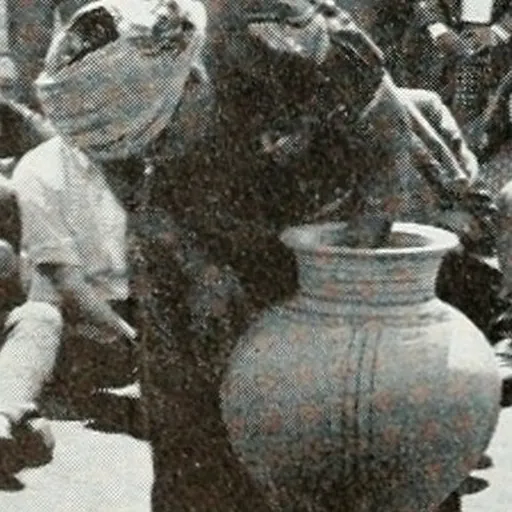
About Ladi Kwali
Lived 1925 – 1984 (aged 59). Ladi Kwali was a Nigerian ceramicist, pedagogue, potter and pottery.
Ladi Dosei Kwali, OON NNOM, MBE ( – 12 August 1984) was a Nigerian potter, ceramicist and educator.
Ladi Kwali was born in the village of Kwali in the Gwari region of Northern Nigeria, where pottery was an indigenous occupation among women. She learned pottery as a child through her aunt, using the traditional method of coiling. She made large pots for use as water jars, cooking pots, bowls, and flasks from coils of clay, beaten from the inside with a flat wooden paddle. They were decorated with incised geometric and stylized figurative patterns, including scorpions, lizards, crocodiles, chameleons, snakes, birds, and fish.
Her pots were noted for their beauty of form and decoration, and she was recognized regionally as a gifted and eminent potter. Several were acquired by the emir of Abuja, Alhaji Suleiman Barau, in whose home they were seen by Michael Cardew in 1950.
Early life
Miss Kwali was born in the small village of Kwali, present Kwali Area Council of the Federal Capital Territory, in 1925 (other historians indicate her date of birth is actually 1920). She grew up in a family that kept up with the folkloric female tradition of pottery making. In 1954, Ladi Kwali joined the Abuja Pottery as its first female potter. There, she learned wheel throwing, glazing, kiln firing, production of saggars, and the use of slip, eventually assuming the role of instructor. The quintessential Ladi Kwali pot was coiled in a stoneware clay, decorated with lizard patterns and fired with a dark shiny glaze. For Western viewers and collectors, the dark glaze was a metaphor for the pots' "Africanness." Ladi Kwali's pots were featured in international exhibitions of Abuja pottery in 1958, 1959, and 1962, organised by Cardew. In 1961, Kwali gave demonstrations at the Royal College, Farnham, and Wenford Bridge in Great Britain.
In 1977, she was awarded an honorary doctoral degree from Ahmadu Bello University in Zaria. the highest national honor for academic achievement.
Her works are held in collections all around the world, such as Smithsonian National Museum of African Art, USA, Victoria and Albert Museum, and Aberystwyth University Ceramics Gallery, UK.
In 2022, a significant exhibition titled Body Vessel Clay: Black Women, Ceramics & Contemporary Art, curated and conceived by Dr Jareh Das, was held at Two Temple Place and the York Art Gallery. This exhibition highlighted Ladi Kwali and her influence on a generation of Black female artists, using Kwali as a starting point to explore 70 years of ceramics by Black women artists. In 2025, Body Vessel Clay made its US debut at the Ford Foundation Gallery.
The Google Doodle for 16 March 2022 was in honor of Kwali.
Don’t just read it —
keep it.
Full-length biographies made to live with: read them, listen on the way to work, watch them tonight.
- E-book
- Audio
- Video
Instant download · yours to keep · every purchase keeps this site free
Important facts
People in Ladi Kwali's life
Named in this biography and alive at the same time

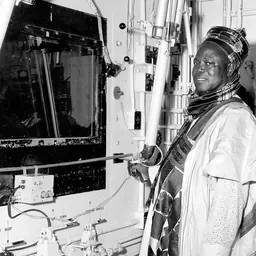
Related people
Same field, nearest in time


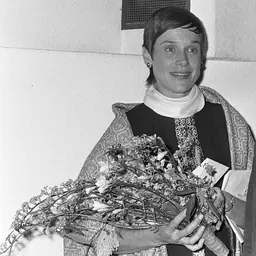


Contemporaries
People whose lives overlapped Ladi Kwali's



Frequently asked questions
Who was Ladi Kwali?
Nigerian potter
When was Ladi Kwali born?
Ladi Kwali was born on 16 March 1925 in Kwali.
When did Ladi Kwali die?
Ladi Kwali died on 12 August 1984 in Minna.
What was Ladi Kwali's occupation?
Ladi Kwali was a ceramicist, pedagogue, potter and pottery.
What nationality was Ladi Kwali?
Ladi Kwali was Nigerian.
Sources & further reading
Cite this page
APA: Biography.guide. (2026). Ladi Kwali. https://biography.guide/ladi-kwali/
MLA: "Ladi Kwali." Biography.guide, https://biography.guide/ladi-kwali/.
Chicago: "Ladi Kwali." Biography.guide. https://biography.guide/ladi-kwali/.
Data last updated: 2026-09-22 · Spot an error? Report a correction.
Portrait: Wikimedia Commons · author & licence
Page generated 2026-09-27 05:04 UTC