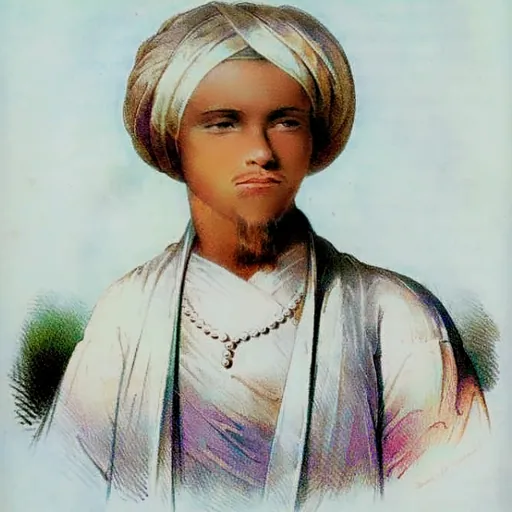
Kyai Madja
Indonesian cleric, rebel and war commander
About Kyai Madja
Lived 1792 – 1849 (aged 56–57).
Muslim Mochammad Khalifah ( 1792 – 20 December 1849), better known as Kyai Maja or Kyai Modjo, was a Javanese ulama and spiritual leader best known for his role as a key commander and religious adviser of Diponegoro during the Java War. He was a key commander of the rebels until his surrender in late 1828, and he was later exiled to Tondano where he died in 1849.
Early life Kyai Maja was born as Muslim Mochammad Khalifah around 1792 at the village of Mojo, within the Surakarta Sunanate. His father was Iman Abdul Ngarip, a notable ulama in Java better known to contemporaries as Kyai Baderan. Maja's mother R. A. Mursilah was of Yogyakartan nobility, being the sister of Sultan Hamengkubuwono III. Ngarip was also of noble birth at the Surakarta Sunanate, but became an Islamic preacher.
Java War Sometime in the late 1810s, Prince Diponegoro's eldest son Diponegoro II became a pupil of Maja's. Under these circumstances, Diponegoro (Maja's cousin) met Maja at the latter's religious establishment in Mojo. Maja would in turn visit Diponegoro at his feudal estate of Tegalreja. In August 1825, following the outbreak of the Java War, Diponegoro summoned Maja to his base at . Diponegoro retained Maja as a religious adviser, especially on matters of the Quran. Among other santri who sided with Diponegoro, Maja gained a leading role due to his strong knowledge of the Quran and his strong character. This was despite many of Diponegoro's supporters being hajji, while Maja had never gone on hajj.
After the rebels' failed siege of Yogyakarta, Maja led a rebel force which quickly seized much of the Pajang area. Diponegoro would move north from Yogyakarta to Surakarta in 1826, linking up with Maja's army. A dispute emerged between the two, with Maja advocating for an aggressive approach to secure more of Surakarta's territories while Diponegoro took a more cautious approach. This caused a delay, which allowed Dutch forces to reorganize and defeat the rebel force in the Battle of Gawok in October 1826. Maja took much of the blame from the defeat. Due to his Surakartan origins, Maja was already seen with suspicion by Diponegoro's Yogyakartan aristocratic supporters. He died at the shores of Lake Tondano on 20 December 1849, and was buried there. Later president Prabowo Subianto proposed in 2018 that Maja's grave be relocated back to his homeland in Surakarta. In modern Surakarta, a neighborhood is named after Maja, along with a major road within the neighborhood.
Don’t just read it —
keep it.
Full-length biographies made to live with: read them, listen on the way to work, watch them tonight.
- E-book
- Audio
- Video
Instant download · yours to keep · every purchase keeps this site free
Important facts
People in Kyai Madja's life
Named in this biography and alive at the same time
Contemporaries
People whose lives overlapped Kyai Madja's





Frequently asked questions
Who was Kyai Madja?
Indonesian cleric, rebel and war commander
When was Kyai Madja born?
Kyai Madja was born in 1792.
When did Kyai Madja die?
Kyai Madja died in 1849.
Sources & further reading
Cite this page
APA: Biography.guide. (2026). Kyai Madja. https://biography.guide/kyai-madja/
MLA: "Kyai Madja." Biography.guide, https://biography.guide/kyai-madja/.
Chicago: "Kyai Madja." Biography.guide. https://biography.guide/kyai-madja/.
Data last updated: 2026-09-22 · Spot an error? Report a correction.
Portrait: Wikimedia Commons · author & licence
Page generated 2026-09-27 05:02 UTC