
Kunz Lochner
Armourer from Nuremberg
About Kunz Lochner
Lived 1510 – 1567 (aged 56–57). Kunz Lochner was a German armourer and armourer (plate).
Kunz (Konrad; also Conrad or Conrath) Lochner (1510 – 19 August 1567) was a master plate armourer, blacksmith, armour etcher, and silversmith active in the Free Imperial City of Nuremberg in the Holy Roman Empire (in present‑day Germany).
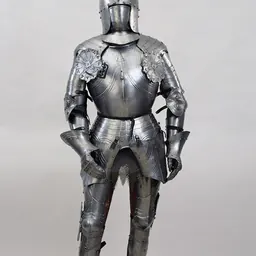
Lochner was the son of a skillful armourer with the same name (d. 1527), and his two brothers Heinrich and Hans who were also skillful armourers and blacksmiths. Around 1550, his work for the Austrian Habsburgs came to an end. In 1552, he supplied the Electorate of Saxony, and from 1557, he was in contact with King Sigismund II Augustus of Poland. In 1559, he travelled to the Polish royal court to collect outstanding payments. Shortly after 1560, he produced a horse armour for Carlos, Prince of Asturias. Lochner's workshop produced some of the most magnificent plate armours made during the 16th-century Renaissance period for field warfare, tourney, and ceremonial occasions. Lochner's patrons included royalty, knights, and nobility from across Europe.
Armour crafted by Lochner—whether bearing his personal hallmark (a shield with a demi-lion in dexter and bendy of six in sinister, or a shield with lion rampant), often marked together with the Nuremberg Beschau hallmark (the city's official assay and quality‑control stamp), or attributed to him on stylistic grounds—is preserved in museums such as the Royal Armoury (Livrustkammaren) in Stockholm, the Dresden State Art Collections (Dresden Armoury) in Dresden, the Army Museum in Paris, and the Metropolitan Museum of Art in New York City.
Known preserved works Parade armour for man and horse
The armour was crafted in 1550 for King Sigismund II Augustus of Poland, the last ruler of the Jagiellonian dynasty. In his wills he divided his personal possessions among his sisters, including Catherine Jagiellon, Queen of Sweden and wife of John III. As Poland had no designated heir, John III sought to advance the claim of their son, Sigismund, in the forthcoming royal election. During the negotiations surrounding the Polish succession, Catherine's sister Anna sent the armour to John III as a diplomatic gesture intended to reassure him regarding the inheritance and to secure Swedish support. The surviving components comprise elements of a full plate armour and bard.
Gallery of preserved works
Don’t just read it —
keep it.
Full-length biographies made to live with: read them, listen on the way to work, watch them tonight.
- E-book
- Audio
- Video
Instant download · yours to keep · every purchase keeps this site free
Important facts
Related people
Same field, nearest in time




Contemporaries
People whose lives overlapped Kunz Lochner's



Frequently asked questions
Who was Kunz Lochner?
armourer from Nuremberg (1510–1567)
When was Kunz Lochner born?
Kunz Lochner was born in 1510 in Nuremberg.
When did Kunz Lochner die?
Kunz Lochner died in 1567.
What was Kunz Lochner's occupation?
Kunz Lochner was an armourer and armourer (plate).
What nationality was Kunz Lochner?
Kunz Lochner was German.
Sources & further reading
Cite this page
APA: Biography.guide. (2026). Kunz Lochner. https://biography.guide/kunz-lochner/
MLA: "Kunz Lochner." Biography.guide, https://biography.guide/kunz-lochner/.
Chicago: "Kunz Lochner." Biography.guide. https://biography.guide/kunz-lochner/.
Data last updated: 2026-09-20 · Spot an error? Report a correction.
Page generated 2026-09-27 05:14 UTC