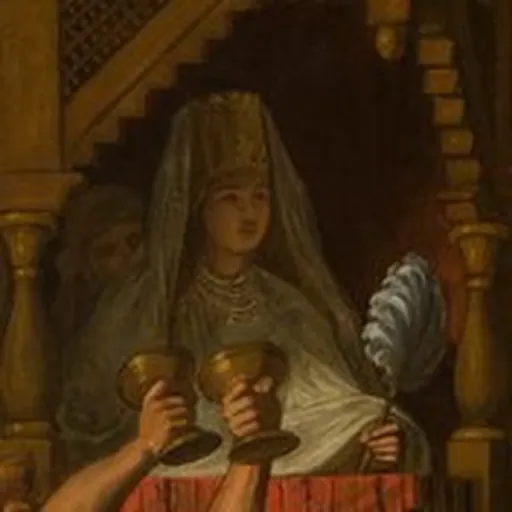
Kreka
Wife of Attila
About Kreka
Kreka or Hereka was the wife of Attila. She was described by Eastern Roman diplomat Priscus in his account of his stay at Attila's court in 448 or 449 AD. She and Attila had three sons: Ellac, Dengizich, and Ernak, who split among themselves what remained of Attila's empire after his death in 453.
Kreka also appears in Germanic heroic legend under the name of Helche or Herka.
History Priscus during his stay at Attila's court in 448 or 449 AD wrote "the next day I arrived at the wall of Attila's compound, carrying gifts for his wife... She had borne three children to him, of whom the eldest Ellac was ruling the Akateri and the other nations in the parts of Scythia near the Sea." He then describes the compound:
At the last days of his mission to Attila, Priscus and Maximinus were "invited by Kreka to dinner at the house of Adames the man who oversaw her affairs. We joined him along with some of the nation's leading men, and there we found cordiality. He greeted us with soothing words and prepared food. Each of those present, with Scythian generosity, arose and gave us each a full cup and then, after embracing and kissing the one who was drinking, received it back. After dinner, we went back to our tent and went to sleep".
Kreka also appears as a character in Germanic heroic legend, where, under the name Helche or Herka, she is the wife of Attila (Etzel/Atli) and a special confidant of the hero Dietrich von Bern in the Middle High German poems Dietrichs Flucht, the Rabenschlacht and the Old Norse Thidrekssaga. She is portrayed as having just died in the Nibelungenlied. In the Eddic poem Guðrúnarkviða III, she appears as Atli's concubine.
Etymology The name is recorded in various manuscripts of Priscus as κρέκα (κreka), ἡρέκα (hereka), ἡρέκαν (herekan), and ἠρέκαν (erekan). Some copyists dropped the ending -v (-n).
On the basis of the later Germanic forms of the name (Herche, Helche, Herkja, and Erka), Otto J. Maenchen-Helfen argues that the forms beginning with eta rather than kappa are original. He argued in favor of Willy Bang Kaup's etymology, by which it derives from Turkic *arï(y)-qan (the pure princess), (cf. Karakalpaks name Aruvkhan (aruv, "pure")).
Pavel Poucha derived Kreka or Hreka from Mongolian appellation gergei (wife), a derivation also supported by Omeljan Pritsak.
It has also been proposed that the name may be Gothic, meaning "Greek woman".
In Hungarian, Kreka is known as Réka. According to the Székely (Hungarian) tradition Réka, wife of Attila was buried at Odorheiu Secuiesc (Székelyudvarhely). The woods, the creek, the elevation (castle) there at that site is called after Réka since that time on.
Don’t just read it —
keep it.
Full-length biographies made to live with: read them, listen on the way to work, watch them tonight.
- E-book
- Audio
- Video
Instant download · yours to keep · every purchase keeps this site free
Important facts
Family & relationships
Frequently asked questions
Who was Kreka?
Wife of Attila
When was Kreka born?
Kreka was born in Byzantine Greece, Pannonia.
Sources & further reading
Cite this page
APA: Biography.guide. (2026). Kreka. https://biography.guide/kreka/
MLA: "Kreka." Biography.guide, https://biography.guide/kreka/.
Chicago: "Kreka." Biography.guide. https://biography.guide/kreka/.
Data last updated: 2026-09-22 · Spot an error? Report a correction.
Portrait: Wikimedia Commons · author & licence
Page generated 2026-09-27 05:03 UTC