
Kort Rogge
Swedish bishop
About Kort Rogge
Lived 1425 – 1501 (aged 75–76). Kort Rogge was a Swedish canon.
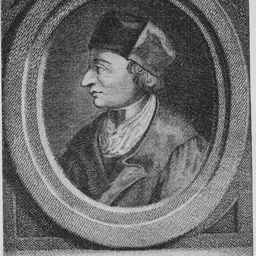
Kort Rogge ( 1425 — 5 April 1501), also known as Rogge Kyle, Konrad Rogge, Cort Rogge, Conradus Roggo gothus and Conradus Roggo de Holmis, was a Swedish bishop, member of the Privy Council of Sweden, and Renaissance humanist.
Background and studies The first mention of Kort Rogge's father in archival sources is from 1423. He had moved to Stockholm from Westphalia, and is listed as a master mason in the 1430s. He appears to have maintained close business links to Gdańsk. Kort Rogge's mother Dorotea, née Horn, was a burgher in Stockholm and is mentioned as a house-owner in 1467, more than ten years after her husband's death. Kort Rogge would later refer to himself as a "citizen of Stockholm" and appears to have maintained close ties to his native city throughout his life.
Rogge studied at Leipzig University between 1446 and 1449, and became a canon in Uppsala upon his return. Already in 1450, however, he left Sweden again, to study mainly canon law at the University of Perugia. He received a doctorate in canon law from the university in 1460 and then returned to Sweden.
Career After his return to Sweden, Rogge entered the chapter of Uppsala Cathedral. During the following decades, he actively, and sometimes with harsh means, sought to promote his own interests and further his career. In 1469, he was chosen by King Charles VIII of Sweden to represent him, together with the chancellor Clas Rytting, at peace negotiations with Denmark in Lübeck. While in Lübeck, he seems to have commissioned an altarpiece for Bälinge Church by Johannes Stenrat. During the 1470s, Rogge systematically increased his engagement with the Diocese of Strängnäs and he was made bishop of the diocese in 1479. As a bishop of Strängnäs, he was also a member of the Privy Council of Sweden. Among his duties within the council was also that of maintaining a rudimentary archive of the state.
Humanism Rogge brought with him a book collection from Italy, which was focused on literature, law and history, and from which theological writings were conspicuously absent. He later donated the library to the cathedral, and it is today housed in his former residence in Strängnäs, Roggeborgen. A speech given by Rogge upon his promotion to doctor and preserved to posterity through his manuscript, has been called the first example of Renaissance humanism within Swedish literature; however, an earlier example of similar kind by another Swedish author does exist.
Don’t just read it —
keep it.
Full-length biographies made to live with: read them, listen on the way to work, watch them tonight.
- E-book
- Audio
- Video
Instant download · yours to keep · every purchase keeps this site free
Important facts
People in Kort Rogge's life
Named in this biography and alive at the same time

Related people
Same field, nearest in time




Contemporaries
People whose lives overlapped Kort Rogge's
Frequently asked questions
Who was Kort Rogge?
Swedish bishop
When was Kort Rogge born?
Kort Rogge was born in 1425.
When did Kort Rogge die?
Kort Rogge died on 5 April 1501.
What was Kort Rogge's occupation?
Kort Rogge was a canon.
What nationality was Kort Rogge?
Kort Rogge was Swedish.
Sources & further reading
Cite this page
APA: Biography.guide. (2026). Kort Rogge. https://biography.guide/kort-rogge/
MLA: "Kort Rogge." Biography.guide, https://biography.guide/kort-rogge/.
Chicago: "Kort Rogge." Biography.guide. https://biography.guide/kort-rogge/.
Data last updated: 2026-09-20 · Spot an error? Report a correction.
Page generated 2026-09-27 05:08 UTC