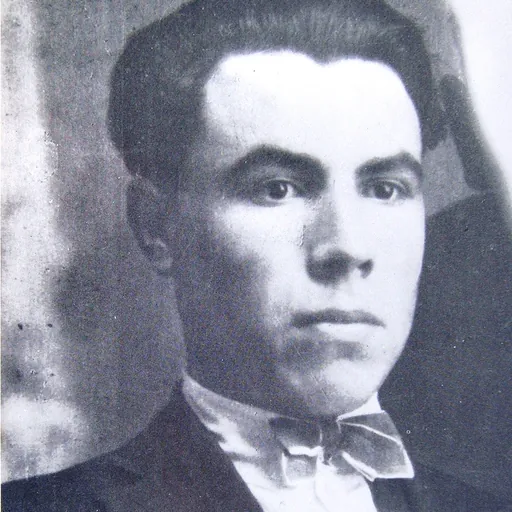
About Kočo Racin
Lived 1908 – 1943 (aged 34). Kočo Racin was a Yugoslav poet, writer, prose writer and opinion journalist, known for Ethnic Macedonian literature.
Kosta Apostolov Solev (; 22 December 1908 – 13 June 1943), primarily known by his pen name Kočo Racin (Кочо Рацин), was a Macedonian poet, writer and communist who is considered a founder of modern Macedonian literature. He is also regarded as a founder of modern Macedonian poetry. Racin wrote in prose too and created some significant works with themes from history, philosophy, and literary critique. He also wrote in Serbian and Bulgarian.
Biography Early life
Kočo (Kosta Solev) Racin was born in 1908 in Veles as Konstantin Apostolov Kostov, in the Kosovo vilayet of the Ottoman Empire (present-day North Macedonia). He was raised in a very poor family. His father, Apostol was a potter who earned just enough to feed his family, and he could not support Racin financially in his education. Racin finished just one year in the local high school at the age of thirteen and then worked in his father's pottery workshop.
Campaigner in the Communist movement In 1924 he took part in KPJ, and in a short time, he positioned himself as one of the most promising young members of the Communist Party of Yugoslavia in Macedonia. In 1926, Racin became a member of the local Committee of KPJ in Veles, and in this period he was writing for the left-wing newspaper Organizovan radnik (Organized worker). After returning to Yugoslavia he was arrested, but three months later he was freed because of insufficient evidence. In April 1929 he went into army service in Požarevac.
In 1929, the party organization in Macedonia collapsed. However, in 1932 the process for reuniting the party began, and in the summer of 1933, the Local Committee of KPJ in Macedonia was started, in which Nikola Orovčanec, Živoin Ćurcić and Racin participated. In November of the same year, LM started to issue the monthly newspaper "Iskra" (Spark), whose editor was Racin. Only two editions of the newspaper were produced. In the beginning of January 1934, there was a break-in, and 15 leading Macedonian communists – together with Racin – were arrested. Racin was given 4 years in prison at Sremska Mitrovica, but in December 1935, he was given amnesty under a new law. His time in jail and the association with Moša Pijade, Rodoljub Čolaković and Ognjen Prica instilled in him faith in the importance of writing in his mother tongue (for Racin the Macedonian). Later he participated in the translation of the "Communist manifesto" into Macedonian.
The nickname "Racin" comes from the name of his loved one, Rahilka Firfova-Raca. Its members were encouraged to boycott him. The boycott lasted until 1942 when the relationship between Racin and the party in Macedonia improved. After the capitulation of Yugoslavia, for a period, he worked in Sofia, where he lived with his compatriot Kole Nedelkovski, who shared his thinking. After Nedelkovski's death, Racin returned to Skopje. In Skopje, he was arrested by the Bulgarian police and interned in the village of Kornitsa.
Joining the Partisan movement and death
In 1943, Racin succeeded in getting back to Skopje. In the spring, he went to the Partisans, in the Korab detachment. He became an editor of the Partisan newspaper Ilindenski Pat. He also prepared two collections of Macedonian folklore songs.
On the night of 13 June 1943, when he was going back from the Partisan printing house on the mountain Lopušnik, Kičevo, he was mortally shot by the printing-house entrance guard. There are two theories about his death. According to the first, it was an accident: Racin was born with a hearing defect, so he may not have heard the guard's call to stop and identify himself. According to the second version, Racin was murdered. In the opinion of his contemporaries, communist official Strahil Gigov politically isolated Racin and organized his murder.
Works
Starting in 1928, Kočo Racin wrote songs, stories, literary-historical articles, pieces for several magazines, literary critiques, and essays. In his essay "The Development of Our New Literature", he argued that the most correct and plausible way to develop modern literature in Macedonia was to build it from the inexhaustible riches of Macedonian folklore, combined with progressive social views. His most notable work was the small collection White Dawns (Beli mugri), which was published in Samobor in 1939. Racin's interest lay in the plight of field and farm workers and wage earners. American historian Joseph Rothschild described his style as "inspired by traditional folk-lyrics" and his theme as "the hard fate of the poor".
Poetry Racin started writing in 1928. From February until July, he dedicated love verses to his loved one, Rahilka Firfova, on 31 cards and in the poem collection entitled Anthology of Pain . The 31 cards are kept today in the Archive of North Macedonia. The songs are mainly written in Serbian, except for six songs written in Bulgarian.
The same year, the Zagreb review Kritika published his first poem, "Hungry Sons" . From May until October 1930, he published four poems in a Sarajevo journal. In 1932 in Skopje, Racin together with Jovan Đorđević and Aleksandar Aksić (students at the Skopje Faculty of Philosophy) published a poem collection in Serbian under the title 1932. This collection includes the poem "Firework" (Ватромет) one of Racin's most powerful poems.
The next published poem was "To a Worker" , which was his first poem in Macedonian.
Literary criticism In the field of literary criticism, Racin wrote the following works and articles: "The development and the meaning of our new literature" (Развитокот и значењето на една нова наша книжевност) (1940), "Anđelko Krstić in front of the court of Ž. Plamenac" (Анѓелко Крстиќ пред судот на Ж. Пламенац) (1939) and "The Realism of A. Krstić" (Реализмот на А. Крстиќ) (posthumously), "The Tired Nonsense about Mona Lisa's smile" (Блазираните глупости за насмевката на Мона Лиза) (1939) and "Art and the Working Class" (posthumously).
Legacy
In 1952, Trajče Popov recorded the film poem "White Dawns" using the lyrics from his poetry collection. In 1956, his native house in Veles was transformed into a museum. Starting in 1964, an annual poetry festival called "Racin's meetings" was held in Racin's honor in his hometown, Veles. Since 1992 the event has been Balkans-wide. In 2007 (on the day of his death), the movie Elegy for you (Елегија за тебе) dedicated to him was promoted.
According to some Bulgarian authors, he had pro-Bulgarian views and was a Bulgarian. Per ethnographer Kosta Tsarnushanov, there are reasonable doubts that Racin was purposefully liquidated, while suspected as an opportunist and pro-Bulgarian oriented communist by the Yugoslav partisans on the orders of Svetozar Vukmanović. Public figures Venko Markovski and his wife Filimena consider him as an author who was part of the Bulgarian literature.
Don’t just read it —
keep it.
Full-length biographies made to live with: read them, listen on the way to work, watch them tonight.
- E-book
- Audio
- Video
Instant download · yours to keep · every purchase keeps this site free
Important facts
People in Kočo Racin's life
Named in this biography and alive at the same time



Related people
Same field, nearest in time


Contemporaries
People whose lives overlapped Kočo Racin's


Frequently asked questions
Who was Kočo Racin?
Macedonian and Yugoslav writer, poet and communist (1908–1943)
When was Kočo Racin born?
Kočo Racin was born on 22 December 1908 in Veles.
When did Kočo Racin die?
Kočo Racin died on 13 June 1943 in Mount Bistra.
What was Kočo Racin's occupation?
Kočo Racin was a poet, writer, prose writer and opinion journalist.
What was Kočo Racin known for?
Kočo Racin was known for Ethnic Macedonian literature.
What nationality was Kočo Racin?
Kočo Racin was Yugoslav.
Sources & further reading
Cite this page
APA: Biography.guide. (2026). Kočo Racin. https://biography.guide/koco-racin/
MLA: "Kočo Racin." Biography.guide, https://biography.guide/koco-racin/.
Chicago: "Kočo Racin." Biography.guide. https://biography.guide/koco-racin/.
Data last updated: 2026-09-22 · Spot an error? Report a correction.
Portrait: Wikimedia Commons · author & licence
Page generated 2026-09-27 04:58 UTC