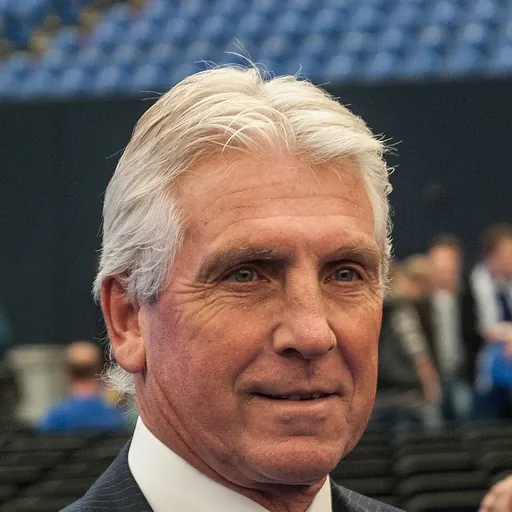
About Klaus Fischer
Born 1949. Klaus Fischer is a German association football player and association football coach.
Klaus Fischer (born 27 December 1949) is a German former professional footballer and coach. He was a key player on the West Germany national team that lost the 1982 World Cup final to Italy. As a forward, he was noted for his bicycle kicks, and scored a spectacular overhead kick equalizer in extra-time of a 1982 World Cup semi-final against France.
Club career Fischer was born in Kreuzstraßl, near Lindberg (Bayerischer Wald) in the district of Regen.
He moved from SC Zwiesel to TSV 1860 Munich in 1968 and made 535 Bundesliga appearances for 1860 Munich, FC Schalke 04, 1. FC Köln and VfL Bochum. With Schalke 04 he won the German Cup in 1972. Schalke 04 were one of the clubs involved in a bribery scandal in season 1970–71 of the Bundesliga. As one of the players involved, Fischer initially received a ban for life, but this punishment was later reduced to a one-year league ban and a five-year ban from national team eligibility.
In 1976, he was top scorer in the Bundesliga. With 268 goals he ranks third to Gerd Müller and Robert Lewandowski on the list of all-time top Bundesliga goalscorers. In 1988 Fischer's club side VfL Bochum made it to the German Cup final, but Fischer did not feature in the final match. He ended his career in 1988.
His 182 league goals for Schalke 04 remain a club record.
International career Fischer made 45 appearances for the West Germany national team from 1977 to 1982, scoring 32 goals (eight headers and 24 with his feet, including two bicycle kicks). He appeared in two World Cups and was a World Cup runner-up in Spain in 1982.
Fischer was known particularly for his bicycle kicks, often set up for him by Rüdiger Abramczik. His goal from a bicycle kick in a 4–1 win in a 1977 international match against Switzerland was selected as the Goal of the Year by German television viewers. It was later voted Goal of the Decade and Goal of the Century. He also scored a famous bicycle kick equalizer in extra time in a 1982 World Cup semi-final against France, which West Germany went on to win on penalties.
Coaching career Fischer runs a football training school.
Career statistics Club
International
International goals No. Date Venue Opponent Score Result Competition 1. 27 April 1977 Müngersdorfer Stadion, Cologne, West Germany 2–0 5–0 Friendly 2. 4–0 3. 5 June 1977 La Bombonera, Buenos Aires, Argentina 1–0 3–1 4. 2–0 5. 12 June 1977 Maracanã Stadium, Rio de Janeiro, Brazil 1–0 1–1 6. 14 June 1977 Azteca Stadium, Mexico City, Mexico 1–2 2–2 7. 2–2 8. 7 September 1977 Helsinki Olympic Stadium, Helsinki, Finland 1–0 1–0 9. 16 November 1977 Neckarstadion, Stuttgart, West Germany 3–0 4–1 10. 4–1 11. 14 December 1977 Westfalenstadion, Dortmund, West Germany 1–0 1–1 12. 20 December 1978 Rheinstadion, Düsseldorf, West Germany 2–0 3–1 13. 2 May 1979 Racecourse Ground, Wrexham, Wales 2–0 2–0 UEFA Euro 1980 qualifying 14. 17 October 1979 Müngersdorfer Stadion, Cologne, West Germany 1–0 5–1 15. 3–0 16. 21 November 1979 Lenin Stadium, Tbilisi, Georgia 3–0 3–1 Friendly 17. 22 December 1979 Parkstadion, Gelsenkirchen, West Germany 1–0 2–0 UEFA Euro 1980 qualifying 18. 27 February 1980 Weserstadion, Bremen, West Germany 3–0 8–0 19. 8–0 20. 29 April 1981 Volksparkstadion, Hamburg, West Germany 2–0 2–0 1982 FIFA World Cup qualification 21. 19 May 1981 Neckarstadion, Stuttgart, West Germany 1–0 1–2 Friendly 22. 24 May 1981 Keskusurheilukenttä, Lahti, Finland 2–0 4–0 1982 FIFA World Cup qualification 23. 4–0 24. 2 September 1981 Stadion Śląski, Chorzów, Poland 1–0 2–0 Friendly 25. 23 September 1981 Ruhrstadion, Bochum, West Germany 1–0 7–1 1982 FIFA World Cup qualification 26. 18 November 1981 Westfalenstadion, Dortmund, West Germany 3–0 8–0 27. 8–0 28. 22 November 1981 Rheinstadion, Düsseldorf, West Germany 1–0 4–0 29. 17 February 1982 Niedersachsenstadion, Hanover, West Germany 1–0 3–1 Friendly 30. 3–1 31. 2 July 1982 Santiago Bernabéu Stadium, Madrid, Spain 2–1 2–1 1982 FIFA World Cup 32. 8 July 1982 Ramón Sánchez Pizjuán Stadium, Seville, Spain 3–3 3–3
Honours Schalke 04 DFB-Pokal: 1971–72
1. FC Köln DFB-Pokal: 1982–83
West Germany FIFA World Cup runner-up: 1982
Individual Bundesliga top scorer: 1975–76 (29 goals) Goal of the Year (Germany): 1977 Goal of the Decade (Germany) kicker Bundesliga Team of the Season: 1984–85
Don’t just read it —
keep it.
Full-length biographies made to live with: read them, listen on the way to work, watch them tonight.
- E-book
- Audio
- Video
Instant download · yours to keep · every purchase keeps this site free
Important facts
People in Klaus Fischer's life
Named in this biography and alive at the same time

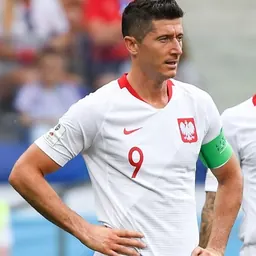


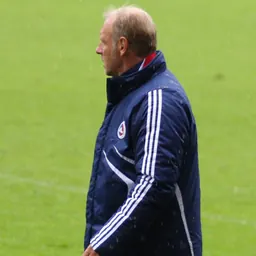
Related people
Same field, nearest in time


Contemporaries
People whose lives overlapped Klaus Fischer's


Frequently asked questions
Who is Klaus Fischer?
German footballer
When was Klaus Fischer born?
Klaus Fischer was born on 27 December 1949 in Lindberg.
What is Klaus Fischer's occupation?
Klaus Fischer is an association football player and association football coach.
What nationality is Klaus Fischer?
Klaus Fischer is German.
Sources & further reading
Cite this page
APA: Biography.guide. (2026). Klaus Fischer. https://biography.guide/klaus-fischer/
MLA: "Klaus Fischer." Biography.guide, https://biography.guide/klaus-fischer/.
Chicago: "Klaus Fischer." Biography.guide. https://biography.guide/klaus-fischer/.
Data last updated: 2026-09-23 · Spot an error? Report a correction.
Portrait: Wikimedia Commons · author & licence
Page generated 2026-09-27 05:05 UTC