Kitty Byron
British murderer
About Kitty Byron
Born 1878.
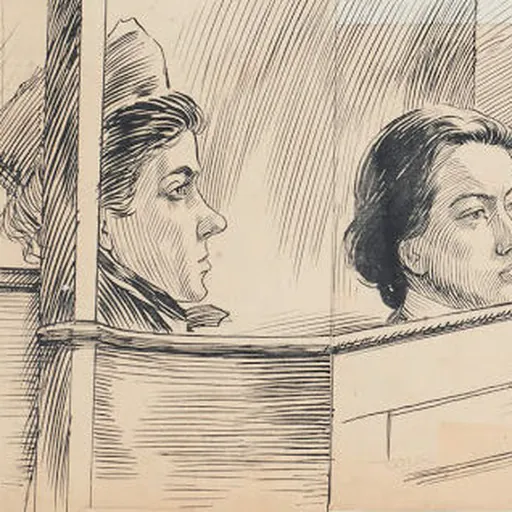
Kitty Byron (right) in the dock at the Old Bailey with a female wardress. Drawing by William Hartley (Crime Museum). Emma "Kitty" Byron (1878 – after 1908) was a British murderer found guilty in 1902 of stabbing to death her lover Arthur Reginald Baker, for which crime she was sentenced to death. This was subsequently commuted to life imprisonment.
Background The daughter of a brewer, Byron came from a respectable family who originally lived in Pimlico, but after her father died, the family moved to Leytonstone, where, at the time of the murder, Byron's mother continued to live in a villa in Napier Road with her married son and his wife and their three children, as well as Byron's 14-year-old sister. In early 1902 "Kitty" Byron had been employed as a milliner's assistant at Mme. Timorey's Court dressmaking establishment in Old Burlington Street, but she was sacked because of her poor time keeping.
At the time of the murder Byron was unemployed and had lived for several weeks in lodgings with her lover Arthur Reginald Baker, a stockbroker, in the home of Madam Adrienne Liard (born 1841 in France), a widowed mantle maker at 18 Duke Street, Portland Place in London. Originally they had rented two rooms but after a few weeks they had difficulty paying for these and subsequently moved into a bed-sitting room at the same address.
Arthur Reginald Baker was born in Crawley in Sussex in 1857, the son of John Baker, a solicitor and partner in the firm of Baker, Blaker and Hoare of London. Baker married Alexandrina Mabel Turner (born 1861) in Marylebone in 1880. Their daughter Aileen Mabel Marguerite Baker was born in 1898; she died in 1969. Alexandrina was the step-daughter of Alderman Thomas Harrison, a former Mayor of Torquay from 1897 to 1898 and the owner of the Queen's Hotel in Torquay.
Baker had not lived with his wife since January 1902, and on 4 November 1902 he was served with a divorce petition from her in which Byron was named as co-respondent. Although Baker was already married Byron called herself "Mrs Baker". Baker was an alcoholic, and he frequently argued with Byron and violently assaulted her.
Murder of Baker William Robert Coleman, who took the message from Byron to Arthur Baker (sketch by William Hartley from the Crime Museum). At 7 p.m. on 7 November 1902 Baker and Byron were again fighting when Byron was forced to leave their rooms, appearing on the landing in her nightdress. Madam Liard reported at the subsequent trial that at that time Baker was drunk and Byron sober. The next day Madam Liard told the couple to leave her house. Baker told the landlady that Byron had agreed to leave if he could keep the room. Initially Madam Liard refused, but after some persuasion she agreed to allow Baker to stay for another week provided Byron left.
On the morning of 10 November 1902, the day of the Lord Mayor's Show, Byron bought a strong-bladed spring knife from a shop at 211, Oxford Street. At about 1 pm she sent an express letter by post office messenger from the Lombard Street Post Office to Baker at the Stock Exchange where he worked. The message said "Dear Reg, I want you a moment, importantly. Kitty." The messenger, 16-year old William Robert Coleman, On arriving at Cloak Lane Police Station Byron said, "I killed him willingly, and he deserved it, and the sooner I am killed the better." Inspector Frederick Fox of the City of London Police stated that Byron later said, "Inspector, I wish to say something to you; I bought the knife to hit him but I did not know I was killing him."
Trial
Her trial began on 15 December 1902 at the Old Bailey before Sir Forrest Fulton, the Recorder of London. The courtroom was packed with spectators, many of them stockbrokers who had come to see Byron.
"As the gaoler called "Kitty Byron", a slender, dark-eyed girl came timidly up the stairs, shrinking a little when she saw the dense throng about her. Then, looking around the court-room, she advanced composedly into the dock and leaned on the iron railing... The girl was very white, but when the gaoler asked her if she felt faint she shook her head. She gave him a grateful look, however, when he placed a chair for her in the corner of the dock. After sitting down she gazed steadily, oblivious of the curious spectators, at Inspector Fox, who entered the witness box to relate the story of her arrest.
Miss Byron is decidedly prepossessing in appearance. She wore a dark skirt and jacket, with a high linen collar, and a sailor hat of white straw. She was very neat, and her features, though somewhat thin, are attractive. She looks younger than her age, which is given on the charge sheet at twenty-three." Members of the Stock Exchange funded her defence. Despite the fact that the murder was premeditated in that Byron had bought a knife earlier in the day of the stabbing, and she was of a lower class than her married lover, she gained the sympathy of the press and the public because of the brutal and unfeeling treatment she had received at the hands of Baker, and so did not give evidence in her own defence. During the trial it was revealed that before moving in with Baker Byron had had romantic relationships with both men and women.
Dickens' spirited defence pleaded manslaughter, claiming that Byron had bought the knife to threaten to kill herself, and had only killed Baker in the heat of the moment after great provocation. However, the judge did not agree with the defence's plea of manslaughter and summed up against her in favour of a murder verdict. On 17 December 1902 the jury returned a guilty verdict on the charge of murder with a strong recommendation to mercy.
After her release Byron disappears from the historical record.
Media portrayals The case was dramatised by BBC Radio in the 1957 series Secrets of Scotland Yard in the episode "A Lesson in Love" .
Don’t just read it —
keep it.
Full-length biographies made to live with: read them, listen on the way to work, watch them tonight.
- E-book
- Audio
- Video
Instant download · yours to keep · every purchase keeps this site free
Important facts
Frequently asked questions
Who was Kitty Byron?
British murderer
When was Kitty Byron born?
Kitty Byron was born in 1878.
Sources & further reading
Cite this page
APA: Biography.guide. (2026). Kitty Byron. https://biography.guide/kitty-byron/
MLA: "Kitty Byron." Biography.guide, https://biography.guide/kitty-byron/.
Chicago: "Kitty Byron." Biography.guide. https://biography.guide/kitty-byron/.
Data last updated: 2026-09-23 · Spot an error? Report a correction.
Portrait: Wikimedia Commons · author & licence
Page generated 2026-09-27 05:07 UTC